
If you’ve been told you need orthotics, you may wonder why one pair costs $40 and another costs several hundred dollars. What is the story with custom orthotics vs. OTC inserts? Are custom orthotics worth the extra cost compared to an over-the-counter (OTC) insert?
Sometimes. But not always.
For some common foot problems, a good over-the-counter insert may work just as well. For others, the ability to build an orthotic around their specific foot structure and mechanics is what makes the added cost worth it.
So the useful question isn’t whether custom orthotics are better in the abstract. It’s whether they’re better for your feet and the problem you’re actually trying to solve. That’s why it’s best to consult a podiatrist near you to ensure you’re correcting the underlying foot problem.
Quick Answers About Custom Orthotics vs. OTC Inserts
| Question | Short answer |
| Are custom orthotics always better than OTC? | No. For several common conditions, quality OTC inserts perform just as well. |
| When is custom worth it? | Structural deformities, specific medical conditions, or when OTC has failed. |
| How much do custom orthotics cost? | About $400–$800 from a clinic (includes exam); mail-in kits are less, but skip diagnosis. |
| Does insurance cover them? | Sometimes — but Medicare generally does not cover everyday custom orthotics. |
| How long do they last? | Custom devices often last several years; OTC inserts, months. |
| Can I use them in any shoe? | No — fit depends on the shoe. Some need a removable insole and a firm heel. |
What’s the Difference Between Custom Orthotics vs. OTC Inserts?
Both go inside your shoe to support or reposition your foot, but they’re built differently.
Over-the-Counter Inserts
OTC inserts are mass-produced in standard sizes and shapes. You buy them off the shelf by shoe size. They’re designed for the “average” foot in a given size range and offer cushioning, generic arch support, or basic heel cushioning.
Custom-Fit Orthotics
Custom orthotics are prescription medical devices made from a 3D scan or physical mold of your foot. They’re then fabricated to address your specific structure, mechanics, and diagnosis. They require a podiatrist exam and lab work, which is why they cost more and take longer to get.
Here’s how custom orthotics compare vs. OTC inserts across what actually matters:
| OTC Inserts | Custom Orthotics | |
| How they’re made | Mass-produced, standard sizes | Molded/scanned to your foot |
| Fit | Approximate, for an average foot | Matched to your structure |
| Cost | Roughly $15–$75 | Typically, several hundred dollars |
| Lifespan | Months | Often several years |
| Best for | Mild, general, or first-try support | Structural problems, specific diagnoses, failed OTC |
| Limitations | Not tailored; wears out faster | Cost: requires exam and fabrication time |
The comparison chart makes custom look like the premium option, and in build quality, it is. But “better made” and “better for your problem” aren’t the same thing, which is where the evidence comes in.
Do Custom Orthotics Actually Work Better vs. OTC Inserts?
Here’s where an honest answer matters more than a sales pitch.
For plantar fasciitis treatment, the single most common reason people seek orthotics, the research is clear and a little surprising.
Custom-Fit Orthotics for Plantar Fasciitis Help But No More Than OTC Inserts
First, orthotics genuinely help. Reviewed evidence shows that orthotics, both prefabricated and custom, reduce pain and improve function for plantar fasciitis. They do so with few side effects, whether used alone or alongside conventional care like stretching and anti-inflammatories.
Second, custom orthotics have not been shown to relieve pain more effectively than high-quality prefabricated inserts for this condition. A clinical evidence review rated at the highest level of evidence concluded that prefabricated orthotics cost less and provide similar relief to more expensive custom devices.
Multiple systematic reviews, including a Cochrane review, likewise found no significant difference between custom and prefab for plantar heel pain across the short, medium, and long term.
So for plantar fasciitis, the honest framing isn’t “custom doesn’t work.” It’s that custom and prefab work about equally well, which makes cost, not effectiveness, the real deciding factor.
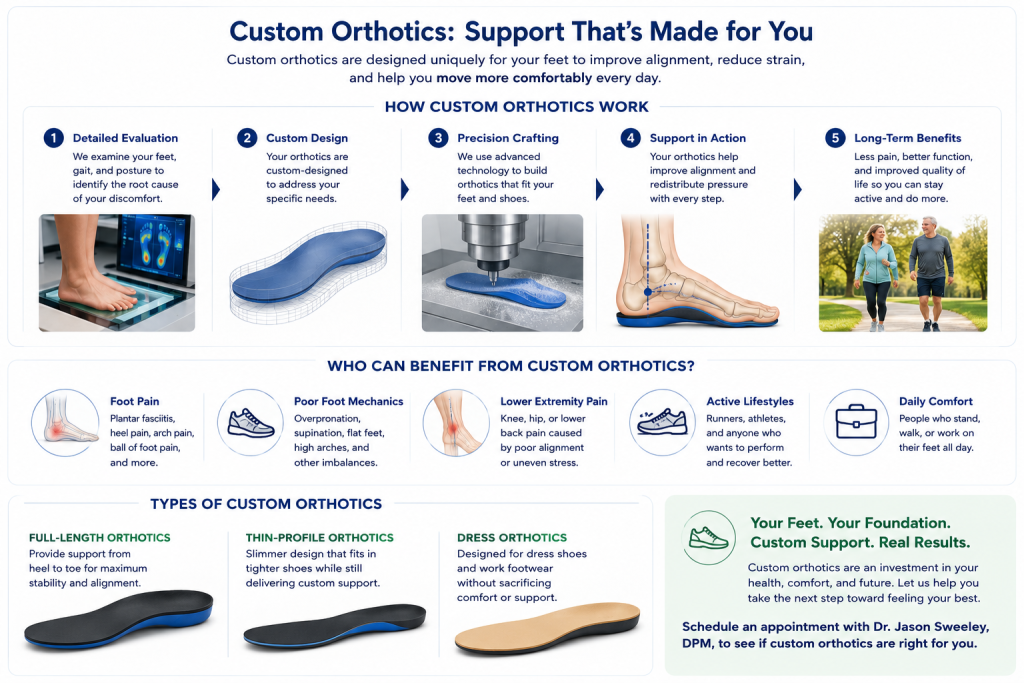
Custom-Fit Orthotics Do Benefit Other Foot Conditions vs Over-the-Counter
Plantar fasciitis isn’t the whole story. For certain structural and systemic conditions, custom orthotics have real, evidence-backed advantages that off-the-shelf inserts can’t match.
Research reviews have found meaningful benefits of custom devices for conditions such as painful high arches (pes cavus), rheumatoid arthritis, juvenile arthritis, and painful bunions. These are cases where the device needs to redistribute pressure or precisely accommodate a specific deformity.
For people with diabetes at risk of foot ulcers, custom-molded devices aren’t a comfort upgrade. They’re a recognized part of preventing serious complications.
So the real clinical question isn’t “custom or OTC?” It’s “which foot, and which problem?”
“The honest answer I give patients is that custom orthotics aren’t automatically better for everything. For a lot of routine heel pain, a good over-the-counter insert and the right stretching will get you there. Custom orthotics earn their keep when there’s a real structural issue driving the problem. Or when someone’s already tried a quality OTC insert and it wasn’t enough. I’d rather save someone money on a device they don’t need and spend it where it actually changes the outcome.”
— Podiatrist Jason Sweeley, DPM, Silver Spring Foot & Ankle
When Are OTC Inserts Enough?
For many everyday foot complaints, a quality over-the-counter insert is a perfectly reasonable first step and sometimes all you’ll need. OTC inserts tend to be a good starting point when:
- You have mild to moderate heel pain or early plantar fasciitis
- You want general arch support or added cushioning
- Your feet fatigue from standing or walking on hard surfaces
- You’re trying conservative treatment for the first time and haven’t yet seen whether simple support helps
- You don’t have a significant structural deformity or a complicating medical condition
There’s a practical case for starting here, too. A good OTC insert is inexpensive and available immediately. When paired with proper stretching and supportive shoes, they resolve many routine cases. If it works, you’ve saved yourself considerable money. If it doesn’t, you’ve lost little and learned something useful to guide your next step.
Not all OTC inserts are equal, though. A firm, supportive insert designed for your foot type is a very different product from a thin gel pad, and cheaper isn’t the same as effective.
What to Look for in an OTC Insert
If you’re going to try an over-the-counter insert first, a few things separate a useful one from a waste of money:
- Firmness over softness. A supportive insert that actually controls your foot beats a thick, squishy one that feels good in the store. Gel pads and pure cushioning rarely address the mechanics behind the pain.
- Structure that matches your arch. Look for defined arch support and a firm heel cup, and choose for your arch type rather than grabbing whatever’s on sale.
- Full-length, removable fit. You’ll usually want to remove your shoe’s existing insole and replace it, not stack the new insert on top.
- The right insert for the activity. A running insert and a work-boot insert aren’t the same; match them to how you’re on your feet.
“When I tell someone to try an over-the-counter insert first, I tell them to skip the soft gel ones. Those feel great for about a day and don’t really help with the mechanics. You want something firm with a real arch and a solid heel cup. If a firm, supportive insert doesn’t help after a few weeks, that’s actually useful information. It tells us the problem probably needs more than support, and that’s the point to come in.”
— Podiatrist Jason Sweeley, DPM, Silver Spring Foot & Ankle
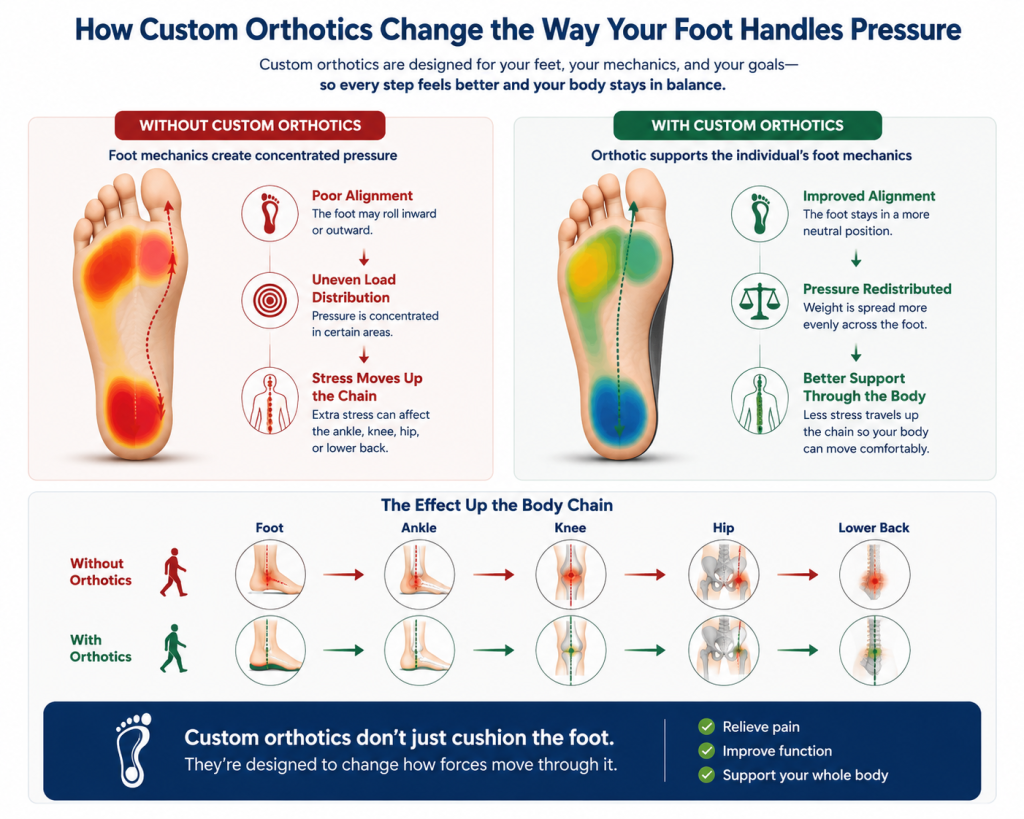
When Are Custom Orthotics Worth It?
Custom orthotics are worth the higher cost when your foot or condition needs something an off-the-shelf product can’t provide. That’s typically the case when:
- You have a structural or biomechanical problem such as a significant flat foot, high arches, or a gait issue that needs targeted correction
- You have a foot deformity that needs precise pressure redistribution
- You have a medical condition where offloading matters clinically, such as diabetes with neuropathy or a history of foot ulcers.
- Your symptoms are persistent or severe and haven’t responded to appropriate conservative care.
- A quality OTC insert has genuinely failed after a fair trial
- You need a device matched to a specific diagnosis rather than general support
The common thread is precision. When the goal is to control the mechanics of a specific foot, you’re paying for a device built around your anatomy, and it’s often worth it.
“The biggest misconception I run into is that custom orthotics are a cushioning product — and that more expensive means more comfortable. That’s not really what they are. A custom orthotic is a biomechanical device meant to change how your foot loads and moves. If your problem is genuinely mechanical, that precision matters. OTC often can’t replicate it. If your problem is just that your feet are tired on a concrete floor all day, you may not need one at all.”
— Harrisburg Podiatrist Jason Sweeley, DPM, Silver Spring Foot & Ankle
How Much Do Custom Orthotics Cost?
It depends heavily on where you get them, and the price gap between options is wide. Costs generally fall into three tiers:
- A podiatrist or medical clinic is roughly $400–$800 per pair. That includes what you don’t pay for elsewhere: a professional foot exam, a gait and biomechanical assessment, a physical cast or 3D scan, and a clinician accountable for the result.
- Specialty arch-support stores cost roughly $300–$1,000, often as multi-pair packages or branded arch supports. Pricing varies widely and isn’t always tied to a medical diagnosis.
- At-home / mail-in custom brands cost roughly $200–$300. You order online, mail in a foam impression of your foot, and receive a device made from it.
That bottom tier drives much of the pricing pressure, and it raises a fair question. If a mail-in kit is a third of the clinic price, why pay more?
The answer is what the clinic price actually buys. A mail-in kit captures the shape of your foot. However, it doesn’t diagnose why your foot hurts, assess your gait, or adjust the device if it doesn’t work. For simple needs, that may be fine.
But if your foot pain has a specific cause, a home-made mold can’t tell you what it is. It also can’t tell you whether a custom orthotic is even the right treatment. You’re paying a clinic not just for a device, but for the judgment about whether you need one and what it should do.
Other Cost Considerations for Custom-Fit Orthotics vs. OTC Inserts
Two more things worth factoring in.
First, lifespan. A custom device that lasts several years spreads the cost over a much longer period than an OTC insert, which you replace every few months, narrowing the real-world gap.
Second, FSA/HSA. Custom orthotics prescribed by a podiatrist are typically eligible for reimbursement through a Flexible Spending Account or Health Savings Account. That can meaningfully reduce out-of-pocket costs even when insurance doesn’t cover the device.
Will Insurance Pay for Custom Orthotics?
Sometimes, but with more caveats than most people expect, and one big one worth understanding up front.
Coverage varies significantly by plan and by diagnosis. Some private and employer-sponsored plans cover custom orthotics when they’re medically necessary and tied to a qualifying condition. Others exclude them entirely or cover them only for specific diagnoses. Whether your plan pays often depends on the exact diagnosis documented and on how your plan defines a covered device.
The most common surprise involves Medicare. Medicare generally does not cover everyday custom functional orthotics, such as those prescribed for plantar fasciitis or flat feet. That category of device is a statutory exclusion, so Medicare typically doesn’t pay for it, even if it’s medically necessary.
Insurance Exceptions
There’s one important exception. For people with diabetes and severe diabetes-related foot disease, Medicare Part B covers therapeutic shoes and inserts through a separate benefit. Generally, that includes one pair per year, with you responsible for 20% after the Part B deductible, and specific certification and supplier requirements. It’s a distinct program from standard custom-fit orthotics, designed specifically to prevent diabetic foot complications.
Because coverage varies by plan, the best move is to verify your benefits before you commit. A podiatry office can often help you check what your plan requires.
How Long Do Custom-Fit Orthotics Last?
With reasonable care, custom orthotics often last several years. The exact lifespan depends on the materials, your weight and activity level, how many hours a day you wear them, and the surfaces you’re on. The rigid or semi-rigid shell of a functional custom device is designed to withstand use. The top covers may need replacing sooner than the device itself.
Over-the-counter inserts, by contrast, are typically made of softer materials that compress and wear out within months. That durability difference is part of the real cost comparison. A custom device costs more up front but is replaced far less often.
A good habit is to have custom orthotics checked periodically. Your feet and your needs can change over time. A device that fit your mechanics a few years ago may need adjustment or replacement.
Can You Wear Orthotics in Any Shoe?
Not always, and this trips people up. An orthotic only works in a shoe that fits it.
Custom orthotics work best in shoes with:
- A removable insole, so the orthotic can take its place rather than stacking on top
- A firm heel counter and reasonable structure to support the device
- Enough depth and volume to hold the orthotic without cramping your foot
That’s why a full-length functional orthotic often won’t fit well in a slim dress shoe, a ballet flat, or many sandals. If you need support across very different types of footwear, raise that during your evaluation. Sometimes the answer is a different device style, or more than one, for different shoes.
What Are the Downsides of Custom Orthotics?
Custom orthotics are genuinely useful for the right problem, but they’re not a universal upgrade, and it’s fair to know the drawbacks:
- Cost. They’re considerably more expensive upfront than OTC inserts and often aren’t covered by insurance.
- They’re not automatically better. Research on plantar fasciitis shows that more expensive doesn’t guarantee better relief for every condition.
- Break-in period. A functional orthotic changes how your foot loads, and it can take days to weeks of gradual wear to adjust.
- Shoe compatibility. They don’t fit every shoe, which can mean rethinking part of your footwear.
- Time. Unlike an OTC insert you can buy today, custom devices require an exam, a mold or scan, and time to fabricate.
None of these are reasons to avoid custom orthotics when you need them. You should ensure the device matches the problem, which a proper evaluation clarifies.
So, Are Custom Orthotics Worth the Money?
It depends on your feet and your diagnosis. That’s not a dodge; it’s the actual answer.
They may not be worth the premium if:
- Your problem is routine heel pain or general foot fatigue
- You haven’t yet tried a quality OTC insert
- You have no significant structural or medical complications
For many people, a good off-the-shelf insert plus proper stretching and supportive shoes does the job for a fraction of the cost.
They’re often well worth it if:
- You have a structural deformity or biomechanical problem
- A medical condition where offloading matters
- Persistent symptoms that haven’t responded to conservative care
- A documented failure of appropriate OTC treatment.
For most people, the smartest approach is to start conservatively. Escalate to custom when the situation warrants it. A podiatrist’s job isn’t to sell you the most expensive device. It’s to figure out the least you need to solve the problem, and to know when that means custom.
If you’ve decided you want custom, the mail-in-kit question follows the same theme. A cheaper mail-in device can reproduce your foot’s shape. But it doesn’t diagnose the reason behind your pain.
If you already know exactly what you need, that may be enough. If you don’t, which is most people, the value of a clinic isn’t just the device. It’s about finding out what’s actually wrong first.
Custom-Fit Orthotics in Mechanicsburg
Silver Spring Foot & Ankle helps patients in the Cumberland, Dauphin, and Perry area determine whether custom orthotics are the right call or a simpler approach will do. If foot pain has you weighing a $40 insert against a several-hundred-dollar custom device, an evaluation is the fastest way to know what your feet actually need.
Our podiatrists see patients in Mechanicsburg, Harrisburg, and Carlisle, as well as throughout Cumberland, Dauphin, and Perry Counties.
Frequently Asked Questions About Custom Orthotics vs OTC Inserts
Are custom orthotics worth the money?
It depends on the problem. For routine heel pain and general support, a quality OTC insert often performs comparably at a much lower cost. For structural deformities, specific medical conditions, or cases where OTC options have failed, custom orthotics are often worth the added cost.
What’s the average cost of custom orthotics vs. OTC inserts?
From a podiatrist or clinic, typically about $400–$800 per pair, including the exam and casting. Mail-in “custom” kits run about $200–$300 but skip the diagnosis. OTC inserts are roughly $15–$75. Custom orthotics are usually FSA/HSA-eligible.
Will insurance pay for custom orthotics?
Sometimes, depending on your plan and diagnosis. Medicare generally does not cover everyday custom orthotics for conditions like plantar fasciitis. It does cover therapeutic shoes and inserts for people with diabetes and severe foot disease under a separate benefit. Verify your specific plan before committing.
How many years do custom orthotics last?
Often, several years with reasonable care, depending on materials and how much you wear them. OTC inserts generally last only months before the material compresses.
Can I wear orthotics in any shoe?
Not always. Custom orthotics need a shoe with a removable insole, a firm heel, and enough depth. As a result, they often don’t fit slim dress shoes, flats, or many sandals. Mention it during your evaluation if you need support across different shoe types.
How many hours a day should you wear orthotics?
It depends on your condition and your podiatrist’s guidance. New custom orthotics usually need to be broken in gradually— start with a few hours a day and build up as your feet adjust. Your provider will give you a specific schedule based on your situation.
Can you ever stop wearing orthotics?
Sometimes. If orthotics support a temporary or treatable condition, you may be able to reduce or stop use once the problem resolves and you address underlying issues (footwear, strength, mechanics). For permanent structural conditions, ongoing support is often part of long-term management. Your podiatrist can tell you which situation applies to you.
What are the three types of orthotics?
Foot orthotics are commonly grouped into rigid (firm devices that control motion and mechanics), soft/accommodative (cushioning and pressure relief), and semi-rigid (a balance of support and cushioning, often used for sport or activity). The right type depends on your diagnosis and goals.
