
A foot corn is a small, hard bump of thickened skin that forms where a toe or part of your foot takes repeated pressure or rubbing. Treating one means two things:
- Removing the hard skin
- Taking away the pressure that caused it
Skip the second step and the corn comes back.
At Silver Spring Foot & Ankle, our foot doctors safely remove painful corns in the office, usually in a single visit. More importantly, we find out why the corn formed and fix that too.
Ready to schedule an appointment? Call (717) 237-9000 or schedule online.
Quick Answers About Foot Corn Treatment
If you have a painful corn, you probably want to know how to get rid of it, whether you can treat it yourself, and when you should see a foot doctor. Here are quick answers to the most common questions.
| Question | Answer |
|---|---|
| How do you get rid of a corn on your foot fast? | The safest, fastest way is to have a podiatrist trim it. Relief is usually immediate. At home, soaking, gentle filing, and padding work more slowly. |
| Do foot corns have a root? | No. A corn has a hard center that points into the skin, but it isn’t a root, and it doesn’t grow. |
| Can I pick or cut a corn out? | Don’t. Cutting or digging at a corn can cause bleeding and infection, and it won’t stop the corn from returning. |
| Do corns ever fully go away? | Yes, once the pressure or rubbing stops. If the cause stays, the corn comes back. |
| Are medicated corn pads safe? | For healthy adults, they can help when used carefully. Don’t use them if you have diabetes, poor circulation, or numbness in your feet. |
| What can be mistaken for a corn? | Calluses and plantar warts are the most common look-alikes. |
What Is a Foot Corn?
A corn is your skin’s way of protecting itself. When a small spot is pressed or rubbed repeatedly, the skin there thickens. Over time, it packs into a hard, cone-shaped center that presses on the nerves beneath it. That’s why a corn hurts when you push on it. The medical term is a heloma.
There are three types:
- Hard corns: Small, dense, and firm, usually on the tops or sides of toes where a shoe rubs. These are the most common.
- Soft corns: Whitish and rubbery, found between the toes. Moisture keeps them soft.
- Seed corns: Tiny, often in clusters on the bottom of the foot. They tend to show up with dry skin.
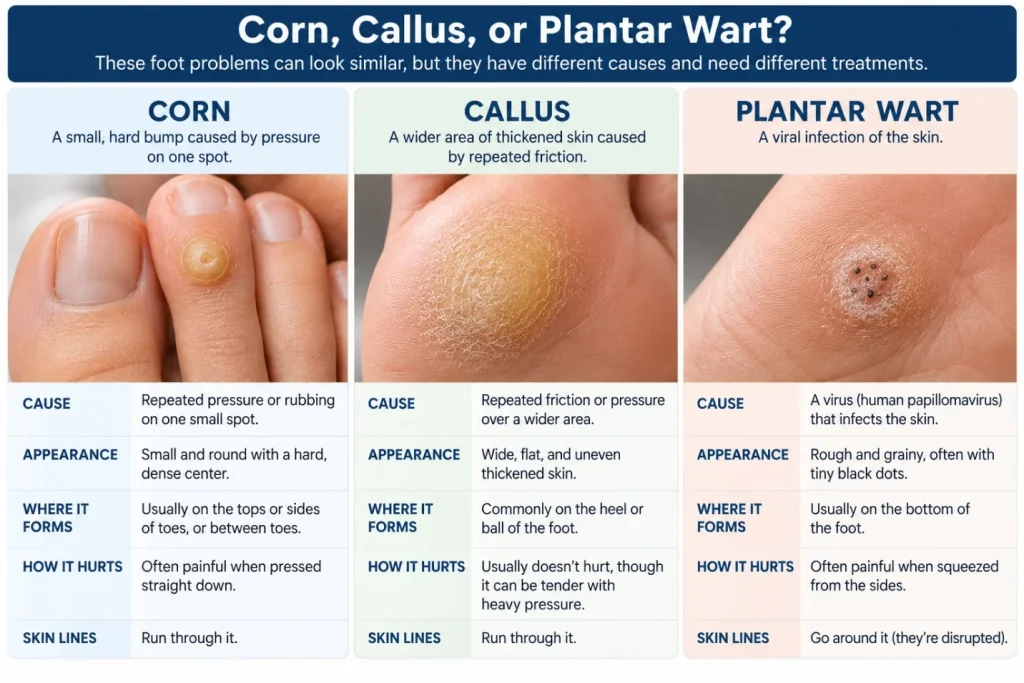
Corn, Callus, or Wart?
Corns, calluses, and plantar warts are often confused. The right treatment differs for each.
| Corn | Callus | Plantar Wart | |
|---|---|---|---|
| Cause | Pressure on one small spot | Friction over a wider area | A virus |
| Size and shape | Small and round with a hard center | Wide, flat, and uneven | Rough and grainy, often with tiny black dots |
| Where it forms | Toes and between toes | Heel and ball of the foot | Bottom of the foot |
| How it hurts | When pressed straight down | Usually doesn’t hurt | When squeezed from the sides |
| Skin lines | Run through it | Run through it | Go around it |
Warts need different treatment because they’re an infection, not a pressure problem. If you aren’t sure which one you have, a foot doctor near you can tell in a quick exam.
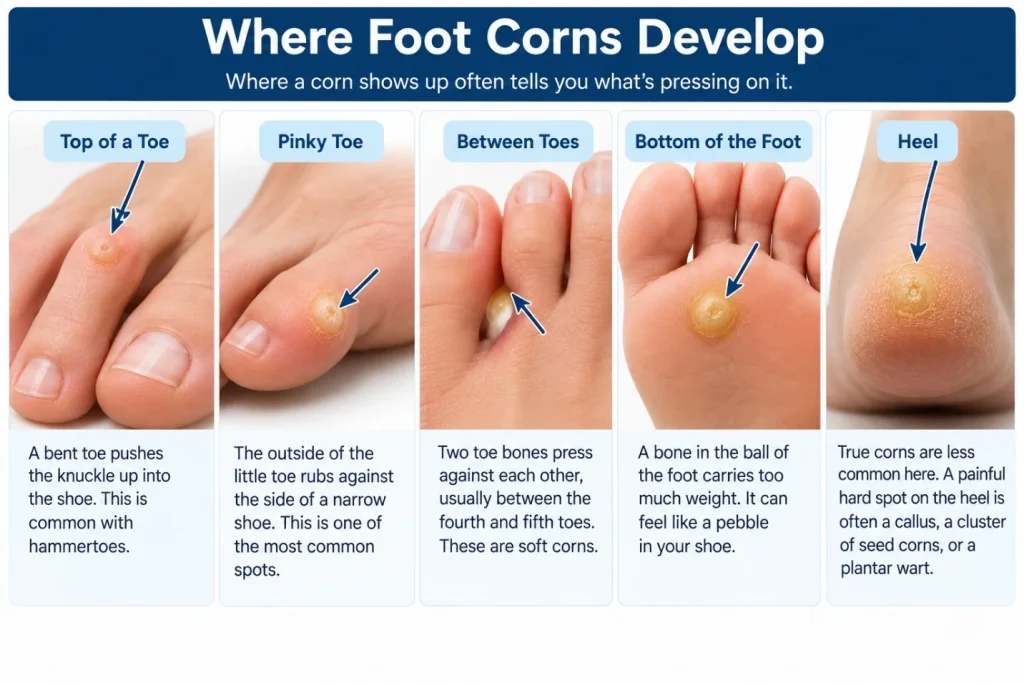
Where Foot Corns Develop
Where a corn shows up tells you what’s pressing on it.
- Corn on the top of a toe. A bent toe pushes the knuckle up into the shoe. This is common with hammertoes.
- Corn on the pinky toe. The outside of the little toe rubs against the side of a narrow shoe. This is one of the most common spots.
- Corn between the toes. Two toe bones press against each other, usually between the fourth and fifth toes. These are soft corns.
- Hard corn on the bottom of the foot. A bone in the ball of the foot carries too much weight. It can feel like a pebble in your shoe.
- Corn on the heel. True corns are less common here. A painful hard spot on the heel is more often a callus, a cluster of seed corns, or a plantar wart.
What Causes Foot Corns?
Every corn has the same underlying cause: too much pressure or friction on one spot. The usual sources are:
- Shoes that don’t fit. Tight shoes squeeze the toes. Loose shoes let the foot slide and rub. High heels push weight onto the front of the foot. Learn more about shoes and foot pain.
- Toe and foot shape. Hammertoes, bunions, and bone spurs create high spots that take extra pressure.
- Going without socks. Bare skin against a shoe means more friction.
- The way you walk. Uneven weight on your feet overloads certain spots.
- Thinner padding with age. The natural cushion under the foot wears down over the years, so bones press closer to the skin.
How to Treat a Foot Corn at Home
If you’re healthy and the corn is mild, home care is a reasonable place to start. It works by softening the hard skin and taking pressure off the spot.
- Soak your foot. Use warm, soapy water for 5 to 10 minutes to soften the skin.
- File gently. Rub a pumice stone or emery board over the corn in one direction. Take off a little at a time and stop before it gets sore.
- Moisturize. A cream with urea or ammonium lactate keeps the skin soft. Use it daily.
- Pad the spot. A donut-shaped pad or a piece of moleskin keeps your shoe from pressing on the corn.
- Change your shoes. A wider toe box and good cushioning do more than any product.
Corn Pads: Medicated or Non-Medicated?
Non-medicated corn pads are cushions. They relieve pressure and are safe for almost everyone.
Medicated corn remover pads contain salicylic acid, which dissolves hard skin. The acid can’t distinguish between corn and healthy skin. As a result, it can cause burns and open sores if it spreads or stays on too long. Don’t use medicated pads if you have diabetes, poor circulation, or numbness in your feet.
What Not to Do
A corn itself is rarely dangerous. Home removal attempts are where people get hurt.
- Don’t cut or shave a corn. Razors, knives, and scissors can cut too deep and lead to a serious infection.
- Don’t pick or dig at it. You’ll break the skin without removing what’s causing the pain.
- Don’t try to remove one overnight. Nothing safe works that fast. Strong acids and long applications burn healthy skin.
- Don’t treat it yourself if you have diabetes, nerve damage, or poor circulation. A small wound can turn into a serious one.
- Don’t keep wearing the shoes that caused it. The corn will return no matter how well you treat it.
Do Foot Corns Have Roots?
No. It’s one of the most common myths about corns, and it’s the reason people dig at them.
A corn has a hard center, sometimes called a core or plug. It’s a cone of packed dead skin with its point facing inward. When a corn is trimmed, that center can look like a small hole or a seed, which is where the idea of a root comes from.
But it isn’t alive, and it doesn’t grow back from anything left behind. Nothing draws a corn out, and a corn never becomes ready to pull. Corns come back for one reason: the pressure that made them is still there.
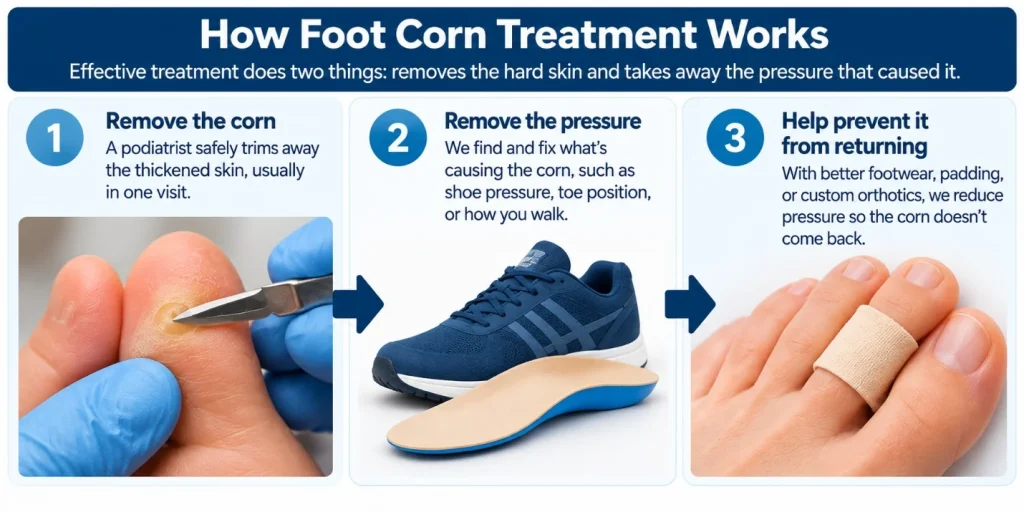
Professional Foot Corn Treatment and Removal
In-office corn removal is quick, and most people feel better as soon as they stand up. Our foot doctors treat the corn and the cause in the same visit.
Removing the Corn
We trim away the thickened skin and lift out the hard center with a sterile instrument. The skin being removed is dead, so it doesn’t hurt and you don’t need numbing. For deep corns, this is the only reliable way to remove the whole center.
Fixing the Cause
Removal brings relief. Keeping the corn from coming back takes a second step, which depends on what’s causing the pressure:
- Padding and toe spacers to cushion a spot or separate toes that rub
- Shoe changes, including the right width and toe box for your foot
- Custom-fit orthotics to shift weight off an overloaded spot on the bottom of the foot
- Treatment for the underlying toe problem, such as a hammertoe or bunion. In stubborn cases, a minor procedure can correct the bone that’s causing the pressure.
Does Insurance Cover Corn Removal?
It depends on your plan and your health. Your first visit is an exam, which is generally covered by insurance. Medicare often covers corn and callus care when a health condition or exam findings make it risky to treat your own feet. Diabetes, nerve damage, and poor circulation are common examples. We’ll tell you at that first visit what your plan should cover.
When to See a Foot Doctor for a Corn
Make an appointment with a podiatrist if:
- The corn hurts enough to change how you walk
- Home care hasn’t helped after two to three weeks
- The corn keeps coming back
- You see redness, swelling, warmth, or drainage
- You aren’t sure whether it’s a corn or a wart
- You have diabetes, nerve damage, or poor circulation
A corn left alone usually gets thicker and more painful. In people with poor circulation or numbness, the skin under it can break down into a sore.
“When someone comes in with a corn, I ask to see the shoes they wear most. The wear pattern inside the shoe usually shows me where the pressure is coming from before I’ve looked at the foot.”
Podiatrist Dr. Jason Sweeley, DPM, Silver Spring Foot & Ankle
Foot Corn Treatment FAQs
What Is Inside a Corn on the Foot?
Packed layers of dead skin. The center is the densest part, and it’s shaped like a small cone. There’s no seed, root, or fluid inside.
What Happens if You Cut a Corn Off?
You risk cutting into healthy skin, which can bleed and get infected. Even if it goes well, the corn grows back because the pressure hasn’t changed.
How Can I Remove Deep Corns From My Feet?
Deep corns are hard to treat at home because filing only reaches the surface. A Doctor of Podiatric Medicine (DPM) can safely remove the entire center in one visit.
Does Vaseline Get Rid of Corns?
No. Petroleum jelly softens skin and can protect the healthy skin around a corn, but it doesn’t remove a corn.
What Happens if a Corn Is Left Untreated?
It usually gets thicker and more painful as long as the pressure continues. It can change how you walk, and in people with diabetes or poor circulation, it can lead to an open sore.
Foot Corn Treatment in Mechanicsburg, Carlisle, and Harrisburg
You don’t have to keep padding, filing, and putting up with a painful corn. If you’re looking for podiatrists in Mechanicsburg, Carlisle, or Harrisburg, Silver Spring Foot & Ankle can remove it and fix what’s causing it. Schedule an appointment or call (717) 237-9000.