
Pushing off your big toe suddenly hurts.
Maybe it happened during a Friday night football game at Cumberland Valley. Maybe it happened on the soccer field, during a hard stop on the basketball court, or during a sprint that went wrong. You felt something at the base of your big toe, maybe a sharp pain, maybe just a sudden wrong feeling. Now every push-off step reminds you that something isn’t right.
That’s turf toe. A sprain of the joint at the base of the big toe. It sounds minor. But it doesn’t feel minor when you’re trying to walk, run, or compete.
Podiatrist Dr. Jason Sweeley, DPM, a foot and ankle specialist, diagnoses and treats turf toe at Silver Spring Foot & Ankle in Mechanicsburg. Most cases respond well to conservative treatment. Determining the injury grade early affects how quickly and fully you recover.
Get Relief Fast
A sore big toe affects every single step. You shouldn’t have to wait weeks to find out how serious it is or what to do.
At Silver Spring Foot & Ankle, we see most new patients within a few days, often the next day after you call. You’ll leave with a clear diagnosis and a turf toe treatment plan to get you back to full activity as quickly and safely as possible.
Ready to schedule an appointment? Call (717) 237-9000 or schedule online.
Quick Answers About Turf Toe Treatment
Turf toe sprains primarily occur on hard, artificial surfaces when a foot is planted, and the toe is forcefully bent backward. Get more insights into the condition with these quick answers.
| Question | Answer |
|---|---|
| What is turf toe? | Turf toe is a sprain of the ligaments surrounding the metatarsophalangeal joint at the base of the big toe. It occurs when the toe is forcibly bent upward beyond its normal range of motion. |
| Is turf toe serious? | It ranges from mild to severe. Grade 1 sprains heal in days to weeks. Grade 3 sprains involving complete ligament tears can sideline athletes for months and occasionally require surgery. |
| Can I play through turf toe? | You may be able to play through a Grade 1 sprain with taping and modified activity. Playing through a Grade 2 or 3 sprain risks turning a manageable injury into a significant one. An evaluation determines your grade. |
| How long does turf toe take to heal? | Grade 1: days to two weeks. Grade 2: two to six weeks. Grade 3: six weeks to several months depending on severity. |
| Does turf toe only happen on turf? | No. The name comes from its association with artificial turf, but turf toe can occur on any surface. It’s about the injury mechanics, not the playing surface. |
| When should turf toe be evaluated? | Any time pain at the base of the big toe limits push-off, walking, or sports activity, a professional evaluation is recommended. Grade matters for turf toe treatment. |
| Is turf toe basically a broken toe? | No. Turf toe is a ligament sprain, not a fracture. However, the two can feel similar and occasionally occur together. Imaging helps distinguish between them, which is one reason evaluation matters. |
What Is Turf Toe?
Turf toe is a sprain of the metatarsophalangeal joint at the base of the big toe where the toe meets the foot. Specifically, it involves the complex of ligaments, tendons, and soft tissue structures on the underside of that joint, collectively called the plantar plate. Learn more about the different parts of your feet.
The injury happens when you force the big toe into an extreme upward extension, usually during push-off. You plant your foot, the heel rises, and the toe hyperextends beyond its normal range. That stretches the structures at the bottom of the joint. Depending on severity, it can lead to a partially torn or completely ruptured tendon.
The big toe joint is critical for normal walking and running mechanics. Every time you take a step, you push off through that joint. When it’s injured, the impact on daily function is immediate and constant.
Turf Toe Grades
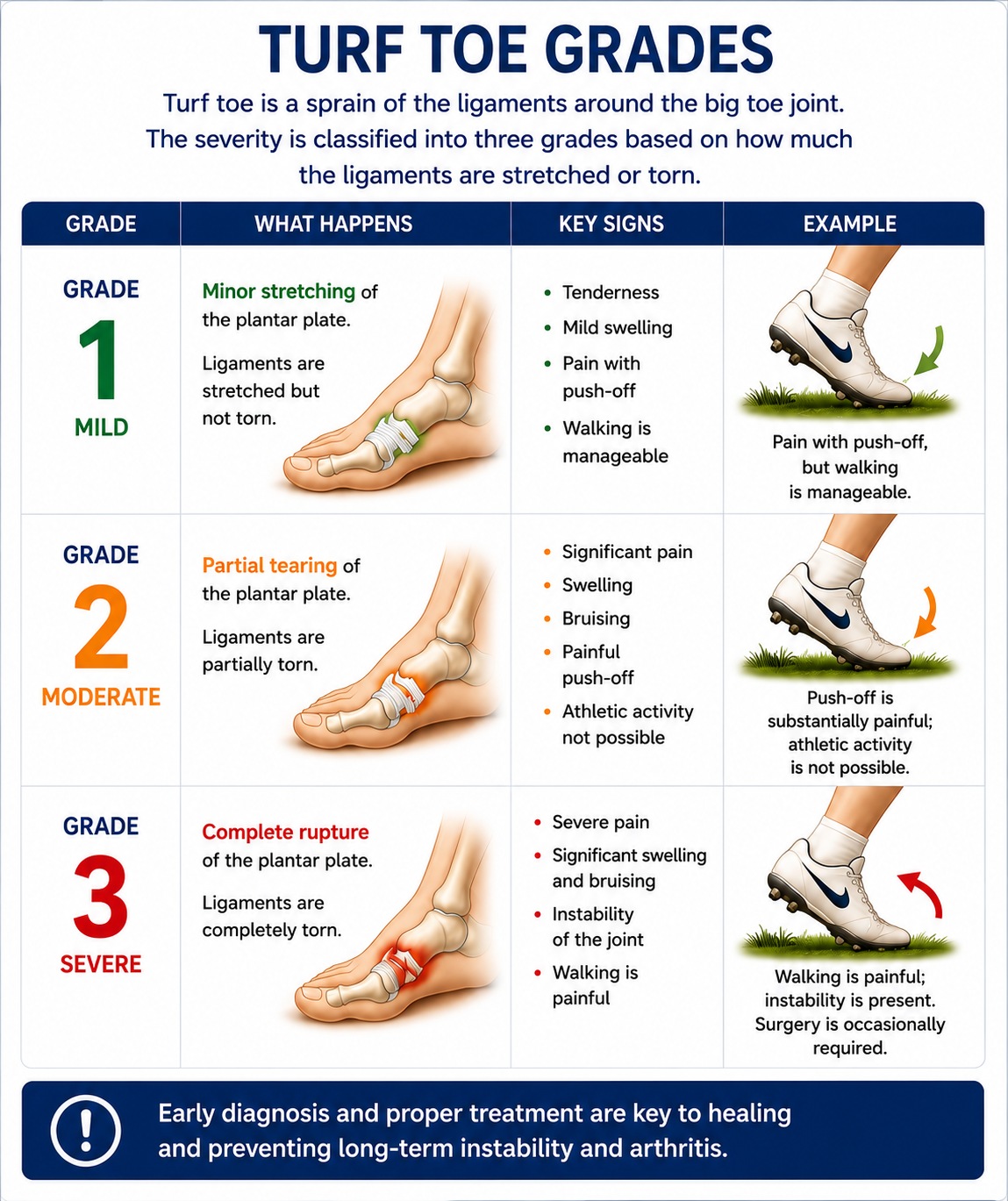
Turf toe is classified into three grades based on severity. The grade drives the turf toe treatment approach and recovery timeline.
- Grade 1. Minor stretching of the plantar plate. Tenderness and mild swelling at the joint. Push-off is painful, but walking is manageable. Recovery typically takes a few days to two weeks.
- Grade 2. Partial tearing of the plantar plate. More significant pain, swelling, and bruising. Push-off is substantially painful, and athletic activity is not possible. Recovery takes two to six weeks.
- Grade 3. Complete rupture of the plantar plate: severe pain, significant swelling, bruising, and instability of the joint. Walking is painful. Recovery can take six weeks to several months. Surgery is occasionally required.
What Causes Turf Toe?
Turf toe happens when the big toe is forced into excessive upward extension faster than the joint can tolerate. A few scenarios make that more likely. While most common in athletes, turf toe can also occur in anyone who forcefully bends the big toe during daily activities. It can happen to dancers and manual laborers, as well as those who misstep on an uneven surface.
- Explosive push-off. Sprinting, jumping, and cutting movements create the most force through the big toe joint. Football, soccer, basketball, and track athletes are particularly susceptible.
- Flexible footwear on hard surfaces. Shoes with flexible soles allow more toe extension than stiffer athletic footwear. That flexibility, combined with a hard or low-traction surface, creates the right conditions for the injury.
- Artificial turf. The name comes from the fact that artificial turf provides more traction than natural grass. The foot plants firmly and the body drives forward, hyperextending the toe.
- Cumulative stress. Turf toe can develop gradually from repeated lower-grade hyperextension episodes rather than a single traumatic event. This chronic version is common in athletes who play through mild big toe pain.
What Turf Toe Feels Like
Symptoms vary by grade but follow a recognizable pattern. Most patients notice these signs after the injury.
- Pain at the base of the big toe, most pronounced during push-off.
- Swelling around the big toe joint.
- Bruising that may appear on the underside of the toe or around it.
- Limited range of motion. The toe feels stiff or resists upward bending.
- A feeling that the joint is unstable or that the toe doesn’t track right.
- Difficulty walking normally, particularly the push-off phase of each step.
- Grade 3 injuries involve pain at rest and significant difficulty bearing weight.
When Should You See a Foot Specialist About Turf Toe?
Many athletes try to tape the toe and play through it. For a Grade 1 sprain, that may be reasonable. For a Grade 2 or 3, it significantly increases the risk of turning a treatable injury into a chronic problem.
Schedule an evaluation with a foot doctor near you if any of these apply.
- Push-off pain is significant enough to change how you walk or run.
- The joint feels unstable, or the toe doesn’t track normally.
- Swelling and bruising are significant.
- The pain isn’t improving after several days of rest.
- You’ve had repeated episodes of big toe pain during sports.
How a Podiatrist Treats Turf Toe
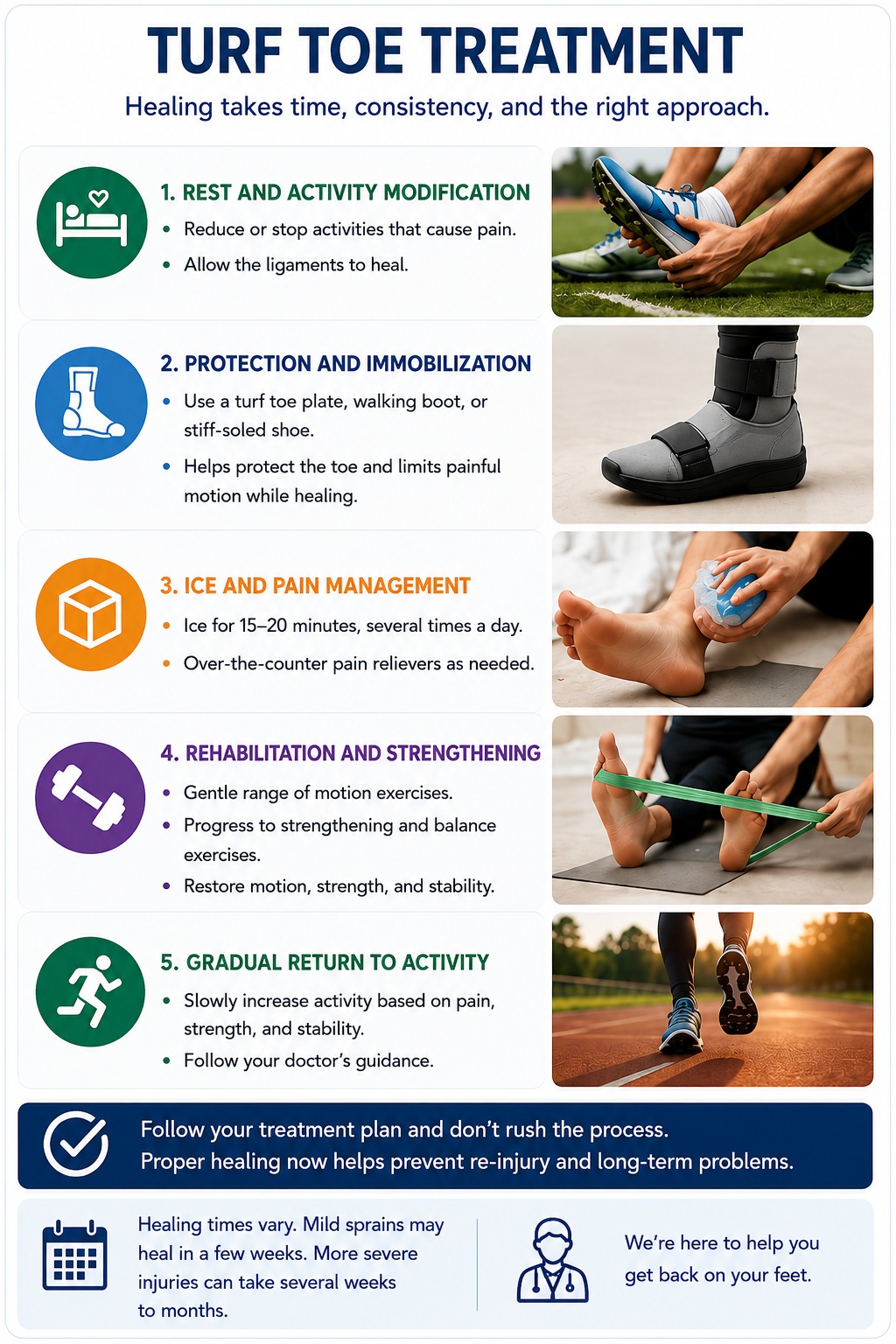
Treatment is graded to match the injury’s severity. Our foot specialists confirm the grade before recommending a turf toe treatment plan. We manage most injuries conservatively.
Grade 1 Treatment
Rest, ice, and activity modification. Taping the toe limits extension and protects the joint during recovery. Return to sport is often possible within days to two weeks with appropriate protection.
Grade 2 Treatment
More significant rest is required. A walking boot or stiff-soled shoe reduces the load on the joint. Physical therapy helps restore range of motion and strength. Return to sport is typically 2 to 6 weeks, with taping and footwear modifications.
Grade 3 Treatment
Significant immobilization, often a boot or cast. Extended rest period before any athletic activity. Physical therapy is an important part of recovery. Surgery is occasionally required for complete tears that involve instability of the joint. Our foot specialists discuss all options before you decide.
Need to schedule an appointment? Call (717) 237-9000 or schedule online.
Can You Prevent Turf Toe?
Not entirely. But you can reduce the risk, particularly with athletes who’ve had it before.
- Wear stiffer athletic footwear. A stiffer sole limits how far the big toe can extend during push-off. Turf-specific footwear is designed with this in mind.
- Use a turf toe plate. An insert that reinforces the forefoot and limits toe extension. Widely used for both prevention and protection during return to sport.
- Tape the toe during high-risk activity. Prophylactic taping limits extension at the big toe joint. Common in football and soccer players with a history of turf toe.
- Don’t play through big toe pain. Repeated lower-grade hyperextension injuries accumulate. What starts as Grade 1 sensitivity can become a Grade 2 or 3 if it’s never properly addressed.
“The big toe does a lot of work that people don’t think about until it’s injured. Every step involves a push-off through that joint. Athletes are often surprised by how much a toe injury limits their performance. Getting the grade right early makes a real difference in how quickly and completely they recover.”
Dr. Jason Sweeley, DPM, Podiatrist, Silver Spring Foot & Ankle
Get Turf Toe Treatment Near You in Mechanicsburg
Whether your turf toe happened last week or has been nagging you through a season, our foot doctors can tell you exactly what you’re dealing with and how to get back to full activity safely.
Patients come to Silver Spring Foot & Ankle from across the West Shore and greater Harrisburg area—Mechanicsburg, Camp Hill, Lemoyne, Carlisle, Harrisburg, and the surrounding communities.
Don’t let a toe keep you on the sideline. Call (717) 237-9000 or request an appointment online. Same-day and next-day appointments are often available.