
Plantar warts are rough, grainy growths on the bottom of the foot, caused by the human papillomavirus (HPV). They usually appear on the heel or ball of the foot, where pressure pushes them inward and makes walking painful.
Many go away on their own. But it can take months or years, and they can spread in the meantime. At Silver Spring Foot and Ankle, our foot doctors confirm the diagnosis and treat stubborn warts in kids and adults so they can walk comfortably again.
Ready to schedule an appointment? Call (717) 237-9000 or schedule online.
Quick Answers About Plantar Wart Treatment
Plantar warts raise a lot of questions, especially when you’re trying to figure out what the spot on your foot is and whether you need treatment. Here are quick answers to some of the questions our patients ask most often.
| Question | Answer |
|---|---|
| What causes plantar warts? | HPV enters the body through tiny cuts or cracks on the bottom of your foot. |
| Are plantar warts contagious? | Yes. They spread through direct contact and damp surfaces like pool decks and locker rooms. |
| Is plantar wart HPV an STD? | No. Plantar warts come from different HPV strains than the ones spread through sexual contact. |
| Do plantar warts go away on their own? | Sometimes, especially in kids. In adults, they often last longer and can spread or multiply. |
| Is it safe to dig out a plantar wart? | No. Cutting or pulling at a wart can cause bleeding, infection, and scarring, and can spread the virus. |
| How do I know it’s a wart and not a corn? | Warts often have tiny black dots and hurt when squeezed from the sides. Corns hurt more with direct pressure. |
What Is a Plantar Wart?
A plantar wart is a skin growth caused by the human papillomavirus (HPV). “Plantar” refers to the sole. They’re reasonably common. Approximately 10% of people have plantar warts. Between 10% and 20% of children and teenagers have them.
Warts on your hands grow outward. Plantar warts get pushed inward by your body weight, so they grow under a layer of thick, hard skin. That’s why they can feel like you’re stepping on a pebble.
Some people get a single wart. Others get a cluster of small warts growing together, called mosaic warts. Mosaic warts are some of the hardest warts to get rid of.
Why Plantar Warts Matter
Most plantar warts aren’t dangerous, but they can be more than cosmetic.
Left alone, a plantar wart can:
- Grow larger and more painful
- Spread to other parts of your foot or to other people in your home
- Change the way you walk, which can lead to pain in your feet, knees, or back
Some growths that look like warts aren’t warts. Corns, calluses, and in rare cases, skin cancers can look similar. If a growth bleeds, changes color, grows quickly, or doesn’t respond to treatment, have a foot doctor in your area check it.
If you have diabetes, neuropathy, or poor circulation, don’t treat a wart at home. A small wound on your foot can turn into a serious infection.
What Causes Plantar Warts?
HPV causes plantar warts. The virus enters your body through tiny cuts, cracks, or soft spots on the soles of your feet.
It thrives in warm, damp places. Common places to pick it up include:
- Pool decks and community pools
- Gym and school locker rooms
- Shared showers
Not everyone who’s exposed gets a wart. Warts can take weeks or months to appear after contact. Plantar warts can be especially common after summer, when kids and adults spend more time barefoot around pools, locker rooms, and other shared spaces.
Who Gets Plantar Warts?
Plantar warts are common, especially in children and teenagers. Anyone can get them, but you’re more likely to develop one if you:
- Are a child or teenager
- Are 65 or older
- Have a weakened immune system
- Have an autoimmune disease
Symptoms of Plantar Warts
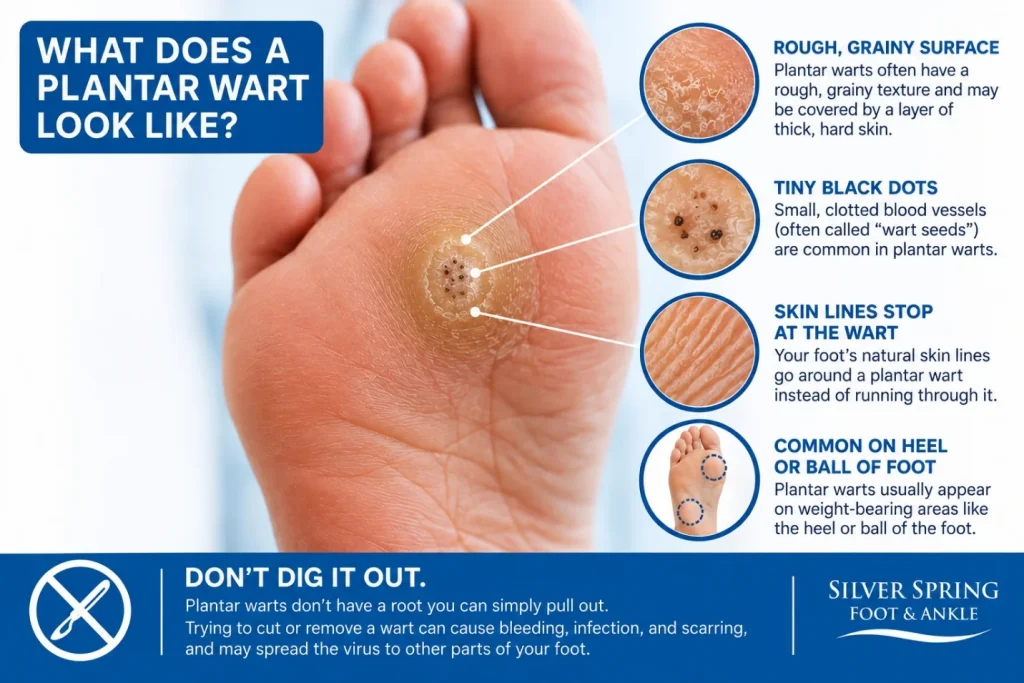
Plantar warts usually show up on the heel or ball of the foot. Common signs include:
- A small, rough, grainy bump on the bottom of your foot
- Tiny black dots in the center (small, clotted blood vessels, sometimes called “wart seeds”)
- Hard, thick skin over one spot, like a callus
- Pain when you walk or stand
- Pain when the spot is squeezed from the sides
- Skin lines on your foot that stop at the growth instead of running through it
Plantar Wart vs. Corn or Callus
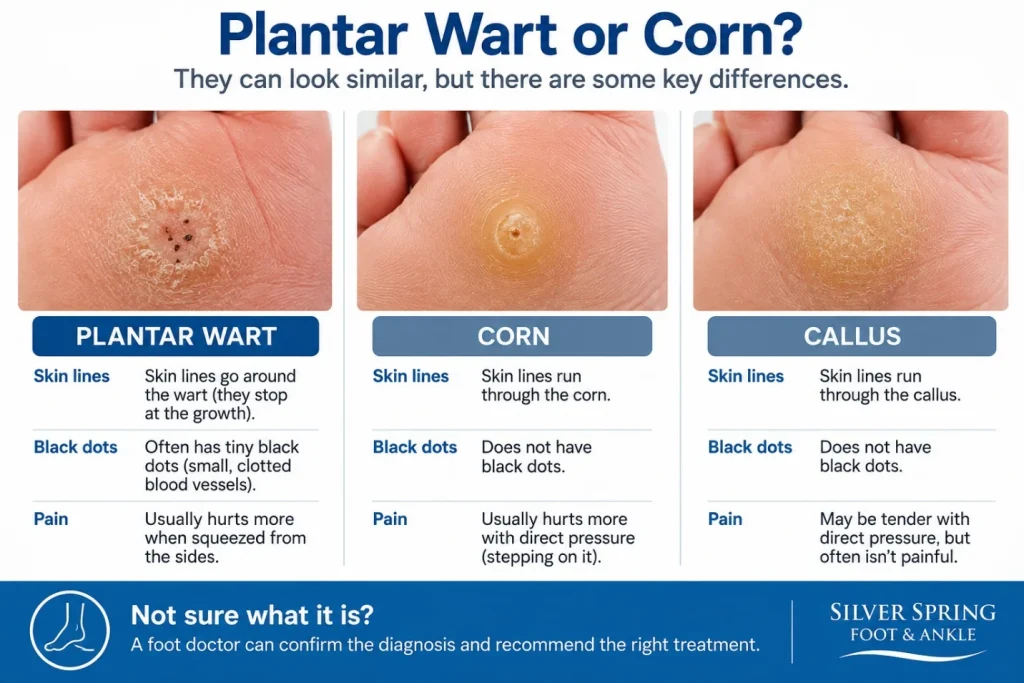
Here’s where most people get stuck, and how to tell them apart:
- Skin lines: Your foot’s natural skin lines run through a corn or callus. They go around a wart.
- Black dots: Warts often have them. Corns and calluses don’t.
- Pain: Warts usually hurt more when you squeeze them side to side. Corns hurt more when pressed straight down.
If you can’t tell, that’s normal. A podiatrist can confirm the diagnosis, usually by gently shaving the top layer to look for the tiny blood vessels underneath. In rare cases, they may send a small sample for testing.
Plantar Warts in Kids
Plantar warts are especially common in children and teens. Kids go barefoot more, share locker rooms and pool decks, and pick at things. The good news is that kids’ warts are more likely to clear on their own than adults’.
Still, a wart that hurts, spreads, or makes your child limp or avoid sports is worth treating.
Plantar Wart Treatment Options
No treatment directly kills the wart virus. Treatment works by removing the infected skin and helping your immune system recognize and fight the virus. Stubborn warts often need more than one visit.
Debridement
A foot doctor trims away the thick, hard skin covering the wart. It often eases pain right away and lets other treatments reach the wart.
Prescription-Strength Salicylic Acid
It’s much stronger than store-bought versions. Salicylic acid softens and removes the infected skin layer by layer, and it’s often used between office visits.
Cryotherapy
The foot doctor freezes the wart with liquid nitrogen. A blister forms underneath, and the dead tissue comes off over the next week or two. Most warts need a few sessions. It can be uncomfortable, so it isn’t always the best choice for young children.
Cantharidin
A blistering agent is applied in the office and covered with a bandage. The application doesn’t hurt, making it a good option for kids. The blister that forms lifts the wart away from healthy skin.
Microwave Therapy
Short bursts of microwave energy heat the wart tissue and prompt your immune system to fight the virus. No cutting or dressing afterward.
Needling
After numbing the area, the podiatrist punctures the wart tissue repeatedly to stimulate an immune response against the virus.
Laser Treatment
Laser energy destroys the wart tissue or the tiny blood vessels that feed it.
Minor Surgical Removal
This option is usually saved for warts that don’t respond to other treatment. It can leave a scar on a part of your foot that carries your weight.
Immunotherapy
Injections or topical medicines help your immune system recognize and fight the virus.
The right treatment depends on:
- The wart’s size
- How long it’s been there
- How much it hurts
- Your age
- Your overall health
At Silver Spring Foot and Ankle, our podiatrists will walk you through the options that make sense for you or your child.
Want it looked at? Call (717) 237-9000 or schedule online.
Plantar Wart Self-Care and Prevention
Not every plantar wart needs immediate treatment in a podiatrist’s office. If the wart is small, doesn’t cause much pain, and you don’t have a condition that puts your feet at greater risk, you may be able to treat it at home first. Just as important is knowing what not to do.
Treating Plantar Warts at Home
Over-the-counter salicylic acid can help some small plantar warts. It works by gradually removing layers of infected skin, so don’t expect the wart to disappear overnight. Treatment usually takes several weeks.
Soaking your foot first can soften the thick skin over the wart. Then gently file away dead skin before applying the medication. Use a separate file or pumice stone for the wart, and never use it on healthy skin.
Don’t try to treat a plantar wart at home if you have diabetes, neuropathy, or poor circulation. Even a small foot injury can become a much bigger problem.
What Not to Do When Treating Plantar Warts
Don’t dig at a wart, cut it out, or pull at it with tweezers. Plantar warts don’t have a root you can remove. Cutting into one can cause bleeding, infection, and scarring, and may spread the virus to your fingers or other parts of your foot.
How to Prevent Plantar Warts
You can’t eliminate your chances of getting a plantar wart. You can make it harder, however, for HPV to reach your skin and spread. The best precautions involve protecting your feet in warm, damp places where people commonly go barefoot.
- Wear shoes in shared spaces. Use shower shoes or flip-flops around pools, in locker rooms, in gym showers, and in other wet public areas.
- Keep your feet clean and dry. Change damp socks and shoes rather than leaving your feet in a warm, moist environment.
- Change your socks daily. If your feet sweat heavily, you may need to change them more often.
- Don’t share personal items. Towels, socks, and shoes can come into contact with infected skin.
- Keep an existing wart covered. A bandage can help reduce contact with the wart and limit its spread.
- Don’t pick at warts. Picking can spread the virus to your fingers or another part of your foot.
When to See a Foot Doctor for Plantar Wart Treatment
A small plantar wart that isn’t bothering you may not require immediate treatment. But if a wart becomes painful, starts changing, or won’t go away, it’s worth having a podiatrist take a look. Also, make sure the growth is really a plantar wart before repeatedly treating it at home.
Make an appointment if the growth:
- Hurts when you stand or walk
- Bleeds or changes in color or appearance
- Spreads or develops into a cluster of warts
- Keeps coming back after treatment
- Hasn’t improved with home treatment
- Makes you change the way you walk
- Doesn’t clearly look like a plantar wart
If you have diabetes, neuropathy, poor circulation, or a weakened immune system, skip home treatment and have the growth evaluated by a DPM.
“The biggest mistake I see is people trying to cut out a wart at home. By the time they come in, they’re dealing with pain, sometimes an infection, and the wart is still there. Plantar warts are very treatable. There’s no reason to limp around for a year waiting for one to go away.”
Dr. Jason Sweeley, DPM, Silver Spring Foot and Ankle
Plantar Wart Treatment FAQs
Are plantar warts contagious?
Yes. The virus spreads through direct skin contact and on damp surfaces such as pool decks, locker rooms, and shared showers. It can also spread from one spot on your foot to another, or to your hands if you pick at a wart.
Is plantar wart HPV an STD?
No. HPV is a large family of viruses. The strains that cause plantar warts differ from those spread through sexual contact. Plantar warts spread through skin contact and shared surfaces. Having one doesn’t mean you have an STD.
Do plantar warts go away on their own?
Many do, especially in kids, often within a year or two. Adults tend to have them longer. Some warts never clear without treatment. Meanwhile, a wart can grow, become more painful, or spread. If a wart is painful or spreading, treatment is usually preferable to waiting.
Are plantar warts common in kids?
Yes. Kids and teens get plantar warts more than any other age group, largely because they spend more time barefoot in shared spaces. Their warts are also more likely to clear on their own. If your child’s wart hurts or keeps them from normal activities, it’s worth having it checked.
Can you dig out a plantar wart?
No. Plantar warts don’t have a root you can pull out. Digging or cutting at one can cause bleeding, infection, and scarring. It can also spread the virus. A foot doctor in your area can safely trim the thick skin over a wart as part of treatment.
What does a plantar wart look like?
A plantar wart usually looks like a small, rough, grainy bump on the bottom of your foot, often covered by hard skin. Many have tiny black dots in the center. Your foot’s skin lines stop at the edge of the wart instead of running through it.
How can you tell a plantar wart from a corn?
Look for black dots, check whether skin lines run through the spot or around it, and notice how it hurts. Warts hurt more when you squeeze them from the sides. Corns hurt more when pressed straight down. When you’re not sure, a podiatrist can tell you in one visit.
What is the fastest way to get rid of a plantar wart?
There’s no overnight fix, but in-office treatment usually works faster than store-bought products. Your foot doctor can remove the thick skin covering the wart and use stronger treatments that reach it more directly. Most warts still need more than one visit.
Why does my plantar wart keep coming back?
Plantar warts can come back even after the visible wart is gone. You can also develop a new wart after another exposure to HPV. Stubborn or recurring warts may need a different treatment approach, so it’s a good idea to see a DPM.
Plantar Wart Treatment in Mechanicsburg, Carlisle, and Harrisburg
A plantar wart shouldn’t make every step hurt, for you or your child. If you’re looking for a podiatrist in Mechanicsburg, Carlisle, or Harrisburg, Silver Spring Foot and Ankle can identify what’s on your foot and develop a treatment plan to get rid of it. Schedule an appointment or call (717) 237-9000.