
Your feet hurt at the end of every day. Or maybe your heels ache in the morning. Maybe you’ve been dealing with persistent arch pain, recurring tendon problems, or a bunion that keeps getting worse despite your best efforts.
You’ve tried drugstore insoles. They helped a little, or not at all. Either way, the problem remains.
Custom-fit orthotics aren’t insoles; they’re a medical device. A podiatrist prescribes them based on your feet’s specific structure and the mechanics driving your pain. For many patients, they’re the treatment that finally addresses the root cause instead of just cushioning around it.
Silver Spring Foot & Ankle provides custom orthotics for feet in Mechanicsburg for patients throughout the Carlisle and Harrisburg area. The process starts with understanding what’s actually causing your foot discomfort. Then we determine whether orthotics are the right solution for your situation.
Next-Day Appointments Often Available
An orthotic insert evaluation includes a thorough assessment of your foot structure, gait, and the mechanics driving your symptoms. We see most new patients at Silver Spring Foot & Ankle within a few days. Often, the next day after you call.
Call (717) 237-9000 or schedule online.
Quick Answers About Custom Orthotics for Feet
Heard about custom orthotics for problem feet, but have more questions? Get answers quickly here.
| Question | Answer |
|---|---|
| What are custom fit orthotics? | Custom fit orthotics are prescription shoe inserts fabricated from a mold or scan of your feet. Unlike OTC insoles, they’re designed for your specific foot structure and biomechanics. |
| Are custom-fit orthotics from a podiatrist worth it? | For patients with structural foot issues, recurring pain, or conditions that respond to mechanical correction, orthotic inserts often provide relief that OTC insoles cannot. The value depends on the diagnosis. |
| What is the difference between custom fit orthotics and store-bought insoles? | OTC insoles provide generic cushioning for the general population. Custom fit orthotics are prescribed and fabricated specifically for your feet, mechanics, and condition. |
| What conditions do custom foot orthotics help? | Plantar fasciitis, Achilles tendonitis, bunions, hammertoes, flat feet, high arches, knee and hip pain caused by foot mechanics, and many sports injuries. |
| How much do orthotic inserts cost? | Cost varies by orthotic type and materials used. Insurance may cover the cost in some cases—custom-fit orthotics typically last three to five years. |
| Do I need a prescription for custom foot orthotics? | Yes. Custom foot orthotics are prescription medical devices. A licensed podiatrist must evaluate, diagnose, and fit them. |
| Will I have to wear orthotics forever? | Not necessarily. Some patients benefit from long-term use. Others use them during treatment or for specific activities. The recommendation depends on the condition and goals. |
What Are Custom Orthotics for Your Feet?
Podiatrists prescribe custom-fit orthotics that fit inside your shoes and modify how your feet function. They fabricate them from a mold or three-dimensional scan of your feet. A foot specialist captures every curve, contour, and structural characteristic of your foot for the design.
The result is an insert that supports and corrects your specific mechanics. It’s not a generic arch that approximates what most feet need.
Custom Orthotics vs. Over-the-Counter Insoles
Patients generally ask this question first, and it deserves a straight answer.
OTC insoles work for average feet. They provide cushioning and general arch support that helps some people, sometimes. If you have mild discomfort from prolonged standing and normal foot mechanics, an OTC insole might be adequate.
Custom fit orthotics are different in kind, not just quality. A foot doctor prescribes them based on a clinical evaluation of your foot structure, gait, and the specific mechanics causing your symptoms. They fabricate them from medical-grade materials to precise specifications. They address your problem directly rather than providing general comfort.
The analogy is between eyeglasses and drugstore reading glasses. Reading glasses help some people with mild presbyopia. But if you have a specific prescription, generic lenses don’t correct it. Custom orthotics work the same way for your feet. For a closer look at how the two compare, read Custom Orthotics vs. OTC Inserts.
Functional vs. Accommodative Foot Orthotics
Not all custom orthotics are the same. The type prescribed depends on the treatment goal.
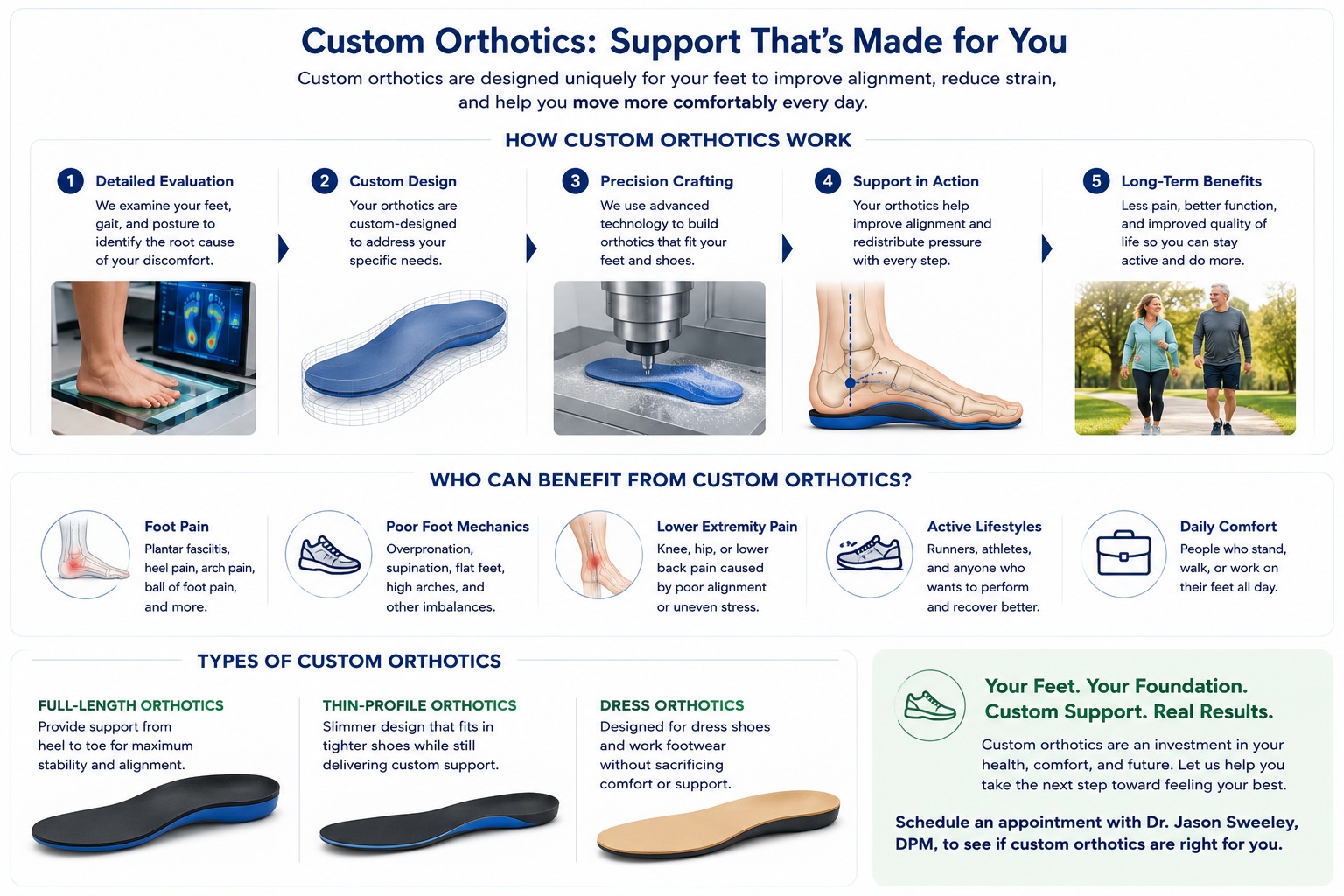
Functional orthotics are made from firmer materials. They help to control abnormal foot motion, correct walking patterns, and address the mechanical causes of pain. Podiatrists commonly prescribe them for plantar fasciitis, Achilles tendonitis, bunions, and sports injuries.
Accommodative orthotics are made from softer, cushioned materials. They redistribute pressure and absorb shock. Common uses include diabetic foot care, painful calluses, and arthritic conditions where cushioning and pressure relief are the primary goals.
Your podiatrist determines the appropriate type based on the diagnosis and treatment goals.
How Custom Fit Orthotics Work
Your feet are the foundation for everything above them. When your feet don’t function properly because of flat arches, high arches, overpronation, or structural issues, excessive stress travels up the kinetic chain. The result is often pain not just in the feet but in the ankles, knees, hips, and lower back.
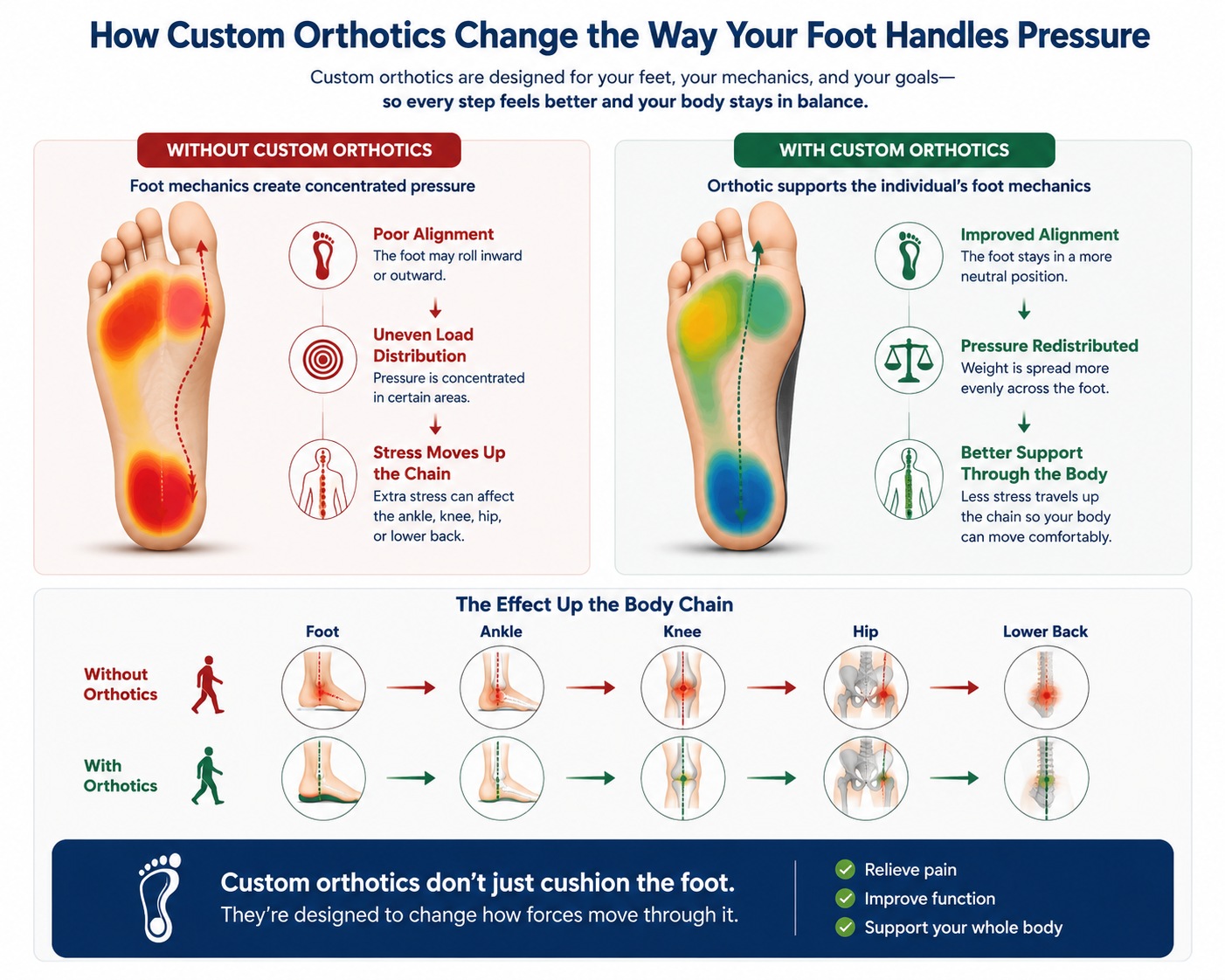
Orthotics for your feet correct or compensate for the mechanical problem at its source. A functional orthotic for overpronation, for example, controls the inward rolling of the foot that places excess stress on the arch, Achilles tendon, and knee. Addressing the mechanics reduces the stress on all the structures above it.
That’s why orthotics are often part of the treatment plan for conditions that seem unrelated to foot structure. Abnormal foot mechanics can drive knee pain, shin splints, and hip discomfort. Orthotics can help correct those mechanics and relieve symptoms.
Signs Your Pain May Be Mechanical
Not all foot pain has a mechanical cause. But several patterns strongly suggest your feet’ function is at the root of the problem.
- Pain returns every time you increase activity, even after it seemed to resolve with rest.
- Over-the-counter insoles provide temporary relief, but the pain keeps coming back.
- One shoe wears out significantly faster than the other, or wears unevenly.
- You’ve had recurring plantar fasciitis, Achilles problems, or stress fractures that keep returning after treatment.
- Knee, hip, or lower back pain accompanies or follows your foot symptoms.
- You have flat feet, high arches, or overpronation that a podiatrist has never formally addressed.
Foot Conditions Commonly Treated with Custom Fit Orthotics
Foot doctors use custom orthotics to treat a wide range of foot and lower-extremity conditions. Some of the most common include:
- Plantar fasciitis. Orthotics correct the foot mechanics that overload the plantar fascia, providing relief that rest and stretching alone often can’t achieve.
- Achilles tendinitis. Controlling overpronation and supporting the arch reduces the load on the Achilles tendon with every step.
- Bunions. Orthotics can’t correct an existing bunion, but they can slow its progression by addressing the mechanics that drive the deformity.
- Hammertoes. Reducing forefoot pressure and correcting alignment can slow the progression of hammertoe deformities.
- Flat feet and overpronation. Custom-fit orthotics provide the specific structural support that flat feet lack, reducing pain and preventing downstream problems.
- High arches. Accommodative orthotics redistribute pressure more evenly across a high-arched foot that concentrates load on the heel and ball.
- Sports injuries. Runners, walkers, and athletes benefit from improved foot mechanics that reduce the repetitive stress that contributes to many overuse injuries.
- Knee, hip, and lower back pain. When foot mechanics are the underlying cause, correcting them at the source often provides relief that knee or back treatment alone doesn’t.
- Diabetic foot care. Accommodative orthotics reduce pressure on vulnerable areas and help prevent the ulcers and complications associated with diabetic foot neuropathy.
What to Expect: The Custom Orthotic Process
Getting custom-fit orthotics is straightforward, but it starts with a proper evaluation, not just a foot scan.
Evaluation and Diagnosis
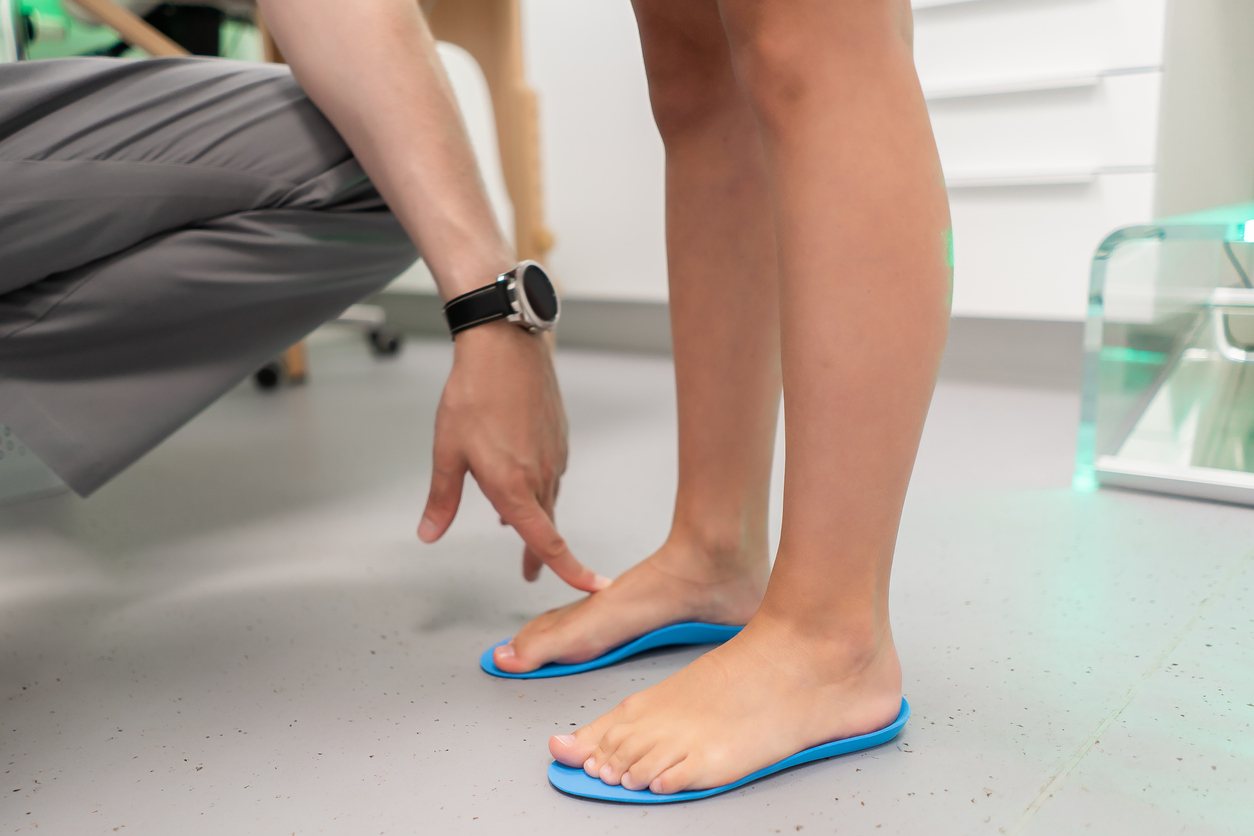
A podiatrist assesses your foot structure, gait mechanics, and the specific symptoms driving your pain. Custom orthotics are appropriate only when the evaluation confirms a mechanical issue that orthotics can address. Not every foot problem requires them. Prescribing orthotics without a clear mechanical diagnosis wastes the patient’s time and money.
Casting or Scanning
A precise mold or three-dimensional scan of your feet captures the exact contours needed to fabricate an orthotic that fits and functions correctly. This step is what separates a custom orthotic from anything available off the shelf.
Fabrication and Fitting
The orthotic is fabricated to the prescription specifications. Podiatrists then fit them to ensure proper function inside your footwear and adjust as needed. The goal is an insert that feels natural and provides the intended correction without discomfort.
Break-In and Follow-Up
Most patients require a short break-in period as the feet adapt to the corrected mechanics. A DPM guides you in incorporating orthotics into your daily routine and monitors your response to achieve the desired result.
Ready to be seen? Most new patients are seen within a few days. Call (717) 237-9000 or schedule online.
How Long Do Custom Fit Orthotics Last?
Most custom orthotics last three to five years with normal use. Athletic orthotics used for high-impact activity may need replacement sooner. The shell typically lasts longer than the top cover material, which can often be replaced separately.
Dr. Sweeley evaluates orthotics at follow-up visits to assess wear and function. An orthotic that has broken down mechanically no longer corrects what it was designed to correct. That means the symptoms it was managing may return.
“The most important part of prescribing orthotics is the evaluation that comes before it. Custom orthotics for your feet work when they’re addressing a real mechanical problem. They don’t work when they’re prescribed without a clear diagnosis. The goal is to identify what’s actually driving the symptoms and make sure orthotics are the right tool for that specific problem.”
Dr. Jason Sweeley, DPM, Silver Spring Foot & Ankle
Looking for Custom Orthotics Near You?
If you’re looking for custom-fit orthotics near you in Mechanicsburg, Carlisle, or Harrisburg, Silver Spring Foot & Ankle provides orthotic evaluations. Our podiatrists evaluate your foot structure, gait, and symptoms to determine whether custom orthotics are right for you.
Recurring foot pain is worth figuring out. Call (717) 237-9000 or request an appointment online. Same-day and next-day appointments are often available.