
You used to love those shoes. Now you can’t get them on. The bump on the side of your foot has gone from something you noticed to something you think about every day. Walking is uncomfortable. Standing for long stretches is worse. You’ve adjusted and compensated for so long that it feels normal now. It’s time to consider bunion treatment.
Bunions are among the most common foot problems Dr. Jason Sweeley, DPM, a board-certified podiatrist and foot and ankle specialist at Silver Spring Foot & Ankle in Mechanicsburg, treats. Some respond well to conservative care. Others need surgery for lasting relief. The most important step is getting the right diagnosis early, before a manageable problem becomes more serious.
Get Relief Fast
You shouldn’t have to wait weeks to find out what’s causing your foot discomfort.
At Silver Spring Foot & Ankle, we see most new patients within a few days. Often, you can schedule an appointment the next day. You’ll see Dr. Sweeley directly to get a clear diagnosis. He’ll provide a straight answer about where your bunion stands and what your options are.
Patients come to us from across Central Pennsylvania, including Mechanicsburg, Harrisburg, Camp Hill, Carlisle, Lemoyne, and the surrounding West Shore communities.
Want to schedule an appointment? We see most new patients within a few days. Call (717) 237-9000 or schedule online.
Quick Answers About Bunion Treatment
If you’re in a hurry, start here. These are the questions our patients ask most often. For even more in-depth answers, read: How to Treat Bunions: Can You Avoid Surgery?
| Question | Answer |
|---|---|
| Will a bunion go away without treatment? | No. A bunion is a structural deformity. The bone will not correct itself, and the condition typically worsens over time without intervention. |
| Does bunion treatment always require surgery? | Not necessarily. Many bunions respond well to conservative care, including footwear changes, padding, and custom orthotics. Surgery is considered when pain or deformity significantly affects daily life. |
| What causes a bunion to develop? | Bunions usually develop from a combination of inherited foot structure and mechanical factors, sometimes accelerated by footwear. If bunions run in your family, your foot mechanics may be predisposed to them. |
| Can bunion progression be slowed? | Yes. Proper footwear, custom orthotics, and early bunion treatment can significantly slow progression. |
| Can I walk after bunion surgery? | In most cases, yes, with limitations. Modern procedures often allow limited weight-bearing within days. You wear a protective boot initially during the healing period. |
| How long does bunion surgery recovery take? | Most patients return to normal daily activity within six to twelve weeks. High-impact activity like running typically resumes between three and six months. Full tissue healing can take up to a year. |
| What is a tailor’s bunion? | A tailor’s bunion, also called a bunionette, is a similar deformity at the base of the pinky toe rather than the big toe. It develops for the same reasons and responds to the same conservative and surgical treatments. |
| At what age do bunions develop? | Bunions become more common after age 40 but can develop at any age, including adolescence, particularly in patients with inherited foot structure issues. |
What Is a Bunion?
A bunion is a structural deformity at the base of the big toe. The medical term is hallux valgus. It develops when the joint at the base of the big toe shifts out of alignment. That shift pushes the toe inward toward the smaller toes. The bony bump you see on the inside edge of your foot is the result.

But a bunion is more than a bump. It’s a progressive condition. Without treatment, it gets worse over time. The joint becomes increasingly unstable. Walking changes. Shoes that used to fit no longer do. Everyday activities start to feel like something to get through, not enjoy.
The good news is that bunions respond well to treatment. The sooner you see a foot doctor near you, the more options you have.
What Causes a Bunion?
Bunions rarely have one single cause. They usually develop from a combination of factors working together over time.
Genetics and Foot Structure
This factor is often the biggest. If you were born with flat feet, low arches, or loose joints, your foot mechanics may be predisposed to developing a bunion. The condition runs in families. Not because the bunion itself is inherited, but because the foot structure that leads to one often is.
Footwear
Tight, narrow, or high-heeled shoes won’t cause a bunion on their own. But they can push a predisposed foot toward deformity much faster. If your shoes crowd your toes, they put constant pressure on the wrong joint.
Arthritis and Injury
Inflammatory conditions like rheumatoid arthritis can weaken joint structures over time. Repetitive stress from running, long hours on your feet, or prior foot injuries can also increase your risk.
What a Bunion Feels Like
Bunions develop gradually. The early signs are easy to dismiss. But they tend to get louder over time. Watch for:
- A visible bump on the inside edge of your foot at the base of the big toe.
- Pain, soreness, or burning around the joint. Especially when you walk or stand for a while.
- Swelling or redness that flares up during activity.
- Your big toe drifting toward or pressing against the second toe.
- Stiffness or limited motion in the big toe joint.
- Corns or calluses where the toes rub together.
- Growing difficulty finding shoes that don’t irritate the bump.
Who Gets Bunions?
About one in three American adults develops a bunion. Some people are more likely than others.
- Anyone with a family history of bunions or inherited foot structure issues.
- People who regularly wear high heels, pointed-toe shoes, or shoes that are too narrow.
- Women develop bunions about twice as often as men.
- Adults over 65, where prevalence climbs to more than 35 percent.
- People with rheumatoid arthritis or other inflammatory joint conditions.
- Anyone who spends long hours on their feet for work or athletics.
When Should You See a Foot Doctor for Your Bunion?
The most common thing we hear from new bunion patients is: “I wasn’t sure if it was bad enough to come in.”

Here’s a simple rule. If your bunion is on your mind, it’s worth having it checked. Specifically, schedule an evaluation if:
- You have persistent pain at the base of your big toe during daily activities.
- Your bunion is making it hard to find shoes that fit.
- The big toe is visibly crowding or overlapping the second toe.
- You’ve noticed swelling or redness that doesn’t go away with rest.
- The bump is growing, or the pain is getting worse.
- Foot pain is keeping you from exercising, working, or enjoying your day.
Early evaluation almost always means more options. A podiatrist can tell you exactly where your bunion stands and what it will take to stay ahead of it.
How Does a Foot Specialist Treat Bunions
Treatment depends on how advanced your bunion is and how much it’s affecting your daily life. We take a conservative-first approach. He starts with the least invasive option that works for your situation.
Conservative Bunion Treatment
For mild to moderate bunions, non-surgical options can improve comfort and slow the deformity’s progression.
- Footwear changes. Switching to shoes with a wide, deep toe box lets your toes spread naturally and takes pressure off the joint.
- Padding and taping. Cushioned pads protect the bump. Taping helps keep the toe better aligned.
- Custom orthotics. Prescription inserts designed for your foot redistribute pressure, support the arch, and improve alignment. They address the mechanics that are driving the deformity.
- Anti-inflammatory treatment. Medication or ice to manage pain and swelling during flare-ups.
Surgical Bunion Treatment
When conservative care isn’t enough, or when the deformity is severe enough to interfere with daily life, surgery may be the right move. A bunionectomy realigns the bone, joint, and surrounding tissue to correct the deformity and relieve pain.
There are several surgical approaches. The right approach depends on your bunion’s severity, activity level, and goals. We’ll walk you through every option so you know exactly what to expect before you decide.
Advanced Bunion Surgery: Lapiplasty® 3D Correction
Not all bunion surgeries are the same.
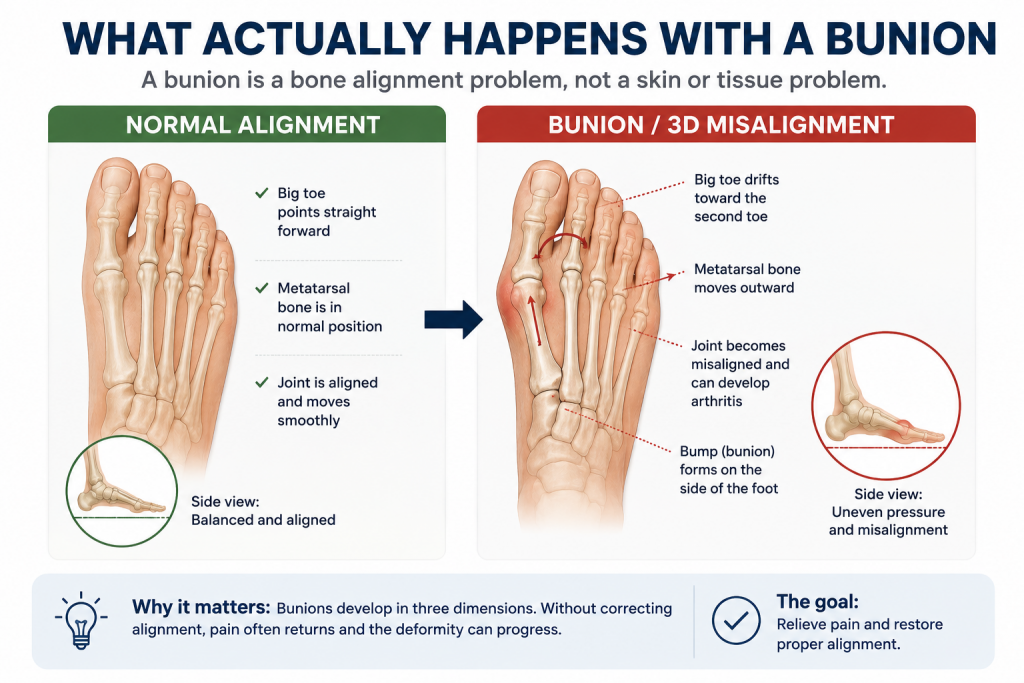
For patients who need surgical correction, Lapiplasty® presents one of the most advanced bunion procedures available today. Traditional surgery addresses the bunion in only one or two dimensions and often shaves the bump. Lapiplasty corrects the underlying misalignment in all three dimensions. It addresses the root cause of the deformity, not just the visible result.
The result is a more complete correction and better long-term stability. The chance of the bunion coming back is significantly lower. Many Lapiplasty patients can bear weight within days of surgery, not weeks.
Not every bunion needs Lapiplasty. But for the right situation, it’s a meaningful advancement over traditional approaches.
Ready to be seen? Most new patients are seen within a few days. Call (717) 237-9000 or schedule online.
Can You Prevent a Bunion?
If you’re genetically predisposed, you may not be able to prevent a bunion entirely. But you can slow its development and reduce the chance it becomes painful.
- Choose shoes with room. A wide, deep toe box lets your toes spread naturally. If your toes feel squeezed, the shoe is working against you.
- Go easy on the heels. If you wear high heels or narrow shoes regularly, balance them with supportive footwear the rest of the time.
- Get the right fit. Leave about a half inch between your longest toe and the end of the shoe. Feet change size over time. Get measured periodically.
- Consider orthotics early. If you have flat feet or low arches, custom orthotics can correct the biomechanical factors that contribute to bunions before a problem develops.
“My goal is always to get you back to your life with as little disruption as possible. For many patients, the right shoes, a good pair of custom orthotics, and some straightforward changes are enough to make a real difference. I don’t recommend surgery unless I believe it’s genuinely the best path forward. When it is, I want you to feel confident about what’s ahead.”
Dr. Jason Sweeley, DPM, Podiatrist, Silver Spring Foot & Ankle
Ready to Stop Living Around Your Bunion?
Whether it’s been bothering you for years or you just noticed it recently, we can help. You’ll get a clear picture of where your bunion stands, your options, and what happens next. No guesswork. No waiting months for answers.
Patients come to Silver Spring Foot & Ankle from across the West Shore and greater Harrisburg area, including Mechanicsburg, Camp Hill, Lemoyne, and Carlisle, for foot problems. They come for straight answers and care that fits their lives.
Bunion pain doesn’t wait for a convenient time. Call (717) 237-9000 or request an appointment online. Same-day and next-day appointments are often available.
Serving Cumberland, Dauphin, Perry, and surrounding counties.