
You spent the day walking the Carlisle car show. By mid-afternoon, it felt like a pebble was stuck in your shoe, right under the ball of your foot. You checked. Nothing there. By the drive home, the burning had spread to your toes, and they felt slightly numb. Pain like that, a pebble that isn’t there, often signals it’s time to consider treatment for Morton’s neuroma.
Here’s what surprises most people. In one study of foot MRI scans, researchers found nerve thickening consistent with Morton’s neuroma in about a third of patients with no symptoms. A thickened nerve doesn’t always hurt. When it does, pressure on the nerve often plays a role, and treatment can address it.
At Silver Spring Foot & Ankle in Mechanicsburg, we treat Morton’s neuroma for patients in Mechanicsburg, Carlisle, and Harrisburg. We confirm what’s causing your ball-of-foot pain, start with the simplest treatments that work, and only move to procedures when they’re truly needed.
Ready to schedule an appointment? Call (717) 237-9000 or schedule online.
Morton’s Neuroma: Quick Answers
Morton’s neuroma can cause burning pain, tingling, and numbness in the ball of your foot. Here’s a quick look at what causes it, where it hurts, and how it’s treated.
| Question | Answer |
|---|---|
| What is it? | Thickened tissue around a nerve between the toes |
| Where does it hurt? | The ball of the foot, most often between the third and fourth toes |
| What does it feel like? | Burning, sharp pain, tingling or numbness in the toes, or a pebble-in-the-shoe feeling |
| What causes it? | Pressure on the nerve, often from tight or high-heeled shoes |
| Do most people need surgery? | No. Most people improve with shoe changes, padding, and other conservative care |
What Is Morton’s Neuroma?
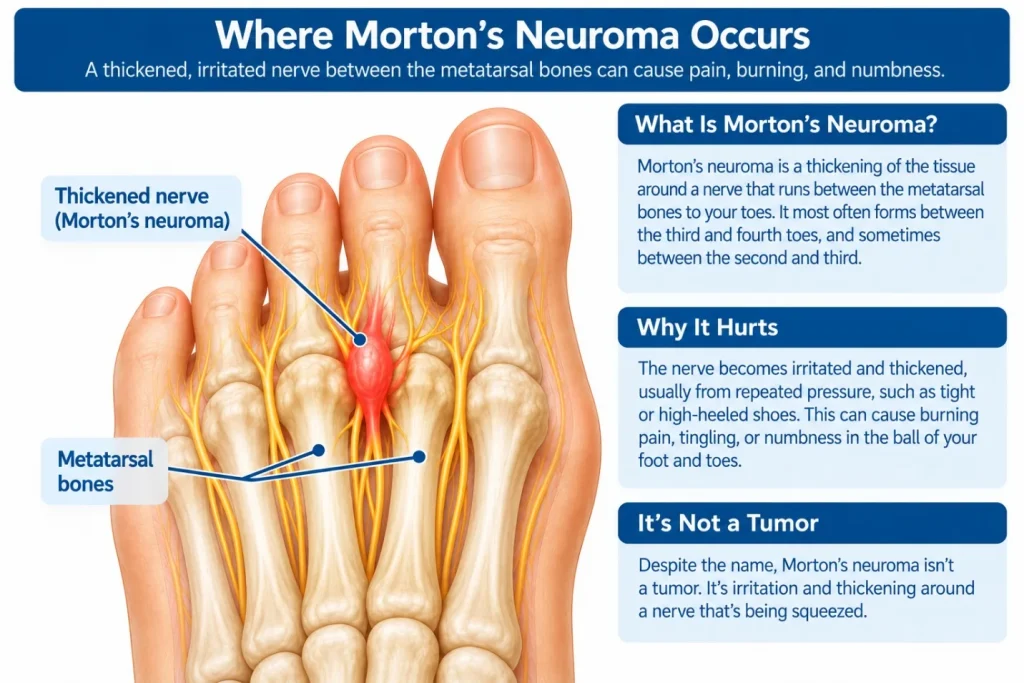
Morton’s neuroma is a thickening of the tissue around a nerve that runs between the bones of your forefoot and toes. It usually forms between the third and fourth toes, and sometimes between the second and third.
Despite the name, it isn’t a tumor. “Neuroma” sounds alarming, but it’s irritation and thickening around a squeezed nerve.
Morton’s neuroma and metatarsalgia both cause ball-of-foot pain, but they’re different problems. Metatarsalgia describes pain in the ball of the foot, often around the metatarsal heads at the base of your toes. Morton’s neuroma specifically involves a nerve between those bones, which is why it often causes burning, tingling, or numbness that can spread into the toes.
What Causes Morton’s Neuroma?
Anything that repeatedly squeezes or irritates the nerve can lead to Morton’s neuroma:
- Tight, narrow, or pointed shoes that press the toe bones together
- High heels, which shift your weight onto the ball of the foot
- High-impact activity, like running, jogging, or court sports
- Foot shape and mechanics, including bunions, hammertoes, flat feet, and high arches
It’s more common in women, likely because of footwear.
Symptoms of Morton’s Neuroma
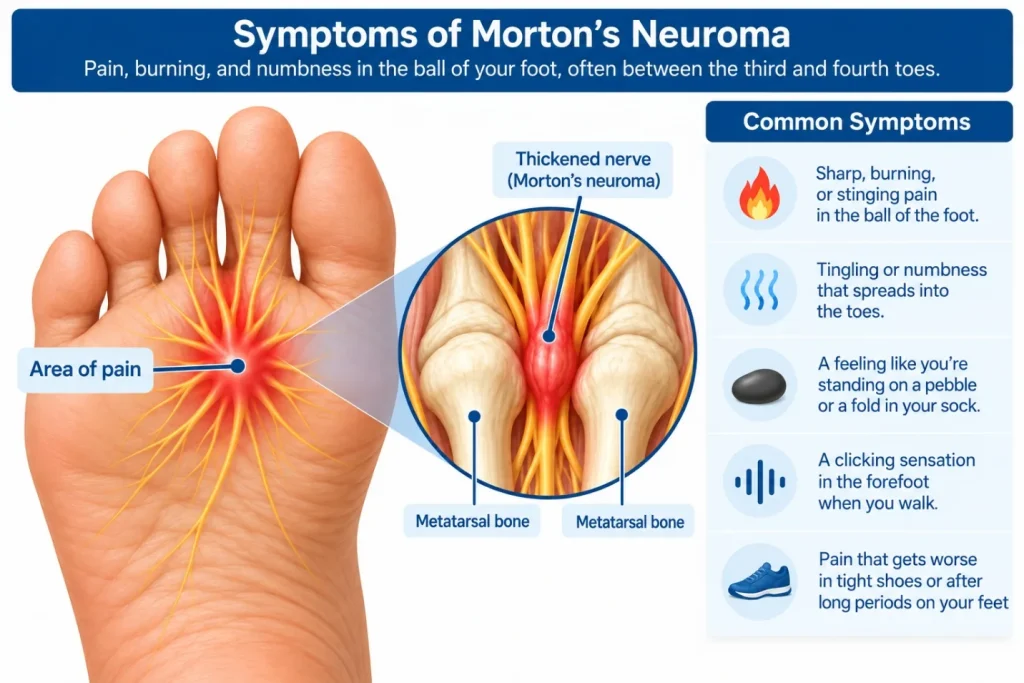
Symptoms often start mild and come and go. Over time, they usually last longer and flare more easily.
- Sharp, burning, or stinging pain in the ball of the foot
- Tingling or numbness that spreads into the toes
- A feeling like you’re standing on a pebble or a fold in your sock
- A clicking sensation in the forefoot when you walk
- Pain that gets worse in tight shoes or after long periods on your feet
“The tell is usually the shoe. People take it off, rub the ball of their foot, and the pain backs off. That’s the nerve getting room. It also tells you where treatment starts: if a tight shoe brought it on, a better shoe is the first part of the fix.”
Dr. Jason Sweeley, DPM, Silver Spring Foot & Ankle
How Is Morton’s Neuroma Diagnosed?
Diagnosis starts with an exam. A podiatrist will press on the spaces between your toe bones to find where it hurts, and may squeeze the forefoot from side to side. This is sometimes called the squeeze test, and the click it can produce is known as Mulder’s click, a common sign of a neuroma.
Imaging helps rule out other problems. An X-ray won’t show a neuroma, but it can rule out stress fractures and arthritis. Ultrasound or MRI can show the thickened nerve when the diagnosis is unclear.
“An MRI can show a thickened nerve in someone who feels nothing. So the scan doesn’t make the diagnosis. Your foot does: where it hurts, what the squeeze test does, and what makes it better or worse.”
Dr. Jason Sweeley, DPM, Silver Spring Foot & Ankle
What Is the Best Treatment for Morton’s Neuroma?
The best treatment depends on how long you’ve had symptoms and how severe they are. Most people start with conservative care.
- Footwear changes. Shoes with a wide toe box and a low heel take pressure off the nerve. For many people, this is the most important change.
- Metatarsal pads. A small pad placed just behind the painful area spreads the toe bones slightly and takes pressure off the nerve.
- Custom orthotics. Orthotics can improve how weight moves across your forefoot, especially if foot shape is part of the problem.
- Activity changes. Cutting back on high-impact activity for a while gives the nerve time to settle.
- Injections. A corticosteroid injection can reduce inflammation around the nerve and ease pain when shoes and padding aren’t enough.
- Newer, less invasive procedures. For persistent pain, options can include alcohol sclerosing injections, radiofrequency ablation, or cryoablation. These aim to calm the irritated nerve without open surgery.
When Is Surgery Necessary?
Most people don’t need surgery. Foot and ankle specialists generally consider it when conservative treatments haven’t provided adequate relief.
The most common procedure is a neurectomy, which removes the affected section of the nerve. Another option releases the tight ligament that presses on the nerve.
“Removing the nerve relieves the pain for most people, but that part of the foot is going to stay numb. That’s a fair trade for some people and not for others, and it’s why surgery comes last, not first.”
Dr. Jason Sweeley, DPM, Silver Spring Foot & Ankle
Symptoms can return after any treatment, including surgery, especially if you don’t change the shoes or activities that caused the problem.
Frequently Asked Questions About Morton’s Neuroma
Can Morton’s Neuroma Go Away on Its Own?
The thickened tissue usually doesn’t disappear, but the pain often improves when you stop putting pressure on it. Early symptoms can settle with better shoes and padding. Without changes, symptoms usually get worse over time.
Does Walking Help or Hurt Morton’s Neuroma?
Walking itself isn’t the problem. Walking in tight, narrow, or high-heeled shoes is. Long walks on hard surfaces can also flare symptoms. In roomy, cushioned shoes, many people can keep walking comfortably.
What Should You Avoid With Morton’s Neuroma?
Avoid tight, narrow, or pointed shoes and high heels, which squeeze the nerve. Thin, flat soles can also be a problem because they leave the ball of the foot unprotected on hard surfaces. A roomy slip-on may feel good around the house, but for all-day wear, choose a wide toe box and good forefoot cushioning.
How Do You Calm a Morton’s Neuroma Flare?
Take off tight shoes and give your foot a break. Gently massage the ball of your foot, ice the area, and switch to roomy, cushioned shoes. A metatarsal pad can also take pressure off the nerve. If flares keep happening, see a podiatrist.
What Is Commonly Mistaken for Morton’s Neuroma?
Several conditions cause similar bottom-of-foot pain, including metatarsalgia, stress fractures, arthritis, inflammation of the joints at the base of the toes, and nerve problems like neuropathy, which can be linked to diabetic feet or vitamin B12 deficiency. That’s why a podiatric exam matters before you start treatment.
What Happens if Morton’s Neuroma Is Left Untreated?
Symptoms often become more frequent and harder to relieve. Burning and numbness may last longer after activity, and shoes that once fit well can start to hurt. Treating it early usually means simpler treatment.
How Painful Is Morton’s Neuroma Surgery?
The procedure is done with anesthesia, so you won’t feel it during surgery. Afterward, soreness and swelling are normal, and recovery time depends on the procedure and how much time you spend on your feet. Your podiatrist will explain what to expect before you decide.
When to See a Podiatrist
Make an appointment if:
- Ball-of-foot pain hasn’t improved after a couple of weeks of wearing roomier shoes
- You have burning, tingling, or numbness in your toes
- Pain is limiting walking, exercise, or work
- You’re not sure whether it’s a neuroma, metatarsalgia, or something else
Looking for Podiatrists in Mechanicsburg, Carlisle, or Harrisburg?
Silver Spring Foot & Ankle can identify the cause of your ball-of-foot pain and recommend the right Morton’s neuroma treatment for you. Schedule an appointment.