
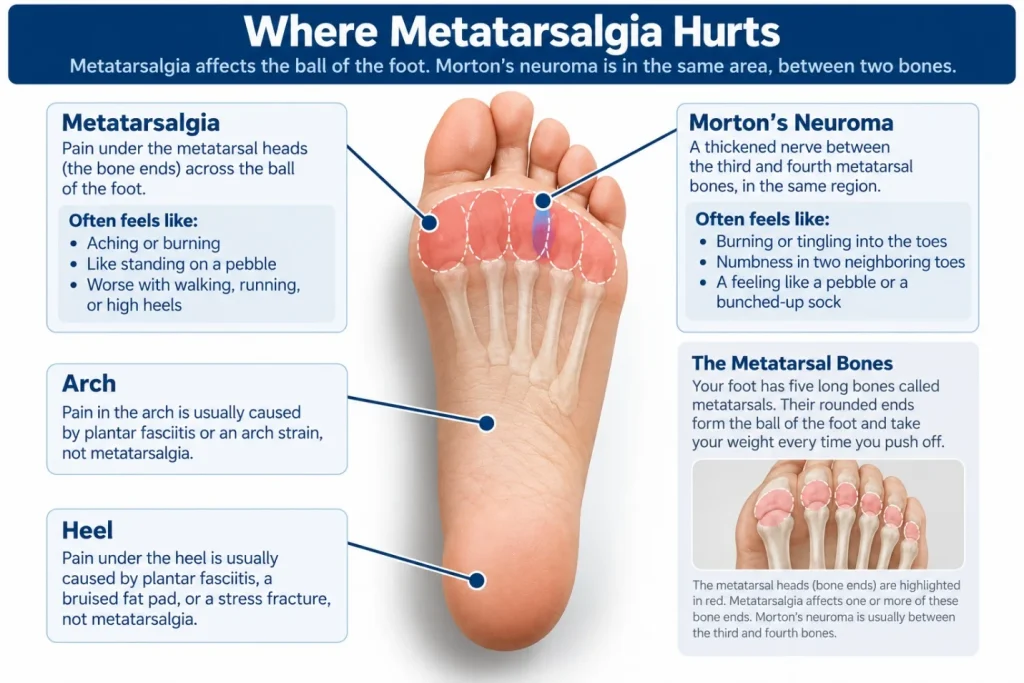
Metatarsalgia is pain in the ball of your foot, the padded area just behind your toes. It happens when the long bones in the front of the foot take more pressure than they can handle. Most people describe it as an ache or a burn, like standing on a pebble. That’s why it’s sometimes called a stone bruise.
At Silver Spring Foot & Ankle, our foot doctors find out why pressure is building in that spot and relieve it. Most cases get better without surgery.
Ready to schedule an appointment? Call (717) 237-9000 or schedule online.
Quick Answers About Metatarsalgia
Metatarsalgia raises many practical questions, especially about how quickly the pain can improve and which activities are safe while your foot heals. Here are quick answers to some of the questions patients ask most often.
| Question | Answer |
|---|---|
| What is metatarsalgia? | Pain and irritation in the ball of the foot caused by excessive pressure on the bones behind the toes. |
| What is the most common cause? | Overload. High-impact activity, thin or narrow shoes, and high heels all push extra force onto the ball of the foot. |
| What is the fastest way to get relief? | Take pressure off the spot. Rest from impact, switch to cushioned shoes with a wide toe box, and use a metatarsal pad. |
| Is walking good for metatarsalgia? | Easy walking in cushioned shoes is usually fine. Long walks, hard floors, and bare feet make it worse. |
| How long does it take to heal? | It depends on the cause. Many cases improve within weeks once the pressure is relieved. |
| What can be mistaken for metatarsalgia? | Morton’s neuroma and stress fractures are the most common look-alikes. |
| What kind of doctor treats metatarsalgia? | A podiatrist, a doctor who specializes in the foot and ankle. |
What Is Metatarsalgia?
Your foot has five long bones called metatarsals. They run from the middle of the foot to the base of each toe, and their rounded ends form the ball of the foot. Every time you push off to take a step, your body weight rolls across those five bone ends.
Metatarsalgia develops when one or more of them bear too much load. The joint, the surrounding tissue, and the skin beneath it become irritated and sore. It most often affects the second, third, and fourth bones in the middle of the ball of the foot.
It can affect one or both feet and tends to develop slowly.
Who Gets Metatarsalgia?
Metatarsalgia is common. Estimates vary across studies, but published research puts it at about 1 in 10 adults. It shows up most often in three groups:
- Runners and other athletes. Running, jumping, and dancing repeatedly load the ball of the foot.
- Women who wear high heels or narrow shoes. Both push weight onto the front of the foot and squeeze the bones together.
- Older adults. The fat pad under the ball of the foot thins with age, leaving the bones with less cushioning.
Why Metatarsalgia Matters
Ball-of-foot pain is easy to put up with at first. You shift your weight, change shoes, and keep going. The trouble is what happens when the pressure stays.
Left untreated, metatarsalgia can:
- Change the way you walk. Limping to protect the ball of the foot can lead to pain in the other foot, knee, hip, or lower back.
- Build up painful corns and calluses. Skin thickens where a bone presses down.
- Damage the toe joint. Ongoing overload can strain the ligament under the joint. Over time, the toe may drift or curl into a hammertoe.
- Hide another problem. A stress fracture or a pinched nerve can feel like metatarsalgia early on.
What Causes Metatarsalgia?
Anything that puts extra force on the ball of the foot or concentrates it on a single bone can cause metatarsalgia. Usually it’s more than one thing at once.
- High-impact activity. Running and jumping load the front of the foot hard, especially after a quick increase in training.
- Shoes. High heels shift your weight forward. Narrow toe boxes squeeze the bones together. Thin or worn-out soles no longer absorb shock.
- Foot shape. A high arch puts more weight on the ball of the foot. So does a second toe that’s longer than the big toe.
- Toe problems. A bunion moves weight off the big toe and onto the smaller bones. A hammertoe pushes the bone beneath it down toward the ground.
- Tight calf muscles. A tight calf lifts the heel earlier and shifts weight forward sooner in each step.
- A thinning fat pad. The cushion under the ball of the foot gets thinner with age.
- Extra body weight. More weight means more force with every step.
- Long hours on hard floors. Standing and walking on concrete all day adds up, whether that’s a warehouse in Carlisle or a hospital floor in Harrisburg.
What Is a Dropped Metatarsal?
A dropped metatarsal is a bone end that sits lower than the ones beside it, so it takes more of the load. The signs are pain under one specific spot and, often, a callus directly beneath it. It’s a structural cause of metatarsalgia, and it usually responds to padding and custom-fit orthotics.
Metatarsalgia Symptoms
Metatarsalgia usually comes on gradually over weeks or months. Common symptoms include:
- An ache, sharp pain, or burning in the ball of the foot
- A feeling that there’s a pebble or a wadded-up sock in your shoe
- Pain that’s worse when you stand, walk, or run, and better when you rest
- Pain that’s worse barefoot, especially on hard floors
- Pain when you flex your toes or push off
- A callus under the sore spot
What Can Be Mistaken for Metatarsalgia?
Several other problems cause pain in the same small area, and each one is treated differently.
| Condition | Where It Hurts | What Sets It Apart |
|---|---|---|
| Metatarsalgia | Under the ball of the foot | Ache or burn, like standing on a pebble |
| Morton’s neuroma | Between the third and fourth toes | Burning, tingling, or numbness that shoots into the toes |
| Stress fracture | One precise spot on a bone | Swelling on top of the foot, pain that keeps getting worse |
| Joint capsule injury | Under the base of the second toe | Swelling and a toe that starts to drift or lift |
| Sesamoid pain | Under the big toe joint | Hurts when the big toe bends upward |
| Plantar wart | Anywhere on the sole | Rough spot with tiny black dots |
How We Treat Metatarsalgia
Treatment has one goal: take the extra pressure off the ball of the foot and keep it off. Most people improve without surgery.
How Metatarsalgia Is Diagnosed
Diagnosis starts with an exam. A foot doctor presses on each bone end to find the sore one, checks for calluses, and looks at your foot shape, your toes, and the way you walk. Squeezing the forefoot helps tell metatarsalgia from a pinched nerve.
An X-ray can rule out a stress fracture and show the length and position of the bones. Ultrasound or MRI is sometimes used if the diagnosis isn’t clear.
Metatarsalgia Treatment Options
Treatment for metatarsalgia focuses on reducing pressure on the ball of the foot and addressing the underlying cause of the overload. Most cases improve with conservative treatment, starting with a few simple changes.
- Activity changes. Cutting back on running and jumping lets the irritated tissue settle. Cycling and swimming keep you moving in the meantime.
- Footwear changes. Cushioned soles, a wide toe box, and a low heel take pressure off right away.
- Metatarsal pads. A small pad placed just behind the ball of the foot spreads the load across a wider area.
- Custom-fit orthotics. An insert made for your foot shifts weight away from the overloaded bone. It’s often the next step when foot shape is part of the cause.
- Callus care. Trimming a thick callus removes a source of pressure and pain.
- Stretching and strengthening. Loosening tight calves and strengthening the small muscles of the foot improve how weight moves through the foot.
- Anti-inflammatory medicine. Short-term use can ease pain and swelling. It doesn’t fix the pressure.
- Injections. In some cases, an injection can calm inflammation that hasn’t responded to other treatments.
- Surgery. Surgery is rarely needed. It’s considered when a bone or toe problem continues to cause pain after months of other treatments.
Our foot doctors will walk you through the options that fit your foot and your activity level.
Metatarsalgia Self-Care
Home care works for many mild cases, and it supports any treatment plan. The aim is the same as in the office: less pressure on the ball of the foot.
Metatarsal Pads: Where They Go Matters
A metatarsal pad is a small, teardrop-shaped cushion that sits inside your shoe. It’s easy to put it in the wrong place.
The pad goes just behind the ball of the foot, not under the sore spot. Placed there, it lifts and spreads the bones so the painful one carries less weight. A pad placed directly under the sore spot adds pressure and can worsen the pain.
To place one, find the sore spot, then set the pad so its front edge ends just short of it. It may feel odd for a day or two. If it hurts, move it back slightly.
Shoes and Insoles for Metatarsalgia
The right shoe does more than any other single change. Look for:
- A wide toe box so the bones in the front of the foot can spread
- Thick, cushioned soles that absorb shock
- A low heel to keep weight off the ball of the foot
- A stiff or rocker-shaped sole that rolls you forward so your toes bend less at push-off
A cushioned insole with a built-in metatarsal pad helps many people. If over-the-counter insoles don’t bring relief, custom-fit orthotics are the next step.
Can You Walk or Run With Metatarsalgia?
Walking is usually fine if you keep it comfortable. Wear cushioned shoes, avoid walking barefoot on hard floors, and shorten your walks if the pain builds.
Running is harder on it. Take a break from running and jumping until you can walk without pain, then build back slowly. Pain in one precise spot that gets sharper as you run could be a stress fracture, and you should stop until it’s been checked.
Metatarsalgia Exercises
Gentle stretching and strengthening can help reduce stress on the ball of the foot and improve how your foot handles pressure. These exercises are a good place to start.
- Calf stretch. Stand facing a wall with one leg back, heel down, and lean in until you feel a stretch in the calf. Hold for 30 seconds and repeat a few times a day.
- Towel curls. Sit with a towel flat on the floor and scrunch it toward you with your toes. This strengthens the small muscles that support the ball of the foot.
- Toe spreads. Spread your toes apart, hold for a few seconds, and relax.
Skip any exercise that makes you rise onto the balls of your feet until the pain has settled.
What Else Helps
A few additional habits can reduce pain while the ball of your foot recovers and help prevent pressure from building up again.
- Ice the ball of the foot for 15 to 20 minutes after activity, with a cloth between the ice and your skin.
- Don’t go barefoot on hard floors, even at home.
- Rest your feet after long periods of standing.
How Long Does Metatarsalgia Take to Heal?
It depends on what’s causing it and how long it’s been going on. When the cause is simple, like a hard training stretch or the wrong shoes, the pain often eases within a few weeks of taking the pressure off.
When foot shape or a toe problem is the cause, the pain tends to return until it’s addressed. Those cases take longer and usually require orthotics or other treatments to improve.
When to See a Foot Doctor for Metatarsalgia
Make an appointment if:
- The pain hasn’t improved after two weeks of rest and better shoes
- It keeps coming back
- The ball of the foot is swollen, or one spot on a bone is very tender
- You have burning, tingling, or numbness in your toes
- A toe is changing position
- You’re limping or can’t put full weight on the foot
- You have diabetes and any new foot pain or callus
“Metatarsalgia isn’t really a diagnosis. It’s a description of where it hurts. What I want to know is which bone is overloaded and what’s sending the pressure there, because that’s what the treatment has to change.”
Podiatrist Dr. Jason Sweeley, DPM, Silver Spring Foot & Ankle
Metatarsalgia FAQs
What Causes Metatarsalgia to Flare Up?
Flare-ups usually follow a jump onto the ball of the foot. Common triggers include a long day on hard floors, returning to running, high heels, thin-soled shoes, and going barefoot.
What Can I Do for Immediate Relief From Metatarsalgia Pain?
Get off your feet, ice the ball of the foot for 15 to 20 minutes, and switch to your most cushioned shoes. A metatarsal pad placed just behind the sore spot often helps the same day.
Is It Good to Massage Metatarsalgia?
Gentle massage of the arch and calf can loosen tight tissue and feel good. Avoid applying deep pressure directly to the sore spot, as it can further irritate it.
What Is the Best Anti-Inflammatory for Metatarsalgia?
No single one works best for everyone. Over-the-counter options like ibuprofen or naproxen can ease pain for a few days. Check with your doctor or pharmacist first if you take other medicines or have stomach, kidney, or heart problems.
How Do You Test for Metatarsalgia?
There’s no single test. A foot doctor diagnoses it with an exam, pressing on each bone end and checking how your foot carries weight. An X-ray may be taken to rule out a stress fracture.
Is Metatarsitis the Same as Metatarsalgia?
People use both words for pain in the ball of the foot. Metatarsalgia is the medical term.
Metatarsalgia Treatment in Mechanicsburg, Carlisle, and Harrisburg
You shouldn’t have to walk around the pain in the ball of your foot. If you’re looking for a podiatrist in Mechanicsburg, Carlisle, or Harrisburg, Silver Spring Foot & Ankle can find what’s overloading it and take the pressure off. Schedule an appointment or call (717) 237-9000.