
If you’re staring at a thick, yellow, crumbling toenail wondering how to actually make it go away, you’ve probably already discovered the frustrating part: everyone online has a “cure,” and most of them don’t work. So how do you get rid of toenail fungus?
We’ll give you a straight answer to the questions you’re actually asking. What gets rid of toenail fungus? What’s a waste of time? And when is it worth seeing a local podiatrist near you instead of buying one more bottle of something?
Quick Answers About How to Get Rid of Toenail Fungus
| Question | Short answer |
| What kills toenail fungus the fastest? | Oral antifungal prescriptions are generally the most effective treatment for confirmed fungal infections. |
| Will it go away on its own? | No. Fungal nails rarely clear without treatment. |
| Do home remedies work? | A few show modest results in mild cases; most don’t. |
| Do OTC treatments work? | Sometimes, especially for mild, early infections. But many “nail renewal” products improve appearance without treating the fungus. |
| Does Vicks VapoRub work? | Limited — some improvement in small studies, not a reliable cure. |
| How long does treatment take? | Months. A toenail takes 9–12 months to grow out completely. |
| Is that yellow nail even fungus? | Not always — trauma and psoriasis can look identical. |
What Kills Toenail Fungus the Fastest?
The fastest, most reliable way to get rid of a toenail fungus infection is prescription oral antifungal medication — usually terbinafine. It works from the inside as the nail grows, and clinical reviews show it has the highest cure rates of any treatment.
“Fastest,” though, is relative. Even with the most effective medication, it’s not a quick fix. The fungus can be killed within weeks to months. But the damaged nail has to grow out and be replaced by a healthy nail, and toenails grow slowly. That’s true, no matter what treatment you use. That’s why anything promising to “cure toenail fungus instantly” is selling you something.
If a quick, complete cure existed, no one would have this problem for years. They do, because it doesn’t.
“The question I get most is ‘What’s the fastest way to fix this?’ And the honest answer is that the fungus and the nail are two different timelines. We can start killing the fungus right away, but you’re watching a new nail grow in over months. Setting that expectation up front saves people a lot of frustration and a lot of money spent on products that promise overnight results.”
— Podiatrist Dr. Jason Sweeley, DPM, Silver Spring Foot & Ankle
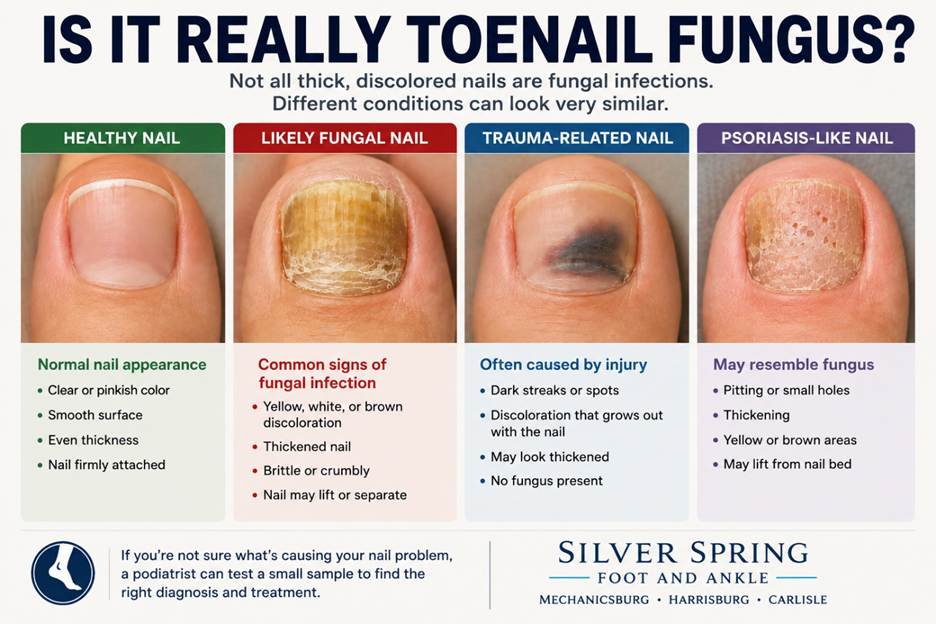
Is It Really Toenail Fungus?
Before you spend a dollar treating fungus, ask whether fungus is actually the problem. It’s a common mistake.
A thick, discolored, or crumbling toenail may indicate a fungal infection. But several other things cause the same appearance:
- Nail trauma. Stubbing a toe or repeated pressure from shoes (common in runners) can thicken and discolor a nail, even without fungus.
- Psoriasis. Nail psoriasis can mimic fungal infection almost perfectly, including pitting, thickening, and separation from the nail bed.
- Other nail conditions. Bacterial infection, aging changes, and certain rarer conditions can all resemble onychomycosis.
It matters because antifungal treatment does nothing for a non-fungal nail. People spend months applying antifungal products to a nail that was never infected, then conclude “nothing works.” But the real issue was the diagnosis.
That’s why a podiatrist will often confirm the infection with a simple nail sample or culture before committing you to months of treatment. Knowing what you’re actually dealing with is the difference between treatment that works and treatment that can’t.
“One of the biggest mistakes I see is people treating a discolored or thickened toenail for fungus without ever confirming that fungus is the problem. A quick test tells us whether we’re even fighting the right thing. Otherwise, you can spend a year on a treatment that was never going to work because there was no fungus there to begin with.”
— Podiatrist Dr. Jason Sweeley, DPM, Silver Spring Foot & Ankle.
What Does Toenail Fungus Actually Look Like?
Assuming it is fungal, here’s what onychomycosis typically looks like:
- Discoloration, including whitish, yellow, or brownish patches, sometimes cloudy or streaky
- Thickening of the nail
- Brittle, crumbly, or flaky texture
- Shape changes or a nail that looks distorted
- Separation of the nail from the nail bed underneath
It usually starts at the front or side edge of the nail and works its way back. The big toenail is the most commonly affected. Pain isn’t usually an early symptom, which is part of why people leave it so long.
How Do You Get Toenail Fungus?
Fungal nails are usually caused by the same dermatophyte fungi responsible for athlete’s foot. In fact, nail fungus often starts as athlete’s foot that spreads to the nail. The fungus gets in through tiny cracks in the nail or the surrounding skin.
Common ways it takes hold:
- Walking barefoot in locker rooms, communal showers, or around pools
- Sweaty feet in tight, non-breathable shoes
- Athlete’s foot that was never fully treated
- Nail trauma that creates an opening
- Shared nail clippers or unsanitized tools
Some people are more prone to it. Risk rises with age and is higher for people with diabetes, circulation problems, a weakened immune system, or a family history of fungal nails.
Toenail fungus is more common than most people realize. General-population estimates run from roughly 3% to 12%, but they climb steeply with age. About 1 in 5 people over 60 have it, and up to half of people over 70 do.
Will Toenail Fungus Go Away on Its Own?
No. Fungal nail infections rarely resolve on their own. Left untreated, they tend to persist or slowly spread to other nails.
Waiting doesn’t help. It can make treatment harder. The more of the nail that’s involved, and the longer the fungus has been established, the lower your odds with any treatment. Early, smaller infections are genuinely easier to clear. That’s the strongest argument for not ignoring it.
What Happens If You Leave the Fungus Untreated?
For an otherwise healthy person, an untreated fungal nail usually isn’t dangerous, but it isn’t harmless either. Over time, it can:
- Spread to other toenails
- Thicken enough to make wearing shoes or walking uncomfortable
- Cause the nail to crumble or detach
- Spread the underlying fungus back to the skin as recurring athlete’s foot
For people with diabetes, poor circulation, or a weakened immune system, the stakes are higher. In those cases, a fungal nail can crack the surrounding skin, opening the door to a more serious bacterial infection. If you’re in that group, see a podiatrist promptly rather than treating it as a cosmetic nuisance.
Do Over-the-Counter Treatments Work?
Sometimes for mild, early infections. Often not for anything more established. It’s worth understanding that before you spend months and a fair amount of money on the foot-care aisle.
The core issue is structural. The fungus lives within and beneath the nail plate. Most OTC products struggle to penetrate that thick, hard nail at a high enough concentration to reach it.
That’s the same wall prescription topicals run into. It’s just steeper for OTC formulas. Generally, OTC treatments have the best chance of success when:
- Only one or two nails are affected
- The infection is near the tip or surface
- The nail bed underneath still looks healthy
Once the fungus is deep, thick, or across multiple nails, OTC products rarely clear it on their own.
Classification of OTC Products
It also helps to know that the products on the shelf fall into two very different categories, because the labels don’t always make it obvious.
Actual OTC Antifungals
These contain a real antifungal drug, most commonly undecylenic acid (in products like Fungi-Nail and FungiCure) or tolnaftate. Sometimes they include OTC clotrimazole or terbinafine creams.
Undecylenic acid is a common active ingredient in OTC antifungal products. It’s fungistatic, so it stops the fungus from growing rather than reliably killing an established infection.
These are genuinely useful for athlete’s foot and for early, superficial nail involvement. They also help treat the skin fungus that often re-seeds the nail. What they don’t do well is cure a deep-seated nail infection.
“Nail Renewal” Cosmetic Products
Here’s the part that trips people up. Some best-selling products, such as Kerasal, are not antifungal drugs. They use ingredients like urea, lactic acid, and propylene glycol to soften, thin, and lighten the nail.
They can genuinely improve the look of the nail within a couple of weeks. That’s why people assume they’re working, but they don’t get rid of the toenail fungus. If you stop before a healthy nail has grown in, the appearance often reverses.
“Patients come in all the time saying a product ‘stopped working.’ When we look closer, it was never an antifungal. It was a cosmetic product that made the nail look better while the fungus continued to spread underneath. Reading the active ingredient matters. If there isn’t an actual antifungal in it, it’s treating the appearance, not the infection.”
— Podiatrist Dr. Jason Sweeley, DPM, Silver Spring Foot & Ankle
None of this makes OTC products worthless. For a minor, early infection, a real OTC antifungal used consistently for months is a reasonable first try. The trap is spending six months, a discolored nail, and a stack of receipts before realizing the product was never reaching the fungus. Or worse, that it was never an antifungal in the first place.
Here’s a good self-imposed rule. If there’s no clear new growth from the base after about three months of daily, consistent use, stop guessing and see a podiatrist to get rid of the toenail fungus.
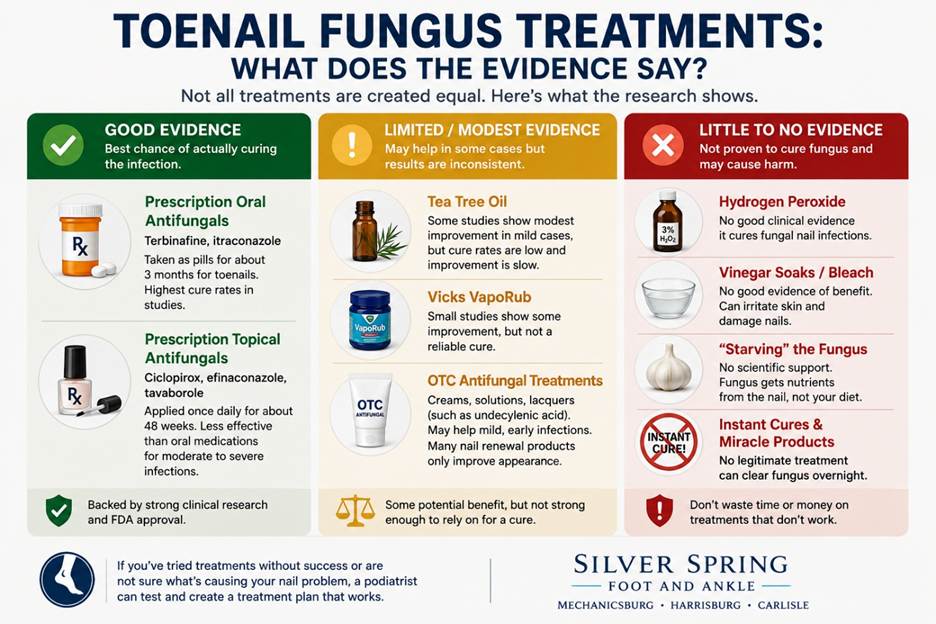
Toenail Fungus Remedies: What Works, What Might Help, and What Doesn’t
Here’s how the most-searched options stack up against the clinical evidence.
Good Evidence for Curing Toenail Fungus
These treatments have the strongest clinical evidence for actually clearing a fungal nail infection. They don’t work overnight, and results vary, but they’re the options most likely to clear toenail fungus rather than improve the nail’s appearance.
Prescription oral antifungals (terbinafine, itraconazole)
The most effective option, with the highest cure rates in head-to-head reviews. Taken as pills over about 3 months for toenails. Your doctor may check liver function because side effects are possible, which is why these are prescription-only.
Prescription topical antifungals (ciclopirox, efinaconazole, tavaborole)
Applied directly to the nail, typically once daily for about 48 weeks. These are the three topical treatments FDA-approved for toenail fungus in the U.S.
They’re less effective than oral medication for moderate-to-severe cases because they have to penetrate the nail to reach the infection. But they’re a reasonable option for mild infections or for people who can’t take oral antifungals.
Limited or Modest Evidence for Curing Toenail Fungus
These remedies have shown some antifungal activity or improvement in small studies, but the evidence is limited. They may help in some cases. But results are inconsistent, and they should not be considered reliable treatments for curing toenail fungus.
Tea tree oil
The best-studied home remedy. A randomized trial found that 100% tea tree oil produced results comparable to those of a topical antifungal cream. But even then, mycological cure was only about 18%, and improvement was slow. The evidence isn’t strong enough to consider it a reliable treatment.
Vicks VapoRub
A small pilot study of 18 people found that daily application produced some clinical improvement in most participants, with complete cure in roughly a quarter.
The active ingredients (thymol, menthol, eucalyptus) do have antifungal activity in the lab. But the evidence is thin, results are slow and partial, and much of the visible “improvement” may be cosmetic rather than a true cure. Not enough to consider it a dependable treatment for getting rid of toenail fungus.
OTC antifungal products
Best for mild, early, or surface-level infections. They have limited efficacy against established ones. See the section above for how to tell a real OTC antifungal from a cosmetic “nail renewal” product.
Little to No Evidence
These remedies are popular online, but little to no clinical evidence shows they can cure toenail fungus. Some may temporarily improve the nail’s appearance. But that isn’t the same as eliminating the fungal infection.
Hydrogen peroxide, vinegar soaks, and bleach
Popular online, poorly supported. These may superficially clean or lighten a nail. However, no strong clinical evidence shows they cure a fungal nail infection. Plus, aggressive use can irritate the skin.
“Starving” the fungus
No diet or trick starves toenail fungus out of your body. The fungus feeds on keratin in the nail itself. You can’t cut off its food supply by changing what you eat.
Everything that promises an instant or overnight cure
No treatment works instantly. The nail has to grow out regardless.
What Not to Do With Toenail Fungus
A few common moves that make things worse rather than better:
- Don’t dig or scrape aggressively under the nail. You can injure the nail bed and create new openings for infection.
- Don’t cut away large amounts of nail yourself, especially if you have diabetes or neuropathy. A small wound can become a serious problem.
- Don’t share clippers or files, which spreads fungus between nails and between people.
- Don’t ignore athlete’s foot. Leaving the skin infection untreated keeps re-seeding the nail.
- Don’t stop prescription treatment early because the nail “looks better.” The visible nail is lagging; quitting early invites recurrence.
- Don’t assume every yellow nail is fungus. Have a podiatrist confirm it.
Should You Cut the Nail Off?
Removing the whole nail yourself isn’t a fix and can cause real harm, especially if you have diabetes or circulation issues. In some severe or stubborn cases, a podiatrist may remove part or all of a nail as part of treatment. But that’s a clinical decision made in a controlled setting, not something to attempt at home with clippers.
How a Podiatrist Treats Toenail Fungus
When home and OTC options have failed, a podiatrist can offer things you can’t do yourself:
- Confirm the diagnosis with nail sampling or culture, so you’re treating the right condition
- Prescription oral or topical antifungals matched to your infection and health history
- Professional debridement that thins and reduces the thickened nail to reduce discomfort and help topical treatments work better
- Combination approaches for stubborn cases
- Realistic expectations and monitoring over the months it takes to grow out
The right diagnosis, the right medication, and someone tracking whether it’s actually working make a difference.
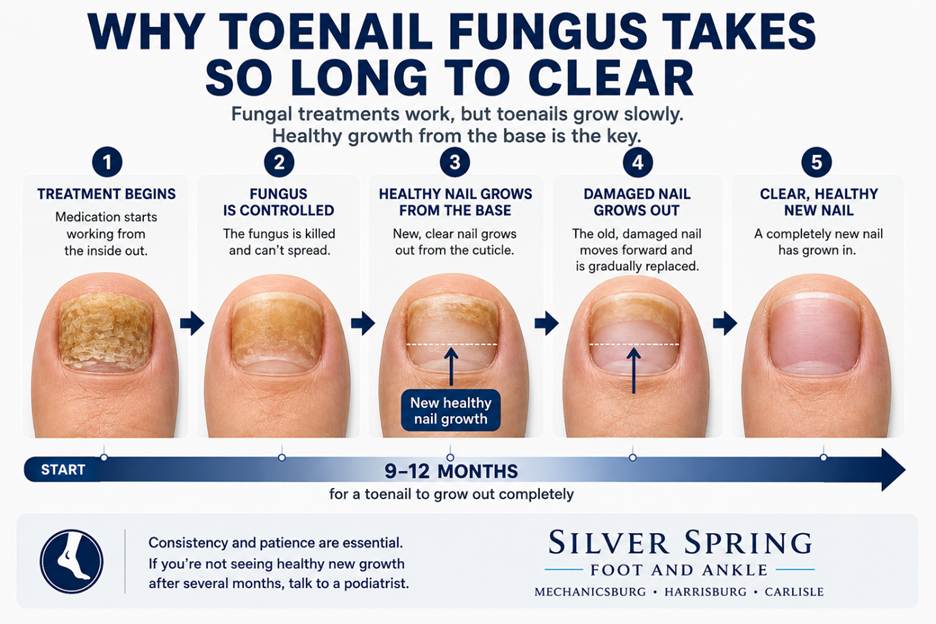
How Long Does It Take to Get Rid of Toenail Fungus?
Plan for several months to a full year. Two separate clocks are running:
- The time to kill the fungus (weeks to months, depending on treatment)
- The time for a healthy nail to grow in and replace the damaged one
Toenails grow slowly — a big toenail can take 9 to 12 months to regrow fully.
One more note. Even after successful treatment, the nail may not look completely normal again if the nail bed was affected. The goal is to clear the infection; a perfectly cosmetic nail isn’t always achievable.
Can the Fungus Come Back?
Yes — recurrence is common. Clearing the infection once doesn’t make you immune to getting it again. Reducing the odds comes down to a few habits:
- Keep your feet clean and thoroughly dry, especially between the toes
- Treat athlete’s foot promptly and completely
- Change socks when they get damp; rotate your shoes so they can dry out
- Wear sandals or flip-flops in locker rooms, communal showers, and around pools
- Disinfect or replace footwear after an infection, and sanitize nail tools
- Don’t share clippers, files, or shoes
When to See a Podiatrist for Toenail Fungus
It’s worth booking an appointment if:
- Home and OTC treatments haven’t worked after a few months
- More than one nail is affected, or a lot of the nail is involved
- The nail is painful or thick enough to make shoes uncomfortable
- You have diabetes, poor circulation, or a weakened immune system (don’t wait on this one)
- You’re not sure it’s even fungus and want a real diagnosis
A podiatrist can tell you what you’re actually dealing with. They can put you on a treatment that has a real chance of working instead of another year of guessing.
Toenail Fungus Treatment in Mechanicsburg
Silver Spring Foot & Ankle treats fungal nail infections for patients across the West Shore and greater Harrisburg area, including Mechanicsburg, Camp Hill, Lemoyne, Carlisle, and communities throughout Cumberland, Dauphin, and Perry Counties. If you’ve been fighting a stubborn toenail on your own, an evaluation with Podiatrist Dr. Jason Sweeley, a foot and ankle specialist, is the fastest way to find out what will actually get rid of the toenail fungus.
Frequently Asked Questions About Toenail Fungus
What kills toenail fungus the fastest?
Prescription oral antifungal medication (usually terbinafine) is the fastest, most effective option and has the highest cure rates. But no treatment is truly fast. Even after the fungus is killed, the damaged nail takes months to grow out and be replaced.
Will toenail fungus go away on its own?
No. Fungal nail infections rarely clear without treatment and tend to persist or spread. Because early infections are easier to treat, waiting usually makes things harder, not better.
Does Vicks VapoRub work on toenail fungus?
There’s limited evidence. A small study found that daily use improved most participants and cured about a quarter. Its ingredients have antifungal activity. But results are slow and partial, and the evidence isn’t strong enough to consider it a reliable cure.
Do over-the-counter toenail fungus treatments work?
Sometimes, for mild or early infections limited to one or two nails with a healthy nail bed underneath. They’re much less effective once the fungus is thick, deep, or across several nails, because they struggle to penetrate the nail.
It also helps to know that some popular “nail renewal” products (like Kerasal) aren’t antifungals. They improve the nail’s appearance but don’t kill the fungus. If you don’t see new clear growth after about three months of consistent use, see a podiatrist.
Does hydrogen peroxide get rid of nail fungus?
There’s no good clinical evidence that hydrogen peroxide cures a fungal nail infection. It may superficially clean or lighten the nail, but it doesn’t reliably eliminate the fungus. Aggressive use can irritate the skin.
Can you starve toenail fungus?
No. No diet or trick starves out toenail fungus. It feeds on keratin in the nail itself, so changing what you eat won’t remove its food supply.
Should I cut my toenail off if it has fungus?
No — don’t remove the nail yourself, especially if you have diabetes or circulation problems. It can cause injury and infection. A podiatrist may remove part or all of a nail in certain severe cases, but that’s a clinical decision, not a home remedy.
How long does it take to get rid of toenail fungus?
Usually several months to a year. The fungus can be killed in weeks to months, but the nail has to grow out and be replaced by a healthy nail. A big toenail can take 9 to 12 months to regrow fully.
What happens if you leave toenail fungus untreated?
It can spread to other nails, thicken, become uncomfortable, and keep re-seeding athlete’s foot on the skin. For people with diabetes, poor circulation, or weakened immunity, an untreated fungal nail carries a higher risk of a more serious skin infection.
