
You finished the run. You stretched, you cooled down, you felt good. Then the next morning, or maybe right after you stopped, your foot reminded you that something isn’t right. Foot pain after running is one of the most common complaints I see as a podiatrist at Silver Spring Foot & Ankle.
It makes sense why. About 50 million Americans run regularly, and studies estimate that at least half of them sustain an injury each year. The foot and ankle absorb the brunt of that repetitive stress with every stride.
The tricky part is that different problems feel different, show up in different spots, and respond to different treatments. Your feet have numerous parts: 26 bones, 33 joints, and more than 100 muscles, tendons, and ligaments. So knowing what you’re dealing with is the first step toward actually fixing it.
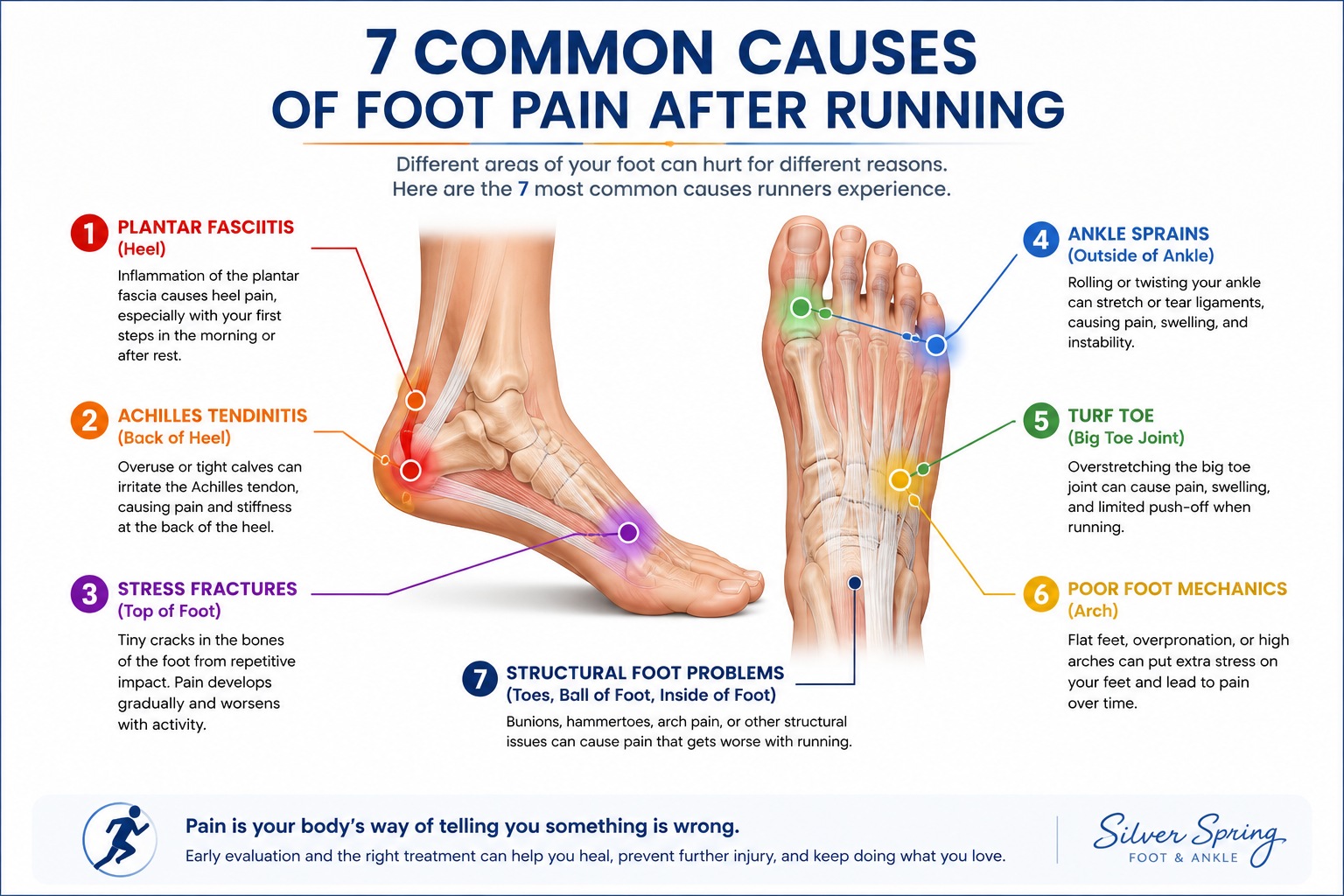
Here are the seven most common causes of foot pain after running, and what each one means for your training.
1. Plantar Fasciitis
Where it hurts: Bottom of the heel
Plantar fasciitis is the most common cause of heel pain in runners. It develops when the plantar fascia, a thick band of tissue that runs along the bottom of the foot, becomes inflamed from repeated overloading.
The signature symptom is sharp, stabbing heel pain with the first steps in the morning. It often eases up after you’ve been moving for a few minutes, then returns after a long run or a period of sitting. If that pattern sounds familiar, plantar fasciitis is a very likely culprit.
Tight calves are one of the biggest contributing factors. Flat feet, high arches, sudden mileage increases, and worn-out shoes are also common drivers.
The most important thing runners get wrong about plantar fasciitis is that they keep running through it. The pain often eases mid-run. So you can be fooled into thinking that’s progress. It isn’t.
The tissue is being repeatedly re-irritated. The condition generally becomes harder to treat the longer it’s left untreated.
2. Achilles Tendinitis
Where it hurts: Back of the heel, above the heel bone
The Achilles tendon connects the calf muscles to the heel bone. It absorbs enormous force with every stride. When it’s pushed beyond its ability to recover, it becomes inflamed and painful.
Achilles tendinitis typically produces stiffness and pain at the back of the heel that’s worst in the morning and after runs. It’s especially common in runners who’ve recently increased their mileage, added hill training, or changed their footwear.
Here’s something most runners don’t know. What looks like Achilles tendinitis is sometimes actually Achilles tendinosis, a degeneration of the tendon tissue rather than inflammation. They feel similar, but they respond differently to treatment. Getting the right diagnosis by a podiatrist from the start saves a lot of wasted time.
If you feel a sudden, sharp pop or crack in the back of your heel during a run, stop immediately and have a foot doctor evaluate you. That pop can indicate a tendon rupture, a more serious injury that needs prompt attention.
3. Stress Fractures
Where it hurts: Top of the foot, specific bone locations
A foot stress fracture is a tiny crack in a bone caused by repetitive impact rather than a single traumatic event. The foot’s metatarsal bones, the long bones running from your midfoot to your toes, are the most commonly affected in runners.
The hallmark pattern is foot pain that gradually builds over multiple runs and worsens with continued activity, with no memory of a specific injury. Pressing directly on the painful bone often reproduces the exact pain. Swelling on the top of the foot is common.
Stress fractures don’t always show up on X-rays early on. If you have the classic pattern of symptoms and a normal X-ray result, that doesn’t mean nothing is wrong. MRI is much more sensitive and can detect a stress fracture before it shows up on X-ray.
The biggest mistake with stress fractures is running through them because the pain isn’t severe enough to stop. A partial crack that’s allowed to progress can become a complete fracture. At that point, treatment becomes significantly more complicated and recovery much longer.
4. Ankle Sprains
Where it hurts: Outside of the ankle
Ankle sprains in runners aren’t always the dramatic roll-and-fall variety. Trail runners, in particular, deal with subtle ankle sprains from navigating uneven terrain. Maybe it’s a slight misstep on a root, a rock, or a divot that loads the ankle ligaments wrong without necessarily sending them to the ground.
Mild sprains can feel like general ankle soreness after a run that improves with rest. Patients sometimes mistake them for muscle fatigue and don’t have a foot doctor evaluate them. That’s where the trouble starts.
An ankle sprain that isn’t properly treated doesn’t fully heal. The ligaments remain slightly lax, the joint is less stable, and the same ankle is now significantly more likely to sprain again. Chronic ankle instability develops this way: one undertreated sprain at a time.
If your ankle feels like it gives way occasionally during runs or daily activity, that’s a sign of chronic instability, not just general weakness. It warrants evaluation and a rehabilitation plan, not just more rest.
5. Turf Toe
Where it hurts: Base of the big toe
Turf toe is a sprain of the joint at the base of the big toe. Despite the name, it doesn’t only happen on artificial turf. It can occur on any surface when the big toe is forcibly bent upward during push-off. Sprinters, trail runners, and anyone running on hard or high-traction surfaces can develop it.
The main symptoms are pain and swelling at the base of the big toe, especially with push-off. The big toe joint is involved in every single step. Even a moderate sprain significantly affects running mechanics.
Turf toe is graded by severity, and that grade determines the treatment approach and recovery timeline. A Grade 1 sprain, when managed properly, often resolves within a week or two. A Grade 3 that’s ignored and run through can mean months of recovery.
Not every running injury is a separate condition. Sometimes, recurring pain stems from how your foot functions with every stride.
6. Poor Foot Mechanics
Where it hurts: Arch, heel, ankle, sometimes knee or hip
Mechanics doesn’t fit neatly into a single condition because poor foot mechanics isn’t a diagnosis — it’s a driver. It’s the underlying reason many runners experience foot pain after running. And it’s why they keep developing the same injuries over and over.
Overpronation, flat feet, high arches, and leg length discrepancies all alter how force travels through the foot and up the kinetic chain with every stride. The result can be plantar fasciitis, Achilles tendonitis, stress fractures, knee pain, shin splints, or hip discomfort. Foot problems often recur despite treatment because you never address the mechanical cause.
Custom orthotics correct the underlying mechanics. They’re not insoles. They’re prescription medical devices designed from a mold or scan of your specific foot to correct your specific mechanical problem. For runners who keep developing the same injuries, orthotics are often the treatment that finally produces lasting results.
Here’s a simple test. If one shoe wears out significantly faster or differently than the other, your foot mechanics are distributing force unevenly. That’s worth having an evaluation from a podiatrist. Especially if you’ve had recurring foot or leg pain.
7. Structural Foot Problems That Running Makes Worse
Where it hurts: Toes, ball of the foot, inside of the foot
Running doesn’t cause bunions or hammertoes. But it accelerates their progression. The repetitive push-off forces involved in running load the big toe joint and the lesser toe joints with every stride. For a patient who already has a mild bunion or a toe beginning to bend, high-mileage training can turn a manageable structural issue into a painful one much faster.
Runners with bunions often notice increased pain and swelling during longer runs. Runners with hammertoes or other structural toe deformities frequently develop corns and blisters where toes rub against the shoe during the stride cycle.
These structural conditions don’t improve with rest and ice. They need an evaluation to understand how far they’ve progressed and what options are available. That may mean footwear modifications, custom orthotics, or, in some cases, surgical correction.
Common Running Mistakes That Lead to Foot Pain After Running
These mistakes don’t cause every injury. But they contribute to most of the conditions discussed above. If any of these sound familiar, they’re worth addressing alongside whatever specific injury you’re dealing with.

- Increasing mileage too quickly. The standard guideline is no more than a 10 percent increase in weekly mileage. Most overuse injuries such as stress fractures, plantar fasciitis, and Achilles tendonitis trace back to a training spike the body couldn’t absorb.
- Running in worn-out shoes. Most running shoes lose meaningful cushioning and support between 300 and 500 miles. Shoes that look fine can be mechanically dead. If your shoes have more miles on them than that and foot pain has recently appeared, they’re the first thing to evaluate.
- Skipping recovery. Adaptation happens during rest, not during training. Runners who run every day without adequate recovery don’t give their bones, tendons, and soft tissues time to repair. Micro-damage accumulates with every run. Rest days aren’t optional. They’re part of the training plan.
- Returning after injury too soon. Here’s the most common cause of recurring injuries. Pain subsides, running resumes, and the underlying issue hasn’t fully healed. The same tissue gets re-injured, often worse than before. A podiatrist-guided return-to-running plan significantly reduces that risk.
“The runners I worry about most aren’t the ones who come in right after an injury. They’re the ones who’ve been managing pain for months by adjusting their gait, shortening their stride, or taking more rest days and calling it fine. By the time they come in, what started as something very treatable has often become something significantly more complicated. Foot pain during training is a signal worth paying attention to early.”
Podiatrist Dr. Jason Sweeley, DPM, Silver Spring Foot & Ankle
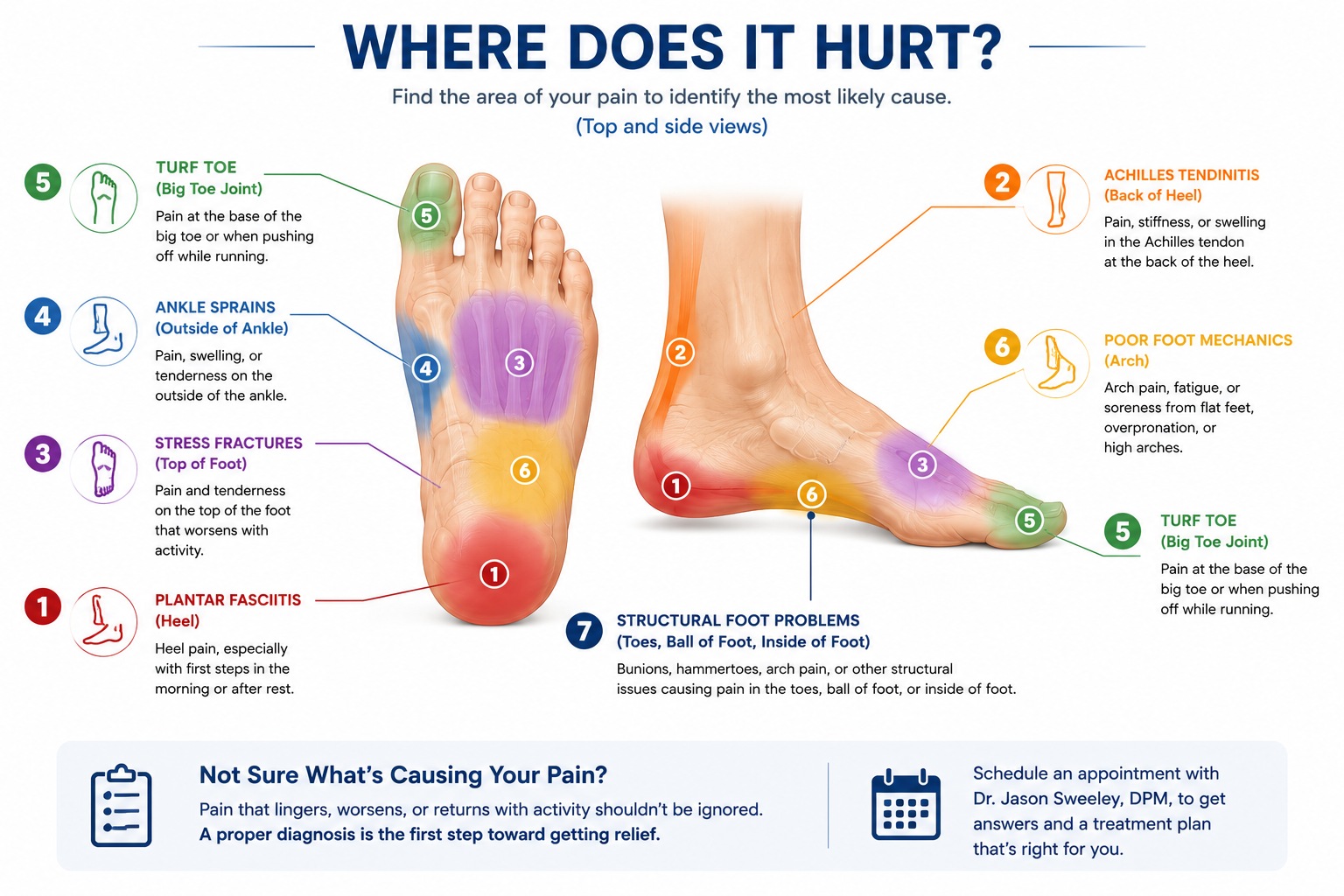
When Should You See a Podiatrist About Foot Pain After Running?
Most runners wait longer than they should. The instinct is to rest for a few days and hope the problem resolves. Sometimes it does. More often, a brief rest period masks the symptoms without addressing the cause. The pain returns as soon as you resume training.
See a podiatrist near you if any of these apply.
- Foot pain that returns every time you try to run, despite rest.
- Pain that’s been present for more than two to three weeks without consistent improvement.
- Localized tenderness directly over a specific bone.
- Swelling that doesn’t resolve with rest and ice.
- Any change in how you walk or run to protect the painful area.
- The same injury keeps recurring after it seems to recover.
Podiatrist Dr. Jason Sweeley, DPM, a foot and ankle specialist, treats runners and other active patients at Silver Spring Foot & Ankle in Mechanicsburg. Most new patients are seen within a few days. You’ll get a clear diagnosis, not a referral runaround. You’ll leave knowing exactly what’s causing your foot pain after running and what it’ll take to get back on track.
At Silver Spring Foot & Ankle, we see most new patients within a few days. You’ll get a clear diagnosis, not a referral runaround. You’ll leave knowing exactly what’s causing your pain after running and what it’ll take to get back on track.
Call (717) 237-9000 or request an appointment online. Same-day and next-day appointments are often available.
