
Your feet hurt, and you may not know why. Maybe it’s a sharp pain in your heel when you first get out of bed. Maybe the ball of your foot burns after you’ve been standing all day. Your toes ache in certain shoes. Some days, it seems like different parts of the foot take turns hurting. Or maybe your feet feel tired and sore, and you couldn’t point to one problem if you tried.
We get it. Foot pain can be frustrating, especially when you don’t know what’s causing it.
Part of the reason is that your feet are incredibly complicated. Each foot contains 26 bones and 33 joints, plus muscles, tendons, ligaments, nerves, blood vessels, and connective tissue. All of them have to work together every time you stand, walk, climb stairs, or push off the ground.
When one part isn’t working quite right, you may feel it somewhere else.
Key Takeaways
- Each foot has 26 bones and 33 joints, along with muscles, tendons, ligaments, nerves, and blood vessels that all work together.
- Foot doctors divide the foot into three main parts: the forefoot (toes and ball of the foot), the midfoot (the arch), and the hindfoot (the heel and ankle area).
- The heel, the ball of the foot, and the big toe joint all handle significant force as you walk, which helps explain why pain often develops there.
- Where your foot hurts and what the pain feels like are the first clues to which part of the foot is involved.
- The painful spot isn’t always the source of the problem. Tight calves, flat feet, or a stiff big toe can cause pain somewhere else in the foot.
- Achy feet don’t always mean an injury. But pain that lasts, gets worse, keeps coming back, or changes how you walk deserves an exam.
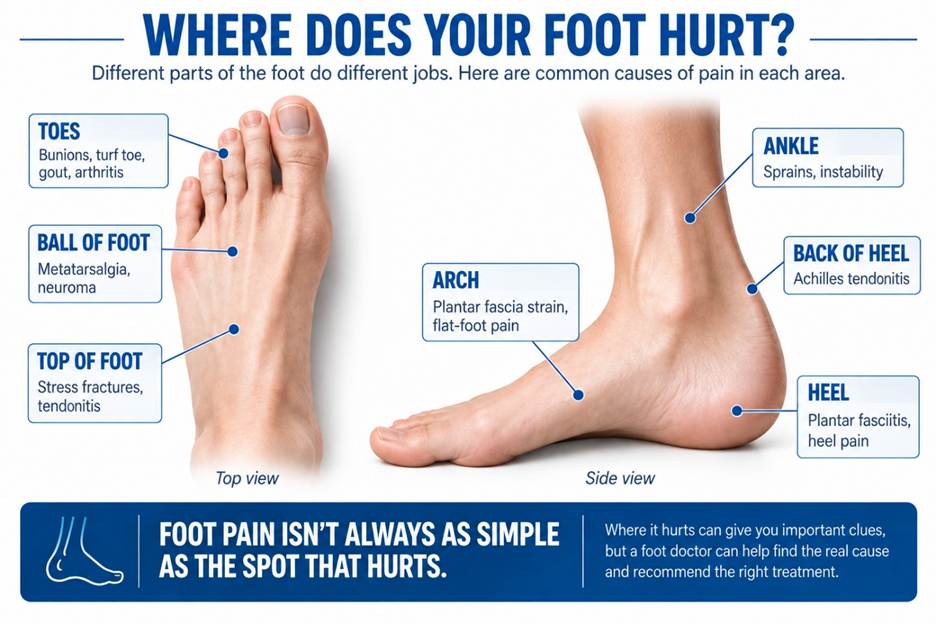
Where Part of Your Foot Hurts?
Most people don’t describe foot pain in medical terms. Nobody walks into our Mechanicsburg office saying, “My hindfoot hurts.” They say, “My heel hurts when I get out of bed,” or “The ball of my foot burns by the end of my shift.”
So let’s start where you are.
| Where It Hurts | Possible Condition |
| Toes | Bunions, turf toe, gout, arthritis |
| Ball of foot | Metatarsalgia, neuroma |
| Top of foot | Stress fractures, tendinitis |
| Arch | Plantar fascia strain, flat-foot pain |
| Heel | Plantar fasciitis, heel pain |
| Back of heel | Achilles tendinitis |
| Ankle | Sprains, instability |
Each area has different parts doing different jobs. That’s why heel pain and toe pain can feel so different. It’s also why they usually have different causes. If the cause isn’t obvious, a foot doctor near you can help figure out what’s really going on.
The Parts of the Foot: Built to Take a Beating
You don’t need a medical degree to understand the basics of foot anatomy. Just think about what your feet do on an ordinary day. They hold up your whole body.
When you walk, each step exerts a force of up to about 1.5 times your body weight through your foot. For a 150-pound person, that’s as much as 225 pounds. When you run, it can climb to two or three times your body weight. Then it turns into a stiff lever so you can push off into the next step.
The average American adult takes about 5,000 steps a day, so your feet repeat that cycle thousands of times, every single day.
To handle that, your foot has three main parts.
1. Hindfoot: The Back of Your Foot
It takes the first hit. The hindfoot includes your heel bone (calcaneus) and your ankle bone (talus), which connects your foot to your leg. That first impact, step after step, is one reason heel pain is so common.
2. Midfoot: The Middle of Your Foot
It forms your arch. A cluster of smaller bones (the navicular, cuboid, and three cuneiforms) and strong ligaments work together here like a spring. It distributes your weight and absorbs force. When your arch aches after a long day on your feet, these are the parts that have been working overtime.
3. Forefoot: The Front of Your Foot
It does the pushing. Five long bones called metatarsals run to the base of your toes, and their rounded ends form the ball of your foot. Your toe bones (phalanges) help you balance and push off. Because the ball of your foot bears so much weight as you step forward, it’s a common site of burning and soreness.
The plantar fascia ties it all together. It’s a thick band of tissue running along the bottom of your foot, from your heel to your toes. It helps support your arch and stores energy with each step, much like a bowstring.
It’s also behind one of the most common complaints we hear: heel pain with your first steps in the morning. That’s a classic symptom of plantar fasciitis.
And don’t underestimate your big toe joint. It bends every time you push off. When it’s stiff, sore, or out of line, you can feel it with every step.
5 Surprising Facts About Your Feet
You probably don’t think much about your feet when they aren’t bothering you. But for something we stuff into shoes and expect to carry us around all day, there’s an amazing amount of engineering packed into them.
Here are five things you may not know about the feet you’re standing on:
- Your feet hold about a quarter of your bones. Your two feet contain 52 of your body’s 206 bones.
- Your big toe is built differently. It has two bones, while each of your other toes has three.
- Your heel bone is the biggest in your foot. It has to be. It takes the first impact of nearly every step.
- You have two tiny “kneecaps” under your big toe. These small bones, called sesamoids, help the tendons there glide and take pressure when you push off.
- You don’t have one arch. You have three. One runs along the inside of your foot, one along the outside, and one across the ball of your foot.
Why Can Your Feet Hurt in So Many Different Ways?
Foot pain doesn’t always feel the same. That’s because your foot has many different tissues, and each can hurt differently.
Muscles
They power every movement your foot makes. Small muscles inside control fine movements, like spreading your toes and keeping your balance. Larger muscles in your lower leg move your foot through long tendons. Tired or overworked foot muscles usually ache, cramp, or feel worn out, especially after a long day on your feet.
Bones
Your bones can develop tiny cracks from repeated stress. That usually feels like a deep ache that worsens with activity, often with one spot that’s tender to the touch.
Joints
They take a pounding and can wear down, swell, or get inflamed. That often feels like stiffness, swelling, or pain when you bend them. Gout is a special case. It usually strikes suddenly, often overnight, and the big toe joint turns hot, red, swollen, and extremely painful.
Tendons
Tendons connect muscles to bones. The best-known is your Achilles tendon, the thickest and strongest tendon in your body, which connects your calf to your heel. Irritated tendons often hurt when you use them in a certain way, like climbing stairs or pushing off. They’re also often stiff after rest.
Ligaments
They connect bones and keep your foot stable. When you roll your ankle, you stretch or tear ligaments. That’s a sprain. Sprains that don’t heal well can leave your ankle feeling loose or wobbly later.
As mentioned, the plantar fascia ligament has a signature complaint: sharp, stabbing heel pain with your first steps in the morning or after sitting for a while.
Nerves
Nerves carry messages between your feet and your brain. When they’re irritated, pinched, or damaged, the pain feels different from everything else. It often burns, tingles, shoots, or goes numb.
Numbness, or foot neuropathy, can make foot injuries more dangerous because you may not feel a blister or cut before it becomes a bigger problem. Diabetes is one of the most common causes of nerve damage in the feet, which is why diabetic foot care matters so much.
Blood Vessels
They bring oxygen and nutrients to your feet so they can heal. Because your feet are the farthest point from your heart, circulation problems often show up there first. Cold feet, color changes, and sores that won’t heal are all worth getting checked.
Why the Location of Your Pain Matters
You don’t need to know whether your posterior tibial tendon or your navicular bone hurts. That’s a podiatrist’s job. But knowing where it hurts and what it feels like can give you and your Doctor of Podiatric Medicine (DPM) important clues.
| Where it hurts | What’s there | What it often feels like | Common pain points |
| Toes | Big toe joint, toe bones, nails | Stiffness, a tender bump, or sharp pain when you push off. Gout often strikes suddenly, with a hot, red, swollen joint. | Bunions, turf toe, gout, hammertoes, arthritis, ingrown toenails |
| Ball of foot | Metatarsals, sesamoids, small nerves | Burning, a pebble-in-your-shoe feeling, or pain shooting into the toes | Metatarsalgia, sesamoiditis, neuroma |
| Top of foot | Metatarsals, tendons | Dull ache or swelling that gets worse with activity | Stress fractures, tendinitis, arthritis |
| Arch | Plantar fascia, ligaments, posterior tibial tendon | Deep ache or tired feeling after standing | Plantar fascia strain, flat-foot pain |
| Bottom of heel | Heel bone, plantar fascia | Sharp or stabbing pain with your first steps in the morning | Plantar fasciitis, heel pain |
| Back of heel | Achilles tendon | Stiffness or pain when pushing off, climbing stairs, or running | Achilles tendinitis |
| Inside of ankle | Posterior tibial tendon, tibial nerve | Aching along the inside of the ankle, or burning and tingling into the sole | Tendon problems, tarsal tunnel syndrome |
| Outside of foot and ankle | Ankle ligaments, peroneal tendons, fifth metatarsal | Sharp pain after rolling the ankle, or aching along the outer edge | Sprains, instability, peroneal tendinitis |
| Throughout the foot | Nerves, blood vessels | Burning, tingling, numbness, or cold feet | Neuropathy, circulation problems |
These are common patterns, not a diagnosis. Many problems overlap, and pain in one spot can have multiple causes. Heel pain, for example, can come from the plantar fascia, the Achilles, a nerve, or the heel bone itself. That’s why a proper exam matters more than matching your symptoms to a chart.
“The first two things I want to know are where it hurts and what it feels like. Sharp pain on the bottom of the heel first thing in the morning points me toward the plantar fascia—stiffness at the back of the heel points to the Achilles tendon. Burning or tingling makes me think about nerves. Together, those two answers narrow the list quickly, and the exam tells us which structure is actually involved.”
Podiatrist Dr. Jason Sweeley, DPM, Silver Spring Foot & Ankle
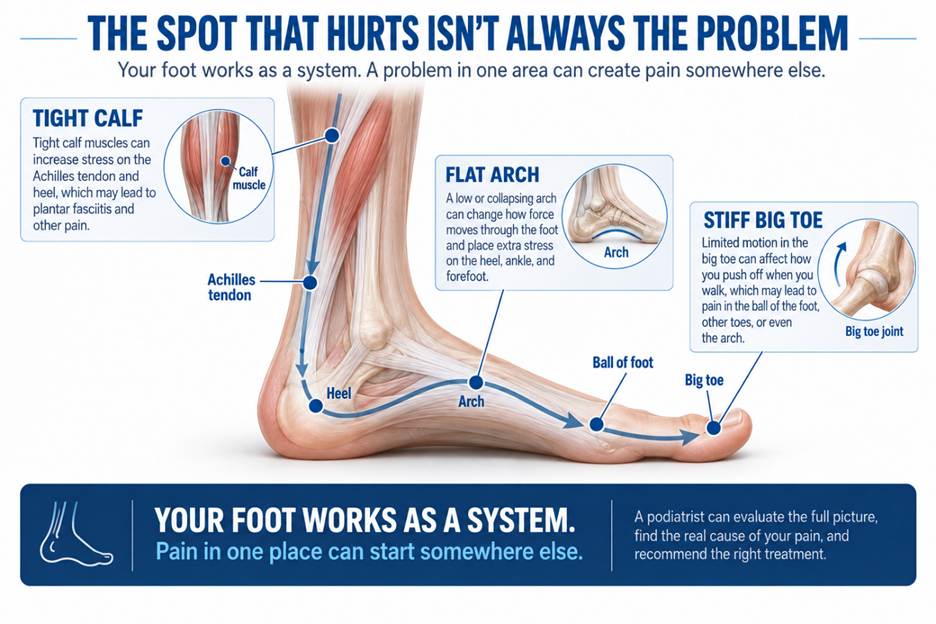
Sometimes the Part of the Foot That Hurts Isn’t the Problem
Your foot doesn’t work one part at a time. Every step passes force from your calf, through your heel and arch, and out through your toes. When one link in that chain isn’t doing its job, another part picks up the slack. Eventually, that part starts to complain.
That means the spot that hurts is sometimes the victim, not the cause.
Tight Calves Can Cause Heel Pain
Your calf muscles connect to your heel through the Achilles tendon. When they’re tight, they pull harder on the heel. That adds strain to the Achilles and the plantar fascia, which is one reason tight calves and heel pain so often show up together.
Flat Feet Can Change How Force Moves Through Your Foot
When your arch sits low or collapses as you stand, the supporting tissues have to work harder. That can lead to pain in the arch, the heel, the inside of the ankle, or even the knees.
A Stiff Big Toe Can Change How You Walk
If your big toe joint doesn’t bend well, you can’t push off normally. Many people start rolling to the outside of the foot or shifting pressure to the other toes without realizing it. Then the pain shows up somewhere new.
Shoes Can Make Any of These Worse
Shoes that don’t support your foot or crowd your toes change how your foot moves and where the pressure lands. You can learn more about that in Shoes and Foot Pain: Your Shoes Could Be the Problem.
It’s why treating foot pain isn’t always about the spot that hurts. When the problem is mechanical, the fix is often mechanical too. Custom orthotics, for example, aren’t just extra cushioning. They’re designed to change how force moves through your foot, so the overloaded part gets relief.
“Some of the heel pain I see actually starts in the calf. If we only treat the heel, it tends to come back. We need to find out why that part of the foot is taking more stress than it should.”
Podiatrist Dr. Jason Sweeley, DPM, Silver Spring Foot & Ankle
Why Do My Feet Just Ache?
Sometimes there’s no sharp pain, no swelling, and no moment when you know you hurt yourself. Your feet are just tired, sore, and achy, especially at the end of the day.
Your feet can ache without one obvious injury, leaving several parts of your foot tired and sore at once:
- A long day on your feet
- A sudden increase in activity
- Shoes that don’t support your feet well
- Changes in how you walk
- The strain of thousands of steps each day
Feet also change with age. The padding under your heel and the ball of your foot can thin over time, and your arches can flatten.
That kind of ache is common, and it isn’t always a sign of something serious. But you shouldn’t have to live with it every day, either.
Aching is also different from burning, tingling, or numbness. Those feelings point more toward your nerves than your muscles or joints, and they’re worth having checked, especially if you have diabetes.
Your Feet Work as a System
Your feet do an incredible amount of work. Every step depends on 26 bones, 33 joints, and the muscles, tendons, ligaments, and nerves that connect them.
That’s why pain is rarely just about the spot that hurts. A sore heel can start in your calf. A stiff big toe can cause pain somewhere else entirely. And sometimes tired, achy feet are simply telling you they’re working harder than they should.
You don’t need to know the name of every part of your foot. What matters is paying attention when something doesn’t feel right. Where it hurts, what it feels like, when it happens, and what makes it better or worse are all clues. Sometimes those clues are enough to help you understand what’s going on. Sometimes they’re not.
And that’s okay. You don’t have to diagnose your own feet.
Still Not Sure Why Your Feet Hurt?
That’s what we’re here for.
Some soreness comes and goes. But if your feet keep hurting, the pain keeps coming back, or it’s starting to change what you can comfortably do, you don’t have to keep guessing. And if you have diabetes, any sore, blister, or cut that isn’t healing needs attention right away.
If you’re unsure about your foot pain, read our guide to the 10 signs it’s time to see a podiatrist.
If you’re looking for a podiatrist in Mechanicsburg, Carlisle, or Harrisburg, Silver Spring Foot & Ankle can help. We’ll determine where your pain is really coming from and walk you through your treatment options. Schedule an appointment or call (717) 237-9000.
Frequently Asked Questions About Parts of Your Foot
What are the different parts of the foot called?
DPM’s divide the foot into three main parts:
- The forefoot (toes and ball of the foot)
- The midfoot (the arch)
- The hindfoot (the heel and ankle area)
The bones fall into three groups: tarsals, metatarsals, and phalanges. Important soft tissues include the plantar fascia, the Achilles tendon, and the ligaments that hold the foot together.
How many bones are in the foot?
Each foot has 26 bones and 33 joints. Together, your two feet have 52 bones, about a quarter of the 206 bones in your body.
What are the bones of the foot?
Each foot has 26 bones in three groups. The 7 tarsals form your heel, ankle, and arch, including the heel bone (calcaneus) and ankle bone (talus). The 5 metatarsals run through the middle of your foot to your toes. The 14 phalanges are the bones in your toes. Most people also have two small sesamoid bones under the big toe joint.
What muscles are in the foot?
Two muscle groups move your foot. Small muscles inside the foot control fine movements like curling and spreading your toes and help you balance. Larger muscles in your lower leg, including your calf muscles, connect to the foot through long tendons and do most of the work when you walk, run, and climb.
How many bones are in your toes?
Each foot has 14 toe bones, called phalanges. Your big toe has two, and each of your other toes has three.
What are the different areas of pain in the foot?
Most pain shows up in the toes, the ball of the foot, the top of the foot, the arch, the heel, the back of the heel, or the inside or outside of the ankle. Each area has different bones, tendons, ligaments, and nerves, so each one tends to have its own set of common problems.
What does foot pain indicate?
Pain usually means a specific part of the foot is irritated, injured, or worn down. That could be a muscle, bone, joint, tendon, ligament, the plantar fascia, or a nerve. Sometimes it’s a sign of a whole-body condition, like diabetes, arthritis, or gout.
What are the stress points on the feet?
The heel, the ball of the foot, and the big toe joint all handle significant force as you walk. Your heel absorbs impact when you land, and the ball of your foot and big toe carry your weight as you push off. That helps explain why pain commonly develops in these areas.
What are the most common foot pain problems?
Common causes include plantar fasciitis, bunions, ingrown toenails, Achilles tendinitis, metatarsalgia, and ankle sprains. Nerve problems like neuropathy are also common, especially in people with diabetes.
Can foot pain come from somewhere else?
Yes. Your foot functions as an interconnected system, so a problem in one area can cause pain in another. Tight calf muscles can strain the heel, flat feet can overload the arch, and a stiff big toe can alter your gait and shift pressure elsewhere in the foot.
