
Achilles tendinitis in runners is reasonably common. It accounts for roughly 9 to 15 percent of all running-related injuries, making it one of the most common reasons runners end up sidelined.
Most runners know the feeling.
You finish a run, and the back of your ankle feels tight. The next morning, those first few steps out of bed hurt. Maybe the discomfort eases after a mile, only to come back later in the day.
It’s easy to write those symptoms off as normal soreness. Too often, they are the earliest signs of Achilles tendinopathy, one of the most common overuse injuries in running.
The good news is that catching the problem early usually means avoiding months of frustration. If you run in Carlisle, Harrisburg, Mechanicsburg, or anywhere in Central PA, this guide will help you understand what your Achilles is telling you.
A Quick Note on Achilles Tendinitis in Runners vs. Achilles Tendinopathy
You will see two terms in this article. Most runners search for “Achilles tendinitis.” Many podiatrists and foot and ankle specialists now prefer “Achilles tendinopathy.”
The difference matters. Tendinitis suggests active inflammation. Tendinopathy is a broader word that also covers the wear and breakdown that builds up in a tendon over time. Since most long-running Achilles problems involve more breakdown than swelling, tendinopathy is usually the more accurate word. We use both here so nothing gets lost.
Quick Answers About Achilles Tendinitis in Runners
| Question | Answer |
| Is Achilles tendinitis common in runners? | Yes. It makes up roughly 9 to 15 percent of all running injuries. |
| What causes it? | Usually training errors that load the tendon faster than it can adapt. |
| Can I keep running? | Sometimes, depending on your pain level and how the tendon is working. |
| Will it heal with rest? | Rest alone rarely fixes it. Progressive rehab is usually needed. |
| When should I see a podiatrist? | If pain lasts more than a week or two, gets worse, or limits your running. |
Why Achilles Tendinitis Is So Common in Runners
Achilles tendinopathy makes up roughly 9 to 15 percent of all running-related injuries. That makes it one of the most frequent overuse problems runners face. Research also shows it becomes more common with age and with higher training volume. Close to half of runners will deal with it at some point.
The reason comes down to load. Running puts tremendous force through the Achilles tendon, up to several times your body weight with every stride. The tendon stores and releases energy like a spring on each step.
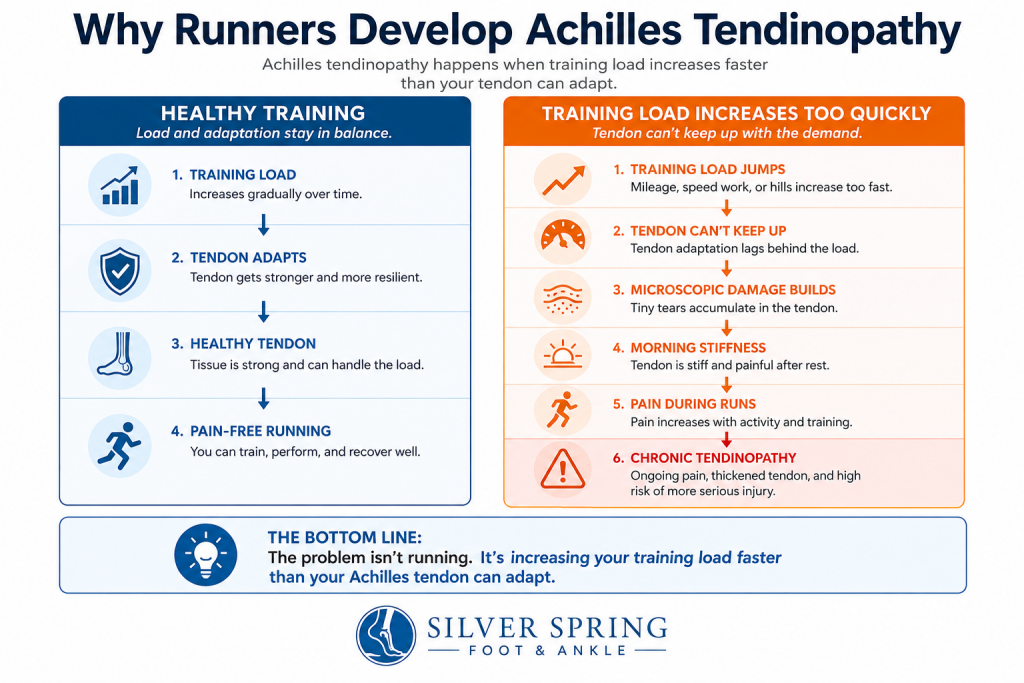
When your training grows faster than the tendon can adapt, tiny amounts of damage start to build up. For a while, you feel nothing. Then the tendon becomes painful, and by that point the problem has usually been developing for weeks.
“Most runners think the problem starts when the pain starts. In reality, the tendon has usually been struggling to keep up with training for weeks before symptoms appear.”
Podiatrist Dr. Jason Sweeley, Foot and Ankle Specialist, Silver Spring Foot & Ankle
Why Does Achilles Pain Feel Worse in the Morning?
Morning stiffness is one of the most telling signs of Achilles tendinopathy, and it is the symptom runners ask about most.
Here’s what is happening. While you sleep, your foot rests in a pointed-down position, and the tendon doesn’t move. Fluid and metabolic activity inside the tendon shift overnight, and the tissue tightens up. Those first steps in the morning stretch a stiff, under-hydrated tendon, which is why they often hurt the most.
As you move around, blood flow increases and the tendon warms and loosens, so the pain eases. That relief feels reassuring, but it doesn’t mean the tendon has healed. The stiffness returning morning after morning is a signal worth paying attention to.
Common Symptoms of Achilles Tendinitis in Runners
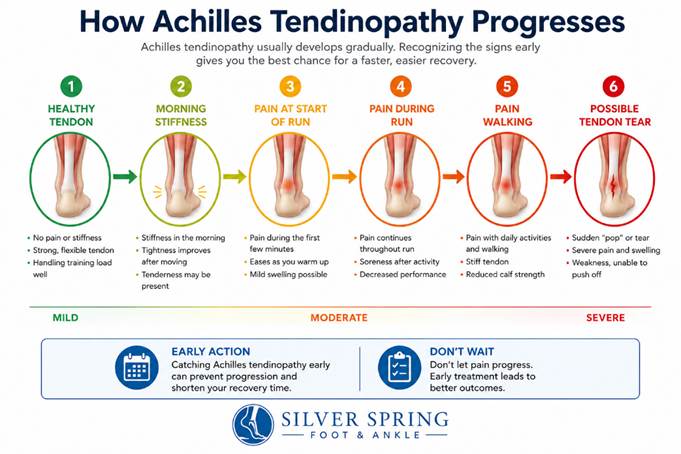
Achilles symptoms tend to follow a pattern. Watching how they change over time tells you a lot about how far along the problem is.
Early Symptoms
- Morning stiffness in the back of the ankle
- Pain during the first few minutes of a run that eases as you warm up
- Tenderness just above the heel
- Mild swelling
Progressing Symptoms
- Pain that stays with you during the run
- Pain that lingers after the run
- Trouble climbing stairs
- A tendon that feels thickened or lumpy
- Reduced calf strength
Why Runners Develop Achilles Tendinitis
Achilles tendinitis rarely comes from a single bad workout. It usually builds from patterns. Most causes fall into three buckets.
Training Errors
- Increasing mileage too quickly
- Too much hill work
- Too much speed work
- Too little recovery between hard efforts
Biomechanics
- Tight calves
- Weak calf muscles
- Limited ankle mobility
Footwear
- Worn-out shoes
- A sudden switch to minimalist shoes
- A drop to a lower heel height than your legs are used to
“One hard workout rarely causes Achilles tendinitis. It is usually the result of repeatedly asking the tendon to do more than it is ready for.”
Podiatrist Dr. Jason Sweeley, Foot and Ankle Specialist, Silver Spring Foot & Ankle
How a Podiatrist Diagnoses Achilles Tendinitis in Runners
Diagnosing Achilles tendinopathy is usually straightforward and, in most cases, doesn’t require imaging. When you visit a foot doctor near you, they’ll follow a few steps to confirm what’s going on and, just as important, rule out anything more serious.
Medical History
It starts with understanding your running pattern. Recent changes in mileage, pace, hills, or shoes often point straight to the cause. How long the pain has been there and how it behaves are also good indicators.
Physical Exam and Palpation
Gently pressing along the tendon helps locate the problem and shows whether it’s in the middle of the tendon or closer to the heel bone. Swelling, thickening, and tender spots all help pinpoint it.
Single-Leg Heel Raise
Rising onto the ball of one foot tests the tendon’s strength and function. Pain or weakness here is a common sign of tendinopathy.
Thompson Test
This quick test checks that the tendon is still intact. It helps rule out a rupture, which is a more serious injury that needs immediate care.
Imaging When Needed
Most cases don’t need it. When the picture is unclear, or the tendon isn’t responding to treatment, an ultrasound or MRI can show the tissue in more detail.
How Achilles Tendinopathy Is Treated
Most articles start with rest and ice. That’s not where the real recovery happens. A tendon gets better when it’s loaded the right way, not when it’s ignored. Treatment is usually a stepped approach, starting with the simplest options and moving on only if needed.
Activity Modification
That means adjusting your mileage, not stopping completely. Full rest often leaves the tendon weaker than before. The goal is to reduce the load enough to calm symptoms while keeping you moving.
Progressive Strengthening and Physical Therapy
Heavy, slow calf raises are the backbone of Achilles rehab. Both straight-knee and bent-knee versions matter, because they target different parts of the calf and tendon. Structured physical therapy helps you load the tendon correctly and safely.
Footwear and Custom Orthotics
Sometimes a simple shoe change makes a real difference. For runners whose mechanics overload the tendon, custom orthotics can correct the pattern and take strain off the tendon with every stride.
Anti-Inflammatory Medication
When appropriate, short-term anti-inflammatory medication can help manage pain so you can stay active in your rehab.
Walking Boot for Selected Cases
In more stubborn or painful cases, a walking boot can offload the tendon for a period to let irritated tissue settle before rebuilding strength.
Advanced Options When Needed
For cases that don’t respond to the steps above, additional treatments such as shockwave therapy or PRP may be considered. Surgery is reserved as a last resort for a small number of cases that fail conservative care.
“The tendon heals best when it is challenged the right way, not when it is completely ignored and not when it is overloaded.”
Podiatrist Dr. Jason Sweeley, Silver Spring Foot & Ankle
Can You Keep Running with Achilles Tendinopathy?
This is the first question almost every runner asks. The answer depends on your pain and how the tendon is holding up. Here is a simple way to think about it.
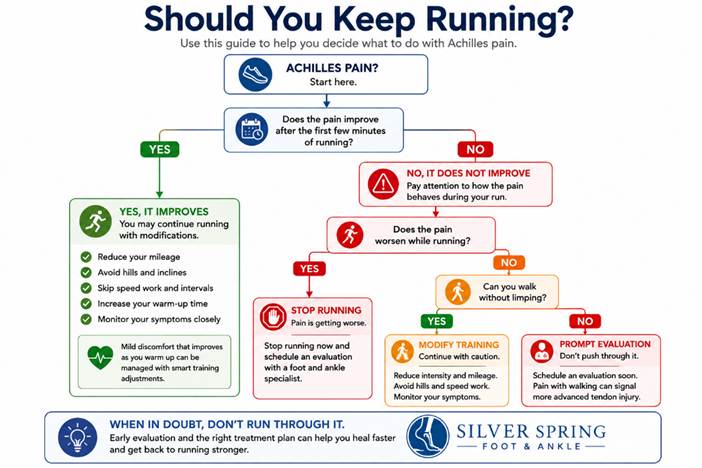
“Our goal usually is not to stop runners forever. It is to keep them moving while the tendon recovers.”
Podiatrist Dr. Jason Sweeley, Silver Spring Foot & Ankle
When Should You See a Foot and Ankle Doctor?
Many runners wait until they cannot finish a run before seeking care. Unfortunately, by then the tendon has often been overloaded for weeks or months.
Early treatment is usually simpler, recovery is often faster, and the risk of a complete Achilles rupture is lower. There’s real value in getting it looked at sooner rather than later.
It’s worth scheduling an evaluation if:
- Pain lasts more than one to two weeks
- Running is becoming harder
- You notice swelling
- You feel or hear a pop
- You cannot do a single-leg heel raise
Silver Spring Foot & Ankle works with runners across Central Pennsylvania, including Carlisle, Harrisburg, and Mechanicsburg, who want to get back on the road without making the injury worse. The earlier you come in, the more options you have and the faster the recovery tends to go.
“One of the biggest mistakes runners make is trying to run through Achilles pain. The earlier we identify the cause, the easier it usually is to keep you running and prevent a much bigger setback.”
Podiatrist Dr. Jason Sweeley, Silver Spring Foot & Ankle
Frequently Asked Questions
Is it okay to run with Achilles tendinitis?
Sometimes. Mild pain that improves as you warm up may be manageable with a reduced load. If pain worsens during a run, you limp, or you swell, stop and get evaluated.
Why does my Achilles stop hurting once I start running?
Warming up temporarily improves blood flow and tendon flexibility, so the pain often eases a few minutes into a run. That relief is real, but the underlying damage remains. The tendon feels better without actually being better, which is why runners often push through and let the problem grow.
Can Achilles tendinitis heal on its own?
Rest alone rarely solves it. The tendon usually needs progressive strengthening to rebuild its capacity, not just time off.
How long does recovery take from Achilles tendinopathy?
It varies. Mild cases can settle in a few weeks. Longer-standing tendinopathy often takes several months of consistent rehab.
Is walking good or bad for Achilles injuries?
Gentle walking is usually fine and can even help. Sharp pain or a limp while walking is a sign to back off and get it checked.
What shoes are best for supporting your Achilles?
There is no single answer. A shoe with a slightly higher heel drop can reduce strain in the short term. Avoid sudden switches to minimalist shoes while you are recovering.
Does stretching help with Achilles tendinitis?
Gentle calf flexibility work can help, but strengthening does more of the real work. Aggressive stretching of an irritated tendon can make things worse.
What is the difference between Achilles tendinitis and tendinopathy?
Tendinitis implies active inflammation. Tendinopathy is a broader term that also covers tendon breakdown over time, which most chronic cases involve.
Can Achilles tendinitis turn into a rupture?
It can raise your risk if the tendon weakens and you keep loading it hard. A sudden pop with sharp pain and weakness is a medical concern that needs prompt attention.
Should I use ice or heat to treat Achilles tendinitis?
Ice can ease pain after activity. Heat may help loosen a stiff tendon before movement. Neither one fixes the underlying problem on its own.
How do I keep Achilles tendinitis from coming back?
Build mileage gradually, keep your calves strong, respect recovery days, and replace worn-out shoes. Most repeat cases trace back to load creeping up too fast.
