
You can sometimes run a marathon with Achilles tendinitis. But only if your symptoms are mild, stable, and not worsening week to week. If your pain builds during runs, you’re limping, or you can’t do a single-leg calf raise without sharp pain, racing puts the tendon at real risk.
The goal isn’t to push through pain or to stop running completely. It’s to keep the tendon working at a level it can handle while you rebuild its strength. Some runners with mild, early symptoms can keep training in a modified way. Others need to pull back or skip the race. Knowing which group you’re in is the most important decision of your training block.
Learn more by reading Achilles Tendinitis in Runners: Symptoms, Causes & Treatment.

Key Takeaways
- Mild, stable symptoms may let you keep training, with less mileage, fewer hills, and less speed work.
- Worsening pain, limping, or a failed calf raise are stop signs. Get evaluated before your next long run.
- Rest alone doesn’t fix it. The tendon needs gradual strengthening, or the pain will return as mileage increases.
- Where it hurts matters; pain at the heel bone and pain higher up the tendon require different treatment.
- Marathon training raises the risk. In a large study of race entrants, marathon runners had the highest rate of Achilles problems.
- A sudden pop or snap at the back of the ankle is an emergency. Stop and get seen right away.
Can You Run a Marathon With Achilles Tendinitis?
It depends on how irritated the tendon is and how it responds to load. A tendon that’s a little stiff in the morning and loosens up after a few minutes is very different from one that hurts more with every mile.
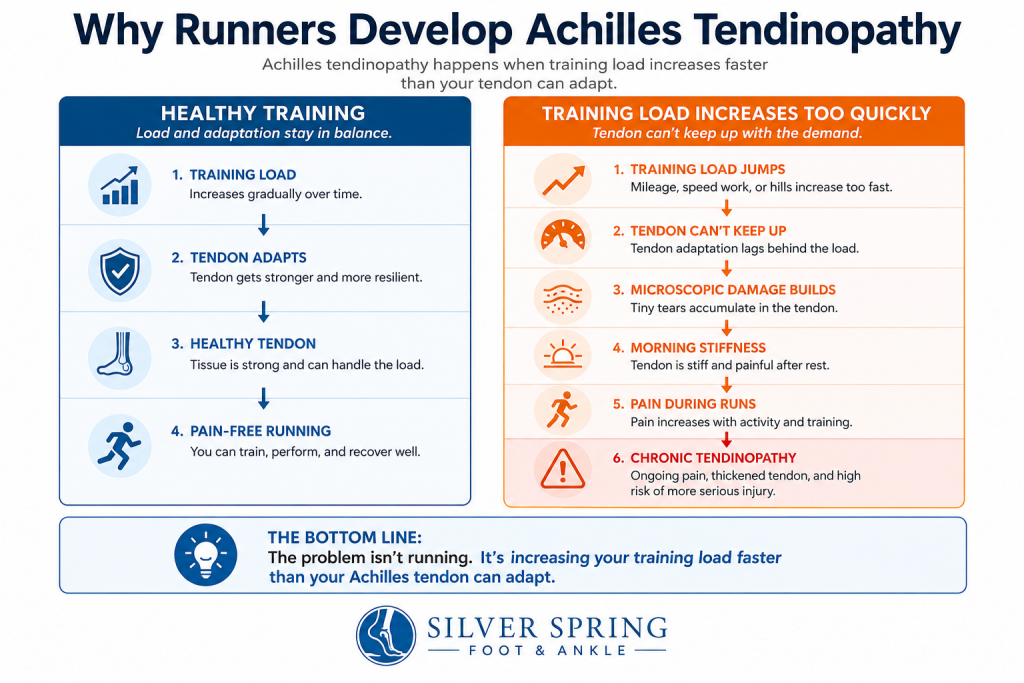
Here’s a simple way to think about it. Your Achilles can handle a certain amount of load right now. Training pushes against that limit. When you go past it too often, the tendon gets irritated. When you stay under it while slowly building strength, the limit goes up.
The question isn’t “Does it hurt?” It’s “Is it getting better, staying the same, or getting worse?”
- If it’s getting better or staying the same with modified training, you may be able to race.
- If it’s getting worse, even with reduced mileage, racing will likely make it worse.
“Rest makes the pain go away. It doesn’t strengthen the tendon. Runners take three weeks off, feel great, go out for a long run, and they’re right back where they started, because the tendon lost strength while the pain was quiet.”
Dr. Jason Sweeley, DPM, Silver Spring Foot & Ankle
Why Marathon Training Is Hard on the Achilles Tendon
The Achilles tendon connects your calf muscles to your heel bone. Every running stride loads it, and marathon training adds up to many more strides.
A large Dutch study followed nearly 2,000 recreational runners who had signed up for races from 5K to the marathon. About one in twenty developed Achilles tendinopathy. Runners who signed up for a marathon had the highest rate, at 7.4%. The strongest risk factor was having Achilles problems in the previous 12 months.
Common training triggers include:
- Ramping up mileage too fast, especially long runs
- Adding hills or speed work at the same time as more mileage
- Changing shoes, particularly to a flatter or more minimal shoe
- Too little recovery between hard sessions
- Tight or weak calf muscles that pass more load to the tendon
You’ll often hear this called Achilles tendinitis. When the problem lasts more than a few weeks, doctors usually call it Achilles tendinopathy. That’s a broader term for the changes that happen in an overworked tendon. It’s the same problem runners know as tendinitis. Doctors treat it the same way: manage load and rebuild strength.
Where It Hurts Changes the Plan
If you’re running with Achilles tendinitis, pain usually shows up in one of two places:
- Insertional: right where the tendon attaches to the back of the heel bone
- Midportion: a couple of inches above the heel, in the narrow part of the tendon
In a recent study of more than 3,000 recreational runners, about two-thirds of new Achilles cases were insertional and about one-third were midportion.
The difference matters because some common exercises help one type and aggravate the other.
“Where it hurts changes the rehab. Pain at the heel bone and pain two inches up the tendon are treated differently. The calf stretch most runners reach for first, dropping the heel off a step, can make insertional pain worse.”
Dr. Jason Sweeley, DPM, Silver Spring Foot & Ankle
Read more in this guide to pain in the back of the heel for other conditions that cause pain in that spot.
Warning Signs to Watch For Running with Achilles Tendinitis
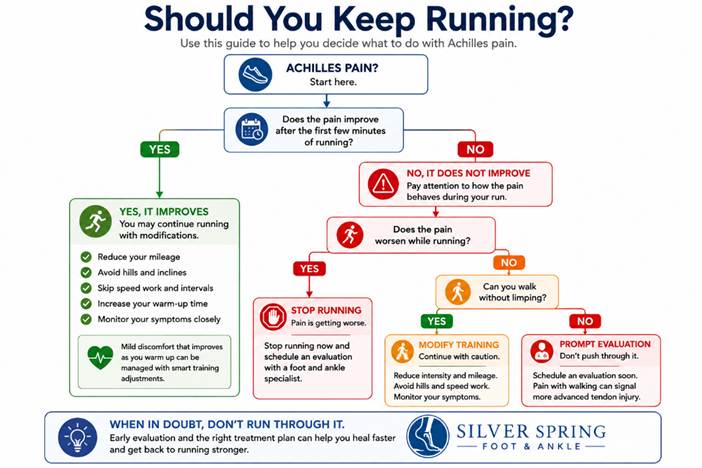
Pay attention to how your tendon behaves, not just how much it hurts.
Signs it may be manageable:
- Morning stiffness that eases within a few minutes of walking
- Mild pain at the start of a run that settles as you warm up
- Symptoms that aren’t worse the next morning
- Normal walking and running form
Cut back and get evaluated by a foot and ankle specialist near you:
- Morning stiffness that lasts a long time or is getting worse
- Pain that builds as the run goes on
- Pain or stiffness that’s worse the morning after a run
- Limping during or after running
- Pain or weakness when you rise on your toes on one leg
- Swelling or a tender lump on the tendon
Stop and get seen right away:
- A sudden pop, snap, or feeling like you were kicked in the back of the ankle
- Trouble pushing off or walking normally afterward
Those last two can mean a tendon rupture, which needs prompt care.
How to Modify Marathon Training If You’re Running with Achilles Tendinitis
If your symptoms are mild and stable, these changes can keep you training while the tendon settles.
- Cut back mileage and intensity. Shorten your long run and reduce your weekly total. Don’t try to make up missed miles later.
- Drop hills and speed work first. Uphill running and fast intervals put the most strain on the Achilles. Stick to flat, even ground at an easy pace.
- Try a walk-run approach. Short walk breaks reduce the tendon’s steady load during longer runs.
- Cross-train for fitness. Cycling, pool running, and the elliptical help maintain your aerobic fitness with less strain on the tendon.
- Start a calf-and-tendon strengthening program. Slow, controlled calf raises, progressed over time, are the core of Achilles rehab. The right version depends on where your pain is.
- Don’t change your shoes close to race day. A sudden switch, especially to a flatter shoe, can add strain when you need it least.
- Check in the morning after. How the tendon feels the next morning is a better guide than how it feels during the run.
Should You Run the Race?
This is the decision most runners are really searching for. Here’s a practical way to decide if you’re running with Achilles tendinitis.
You May Be Able to Race
- Your symptoms have been stable or improving for a couple of weeks
- You’ve completed recent long runs without the tendon getting worse
- Pain the next morning settles quickly
- You can do repeated single-leg calf raises on the sore side without sharp pain.
- You’re willing to run slower than planned or walk if needed
No single sign clears you to race. These work together, and a podiatrist’s exam can help you weigh them.
Racing Is Likely a Bad Idea
- Symptoms are getting worse despite cutting back
- You’ve had to skip your recent long runs because of pain
- You’re limping or changing your stride
- You can’t do a single-leg calf raise on the sore side
- You’re counting on race-day adrenaline to get you through
Be wary of taper weeks. Running less means less pain, so the tendon can feel ready when it isn’t. And remember that race day isn’t the only risk. A tendon that holds up for 26.2 miles can still flare badly in the days after.
In one study, about a third of runners who developed Achilles tendinopathy still had symptoms a year later. One race isn’t worth turning a short-term problem into a long-term one.
“A missed race costs you a registration fee. A tendon that turns chronic can cost you a season. When runners frame it that way, the decision usually gets a lot easier.”
Dr. Jason Sweeley, DPM, Silver Spring Foot & Ankle
Whether you’re training for the Harrisburg Marathon or a race out of state, many events let you defer or switch to a shorter distance. A half marathon may be a reasonable middle ground if your symptoms are mild, but the same warning signs apply.
Treatment and Recovery from Achilles Tendinitis
Achilles tendinopathy responds well to treatment, but it doesn’t heal on a set schedule. Recovery usually takes months, not weeks, especially if symptoms have been around for a while.
Treatment often includes:
- A progressive strengthening program. This is the foundation. Controlled loading helps the tendon rebuild its capacity for running.
- Training load changes so the tendon can recover between sessions
- Footwear review and, when needed, heel lifts or orthotics to reduce strain
- Shockwave therapy for stubborn cases that haven’t improved with exercise alone
- Imaging, such as ultrasound, to check for a tear or other problem
If you’ve recently taken fluoroquinolone antibiotics, such as ciprofloxacin or levofloxacin, tell your foot and ankle doctor. These medications are linked to tendon problems.
A gradual return-to-run plan matters as much as the treatment itself. Coming back too fast after time off is one of the most common reasons symptoms return.
Frequently Asked Questions About Running With Achilles Tendinitis
Can I Run on a Treadmill With Achilles Tendinitis?
A treadmill gives you a flat, predictable surface, making it easier to control your pace and avoid hills. Keep the incline at zero or very low, since an uphill setting adds strain to the tendon. The same warning signs apply indoors and out.
Does Achilles Tendinitis Ever Fully Go Away?
Yes, it can, but it usually takes consistent strengthening, not rest alone. Runners who stop as soon as the pain fades often see it return when they resume full mileage.
What Is the Quickest Way to Get Rid of Achilles Tendinitis?
There isn’t a true shortcut. The fastest path is usually catching it early, reducing load right away, and starting a strengthening program before the tendon becomes chronic. Waiting until it’s severe prolongs recovery.
How Long Should You Stop Running With Achilles Tendinitis?
Not everyone needs to stop completely. Some runners with mild symptoms can keep running at reduced mileage and intensity. If you’re limping, the pain keeps building, or you can’t do a calf raise on that leg, take a break from running and get evaluated.
Can You Run a Marathon After Achilles Tendinitis?
Yes. Many runners return to marathon training after recovering. The key is to rebuild strength first and gradually increase mileage. A history of Achilles problems increases the risk of another flare, so keep ongoing calf strengthening in your routine.
When to See a Podiatrist
Make an appointment if:
- Your Achilles pain isn’t improving after a week or two of reduced training
- Pain builds during runs or is worse the next morning
- You’re limping or can’t do a single-leg calf raise
- You see swelling or feel a lump on the tendon
- You’re trying to decide whether to run an upcoming race
Get seen right away if you feel a sudden pop or snap at the back of your ankle.
Looking for podiatrists in Mechanicsburg, Carlisle, or Harrisburg? Silver Spring Foot & Ankle helps runners manage Achilles pain, adjust their training, and make a clear call on race day. Schedule an appointment before your next long run.
