
If your feet regularly ache, burn, rub, or hurt, your shoes may be causing the pain. Shoes that are too tight, too loose, worn out, or simply wrong for your foot shape create pressure and friction. Most importantly, they change how your foot works with every step.
Sometimes the shoe is the whole story. More often, it’s making an existing problem worse. The good news is that it’s also one of the easiest things to change.
How Can Shoes Cause Foot Pain?
Your foot is built to spread out, flex, and absorb impact. A shoe that fights any of those jobs will eventually let you know.
Most shoe-related discomfort comes from one of four things:
- Pressure: A narrow toe box or a low, tight upper squeezes the toes together and presses on joints and nerves.
- Friction: A shoe that slides, gaps at the heel, or has a rough seam rubs the same spot thousands of times a day.
- Lack of support: Flat, flimsy shoes let the arch collapse and force the bottom-of-foot tissue to do work the shoe should be doing.
- Worn-out cushioning: Even a well-made shoe loses its shock-absorbing ability. Once the midsole is done, your heels and forefoot take the hit.
“One of the first things I look at when someone comes in with foot discomfort is what they’re wearing on their feet. The shoe usually isn’t the entire problem, but it may be contributing to it every time they take a step.”
— Podiatrist Dr. Jason Sweeley, Silver Spring Foot & Ankle
What Is Considered a Poorly Fitted Shoe?
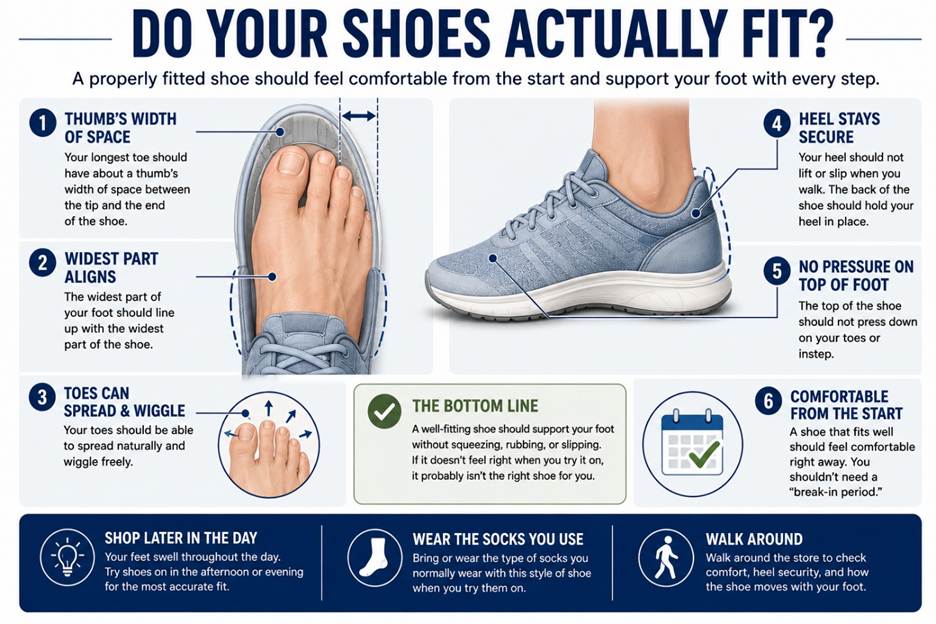
An ill-fitting shoe is any shoe that doesn’t match your foot’s length, width, depth, or shape, or that doesn’t provide the support your activity requires.
In practical terms, a shoe fits poorly if:
- Your longest toe touches the front, or you have less than about a thumb’s width of space beyond it
- The widest part of your foot doesn’t line up with the widest part of the shoe
- Your toes can’t spread or wiggle
- Your heel lifts or slides when you walk
- The top of the shoe presses down on your toes or instep
- You need a “break-in period” before it feels comfortable
That last one surprises people. A shoe that fits should feel right when you try it on. Waiting for leather to stretch or a seam to soften usually means the shoe was wrong from the start.
What Foot Problems Can Poor-Fitting Shoes Cause?
Some foot pain stems directly from shoes. Others start in your foot’s structure and are worsened by the wrong shoe. That difference matters, because it changes how a podiatrist treats your foot pain.
Foot Pain That Shoes Can Cause on Their Own
Some foot pain from shoes can develop directly from repeated pressure or friction caused by footwear. In these cases, changing the shoe’s fit or style may be enough to prevent the problem from recurring.
- Blisters: Friction and moisture, almost always from a shoe that slides or rubs.
- Corns and calluses: Your skin thickens to protect itself wherever a shoe repeatedly presses or rubs.
- Ingrown toenails: A narrow toe box pushes the nail edge into the skin, especially on the big toe.
- Metatarsalgia: Pain in the ball of the foot from thin soles, high heels, or worn cushioning that shifts weight forward.
Problems Shoes Can Make Worse
Shoes don’t cause other foot problems on their own. But the wrong footwear can aggravate them, increase pain, and contribute to their progression over time.
- Bunions: Bunions are largely tied to genetics and foot structure. Tight, pointed shoes don’t create them out of nowhere, but they push the joint in the wrong direction and can speed up progression and pain.
- Hammertoes: A toe that’s starting to curl will get worse in a shoe that doesn’t give it room to lie flat.
- Morton’s neuroma: Narrow shoes that squeeze the forefoot can irritate an already compressed or thickened nerve between the toes and worsen symptoms.
- Plantar fasciitis: The wrong shoe rarely causes it on its own. But unsupportive, flat, or worn-out footwear constantly strains the tissue along the bottom of the foot and keeps it from healing.
Each has treatment options that go beyond “buy better shoes.” But better shoes are often part of the plan.
How Can You Tell if Your Shoes Are Causing Your Foot Pain?
You can do a lot of this detective work yourself. Pay attention to a few patterns:
Where It Hurts
Discomfort at the tip of a toe, the outside of the pinky toe, or the top of the foot usually points to a fit problem. Heel or arch pain points more toward a need for support and cushioning.
When It Hurts
Foot discomfort that builds during the day and fades when you take your shoes off is a strong clue. Pain that’s worst first thing in the morning, before you’ve put on your shoes, is a different pattern and often points to plantar fasciitis.
Whether Foot Pain Follows the Shoe
If your feet feel fine in your sneakers and terrible in your work shoes, you already have your answer.
What Your Feet Look Like
Red marks, pressure lines, blisters, calluses in odd spots, or toes that crowd together after you take your shoes off all signal the shoe is too small or too narrow.
What the Shoe Looks Like
Check the sole. Uneven wear, a midsole that creases easily, or a heel counter you can fold with your thumb means the shoe can no longer support you.
Can the Wrong Shoes Cause Problems Beyond Your Feet?
Yes. Your feet are the base of the whole chain. Your feet have numerous parts: 26 bones, 33 joints, and more than 100 muscles, tendons, and ligaments. When you walk, each step exerts a force of up to 1.5 times your body weight through your foot. So when a shoe changes how your foot lands and pushes off, it changes how your ankle, knee, hip, and lower back absorb that movement.
People who stand or walk on hard floors all day may notice knee or lower back soreness more easily when their shoes don’t provide enough support or cushioning. Warehouse shifts at the Whirlpool facility in Mechanicsburg or a long day at UPMC Harrisburg are good examples. Ten hours on hard flooring in the wrong shoe adds up.
That doesn’t mean every knee problem starts in your shoes. But if your knees or back hurt and your feet do too, check your shoes first.
What Should You Look for When Buying Shoes?
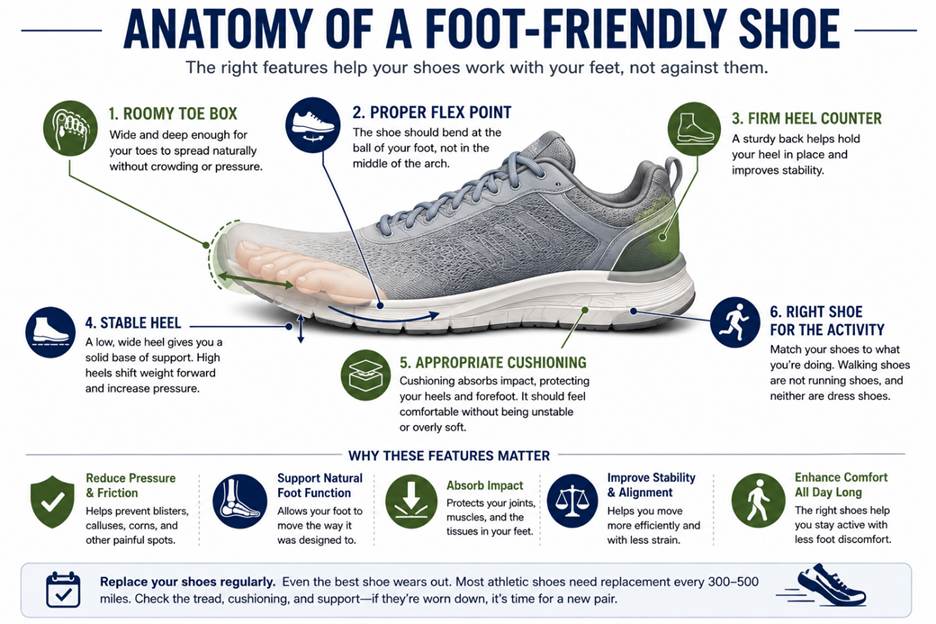
A good shoe fits the length, width, depth, and shape of your foot, provides appropriate support and cushioning, and is designed for the activity you’re doing. You don’t need the most expensive shoe in the store. You need the right one for your foot and what you do in it.
- Toe box: Wide and deep enough for your toes to spread. Rounded or square is usually better than pointed.
- Fit: Shop late in the day, when your feet are at their largest. Try on both shoes and walk in them. Wear the socks you’ll actually use.
- Support: The shoe should bend where your foot bends, at the ball, not in the middle of the arch.
- Heel: A firm heel counter that holds your heel in place. A low, wide heel is more stable than a high, narrow one.
- Cushioning: Enough to absorb impact, but not so soft that the shoe feels unstable.
- Activity: Running shoes for running, walking shoes for walking, work boots with real support for standing on concrete. A shoe designed for one job usually does a poor job at another.
“Expensive doesn’t mean right. I’ve seen people in $200 shoes that don’t fit their feet and people in $60 shoes that fit perfectly. Fit and support matter far more than the price tag.”
Podiatrist Dr. Jason Sweeley, Silver Spring Foot & Ankle
When Should You See a Podiatrist About Foot Pain and Shoes?
Try the easy fix first. If you suspect your shoes, switch to a well-fitting, supportive pair for a couple of weeks and see what changes. Many people feel better quickly.
Make an appointment if:
- The pain lasts more than two to three weeks after changing shoes
- You notice a bump, a toe that’s changing shape, or a nail that’s growing into the skin
- You have numbness, tingling, or burning that doesn’t go away
- The pain is sharp, sudden, or keeps you from walking normally
- You have diabetes or poor circulation and notice any sore, blister, or redness
Schedule an appointment with a DPM near you. They can tell you whether the shoe is the cause, a contributor, or a bystander. They can also fit you for inserts or custom orthotics if your foot needs more than an off-the-shelf shoe can give.
If you’re looking for a podiatrist in Mechanicsburg, Carlisle, or Harrisburg, Silver Spring Foot & Ankle sees patients from across Central PA. If you have serious foot discomfort and aren’t sure why, schedule an appointment and bring the shoes you wear most often. We’ll start there.
Frequently Asked Questions About Foot Pain and Shoes
Can bad shoes cause plantar fasciitis?
Not usually on their own. But unsupportive, ill-fitting, or worn-out shoes can increase stress on the plantar fascia and worsen heel pain. They can make recovery harder if you’re already dealing with plantar fasciitis.
Can tight shoes cause bunions?
Tight shoes don’t cause bunions on their own. Bunions come mostly from inherited foot structure. Tight, narrow shoes can make a bunion progress faster and hurt more.
Should you walk barefoot if your feet hurt?
Sometimes, on soft surfaces and for short periods. On hard floors, going barefoot often worsens heel and arch pain. If your feet hurt, a supportive shoe or house slipper is usually the better choice.
How often should you replace your shoes?
Running and walking shoes typically last 300 to 500 miles, or about six months to a year of regular use. Work shoes worn daily often need replacing sooner. If the sole wears unevenly or the cushioning feels flat, it’s time to replace them.
What shoes do podiatrists say not to wear?
The usual list includes high, narrow heels; flat flip-flops; ballet flats with no support; and any shoe that pinches your toes. None of these are off-limits forever, but they’re poor choices for all-day wear.
