
Most people cut their toenails the way they cut their fingernails. That’s the mistake.
Fingernails are easy to round and trim short. Toenails live inside shoes, carry your body weight, and grow into a tight fold of skin on each side. Cut them wrong, and you can create an ingrown nail, a sore toe, or an infection that can take weeks to clear up.
The right technique takes about two minutes and no special skill. Here’s how to do it, why it matters, and when trimming your own nails isn’t the best idea.
What Is the Right Way to Cut Your Toenails?
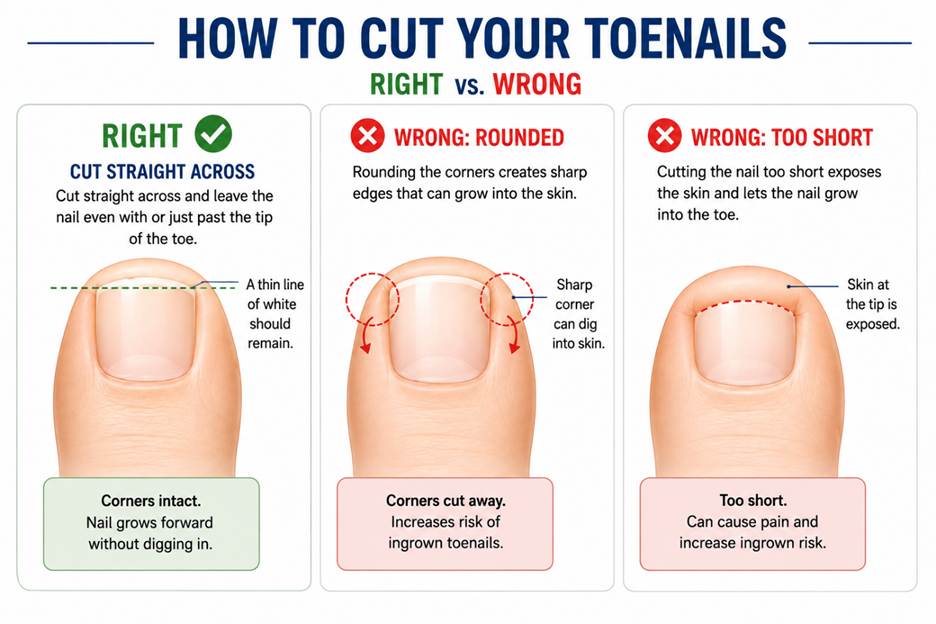
Cut straight across, leave a little length, use small clips instead of one big squeeze, and file the edges smooth. That’s the whole method.
- Cut when nails are dry or slightly softened. Dry toenails are easier to control. If your nails are unusually thick or hard, a brief soak in warm water can make trimming easier.
- Use toenail clippers, not fingernail clippers. Straight-edged toenail clippers are larger and make a flat cut. Small curved clippers pull you toward rounding the corners.
- Trim straight across. Don’t follow the curve of the toe. Take a few small clips across the nail rather than one heavy chop.
- Leave the nail even with or just past the tip of the toe. You should still see a thin white line on the nail.
- Don’t dig into the corners. Leave them alone. If a corner feels sharp, file it lightly rather than cutting it back.
- File rough edges with an emery board. Smooth edges don’t snag socks or catch on the skin.
- Clean your clippers. Wash them with soap and water or wipe them with rubbing alcohol. Don’t share them.
Should You Cut Toenails Wet or Dry?
For most people, dry. Soaked nails tend to bend under the clipper. They can split or tear instead of cutting cleanly. The exception is thick or hard nails, where a short soak in warm water softens them enough to cut with less force. If you soak, let the nails dry for a few minutes so they firm up before you trim.
What Kind of Toenail Clippers Should You Use?
Large, straight-edged toenail clippers or a nail nipper. The straight blade makes it easy to cut across the nail without curving. For thick nails, a heavy-duty nipper with a spring handle gives you more control and needs less force.
“Most of the ingrown toenails I treat didn’t start with an injury. They started with a pair of clippers and good intentions. People think shorter and rounder is cleaner. On a toenail, it’s the opposite.”
— Podiatrist Dr. Jason Sweeley, Silver Spring Foot & Ankle
Why Should You Cut Toenails Straight Across?
Because the corners of the nail are what grow into the skin.
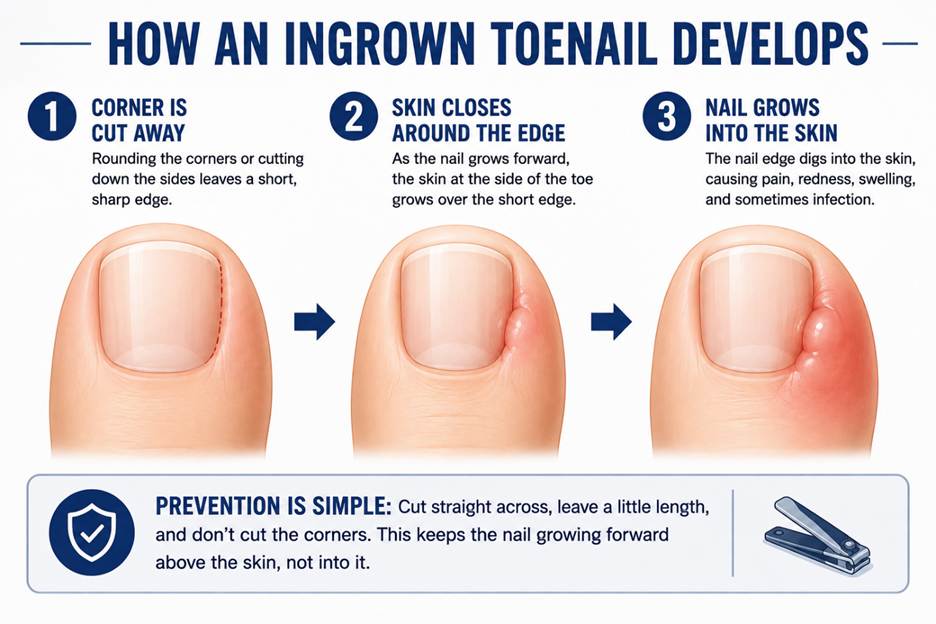
When you round or taper the corners, you leave a short, sharp edge at the side of the nail. As the nail grows forward, that edge has to push past the fold of skin beside it. If the skin has already closed over the spot where the corner used to be, the nail grows into the skin instead of over it. That’s an ingrown toenail.
A straight cut leaves the corners intact and resting on top of the skin. The nail grows forward with nothing to dig in.
To be fair to your clippers, cutting technique isn’t the only cause of ingrown nails. Some people inherit a nail that curves sharply. Tight shoes press the skin against the edge of the nail. Stubbing a toe or dropping something on it can change how the nail grows. But technique is the one cause you fully control, and it’s the one we see most often.
How Short Should You Cut Your Toenails?
Leave the nail even with the tip of the toe or just past it, with a thin white edge still visible. If the skin at the front of the toe is exposed, you’ve gone too short.
“Too short” is the second most common mistake, and it does two things.
First, it exposes the tender skin under the nail tip, which hurts with every step in a closed shoe.
Second, it allows the skin on the front and sides of the toe to push up and over the nail edge. When the nail grows back, it has to push through that skin, which can lead to an ingrown nail.
What If You Cut Your Toenail Too Short?
Let it grow out rather than trying to reshape it further. Keep the area clean and protect it from shoe pressure if it’s tender. Toenails grow about 1.5 millimeters a month (roughly a half inch), so it can take a couple of months to reach a comfortable length again. If redness, swelling, drainage, or increasing pain develops, have it evaluated.
What Can Happen if You Cut Your Toenails Wrong?
The problems from poor trimming range from a sore toe to an infection that needs treatment.
- Ingrown toenails: The most common result. A rounded or too-short nail edge grows into the skin, causing pain, redness, and swelling.
- Nail bed pain: Cutting too far back exposes the sensitive tissue under the nail and can bruise or tear it.
- Nicks and cuts: Cutting the skin beside the nail opens a door for bacteria.
- Infection: A small cut or an ingrown edge can become infected. Redness that spreads, warmth, throbbing pain, or pus means it’s time to call.
- Fungal infection: Damaged nails and dirty clippers both increase the odds of toenail fungus taking hold.
- Sharp spikes. A heavy chop can leave a splinter of nail along the side edge that grows straight into the skin.
How Do You Cut Thick Toenails?
Thick toenails need more patience and a stronger tool, not more force.
Soak the foot in warm water for 10 minutes to soften the nail and let it dry. Then use a heavy-duty nipper to take small bites across the nail rather than trying to cut through in one squeeze. File the surface and edges afterward. Cut more often, so you’re never dealing with a lot of nail at once.
Thick, yellowed, or crumbling toenails often signal a fungal infection. Cutting them at home gets harder over time and will eventually land you at a toenail doctor’s office.
Who Should Be Careful About Cutting Their Own Toenails?
For most people, trimming toenails at home is fine. For some, a small mistake can become a serious problem. Be careful, or let a podiatrist do it, if you:
- Have diabetes. Reduced feeling in the feet means you may not notice a nick or an ingrown edge until it’s infected, and slower healing gives infection time to spread. Our guide to diabetic foot care covers this in more detail.
- Have poor circulation or numbness in your feet for any reason.
- Can’t see or reach your feet well. Trimming by feel or at a bad angle can round corners and cut skin.
- Have thick, hard, or fungal nails that won’t cut cleanly with normal clippers.
- Keep getting ingrown toenails despite cutting straight across.
“If you have diabetes or you can’t feel your feet well, don’t treat your toenails as a do-it-yourself job. The cut you can’t feel is the one that ends up in my office three weeks later.”
— Podiatrist Dr. Jason Sweeley, Silver Spring Foot & Ankle
When Should a Podiatrist Cut Your Toenails?
A podiatrist should handle your nail care when trimming at home is risky or when there’s a problem you can’t fix with clippers.
That includes people with:
- Diabetes or foot neuropathy
- Thick or fungal nails
- Nails that keep growing in
- Anyone whose vision, mobility, or dexterity makes safe trimming hard
Routine nail care at the office is quick and painless. For higher-risk patients, it also serves as a routine check of the entire foot. Depending on your situation, we may recommend it every six to ten weeks. That’s roughly how long a properly trimmed nail takes to need attention again.
If you’re looking for podiatrists near you in Mechanicsburg, Carlisle, or Harrisburg, Silver Spring Foot & Ankle offers nail care and treats problems caused by improper nail trimming. If a toe is sore or red, or you’re not sure whether you should trim your own nails, schedule an appointment or call 717.237.9000.
Frequently Asked Questions About Cutting Toenails
How often should you cut your toenails?
About every six to eight weeks for most people. Toenails grow slowly, so trimming a little at a time on a regular schedule is easier. It’s also safer than cutting a lot at once.
Should you cut your toenails down the sides?
No. Cutting into the sides creates the sharp corner that grows into the skin. Trim straight across and leave the corners alone.
What happens if you never trim your toenails?
They grow long, thicken, curl, and press against the inside of your shoes. Long nails can lift away from the nail bed, tear, and cause pain or infection.
Why do podiatrists not recommend pedicures?
Most podiatrists don’t object to pedicures, but they do object to a few things that happen during them. That includes cutting cuticles, rounding the corners of the nails, and using tools that aren’t properly sterilized. If you get pedicures, ask the salon to cut straight across, leave the cuticles alone, and consider bringing your own tools. If you have diabetes, talk to your podiatrist first.
What’s the safest way to cut toenails for older adults?
Cut when nails are dry, in good light, with sturdy straight-edged clippers, and take small clips straight across. If reaching your feet or seeing them clearly has become difficult, or the nails have thickened, it’s safer to have a podiatrist trim them.
