
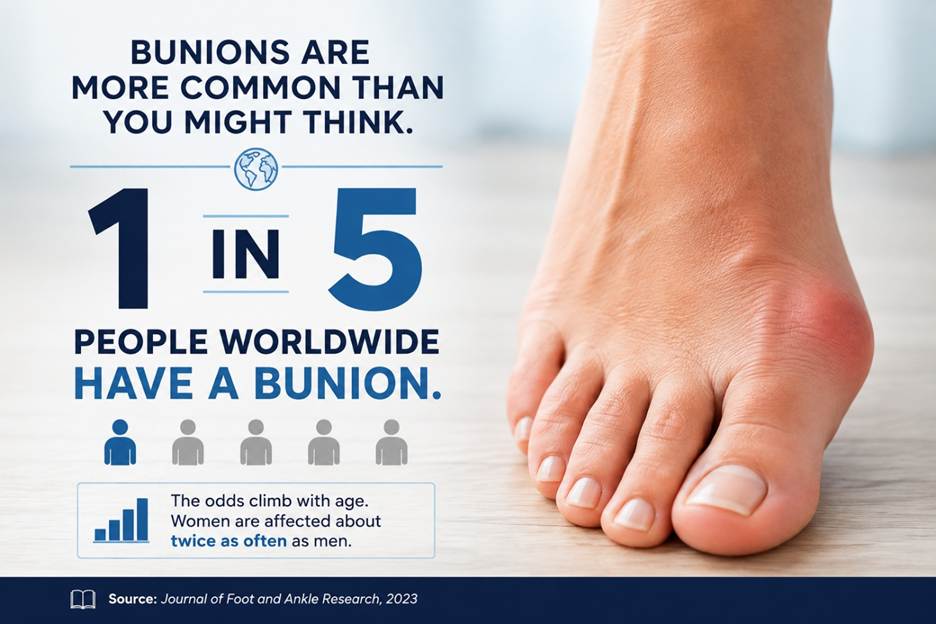
Bunions are far more common than that bump on the side of your foot might suggest. Research estimates that roughly 1 in 5 people worldwide has a bunion, and the odds climb with age. Women are affected about twice as often as men. But when it comes to treating bunions, there’s an important distinction between relieving the pain and correcting the bunion itself.
But here’s the question most people with a bunion actually want answered:
Can you make it go away without surgery?
The answer has two parts, and the distinction matters more than most people realize. You can almost always relieve bunion pain. Whether you can correct the bunion itself without surgery is a different question with a different answer.
Quick Answers About How to Treat Bunions
| Question | Short answer |
| Can a bunion go away on its own? | No. |
| Can you shrink a bunion naturally? | You can reduce symptoms, but not permanently realign the bones. |
| Do bunion pads and orthotics help? | Yes — they can reduce pressure and pain. |
| Does every bunion need surgery? | No. |
| When is surgery considered? | When pain or deformity significantly affects daily life despite conservative care. |
What Causes Bunions?
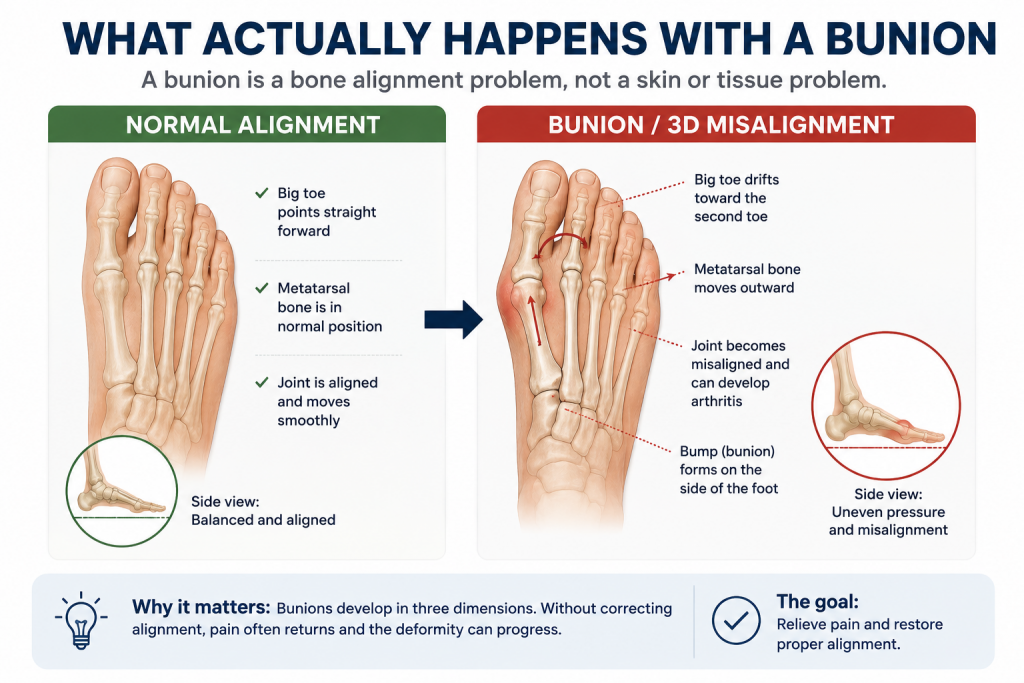
A bunion isn’t a growth or a buildup of bone that appeared. It’s a change in your foot’s alignment. The big toe drifts toward the second toe. The joint at the base of the big toe pushes outward, creating the bump you can see and feel. The medical name is hallux valgus.
That structural detail explains a lot about the treatment, so it’s worth holding on to. A bunion is a bone alignment problem, not a skin or tissue problem.
Bunions tend to develop from a combination of factors rather than a single cause:
- Foot structure and mechanics you inherit. Bunions run strongly in families. If a parent has one, your odds go up considerably. Not because the bunion itself is passed down, but because the foot shape and mechanics that lead to one are.
- Age. Alignment changes accumulate over years. Prevalence rises steadily with age.
- Sex. Women develop bunions roughly twice as often as men, a difference tied to both foot structure and footwear patterns.
- Footwear. Narrow, tight, or high-heeled shoes don’t necessarily cause a bunion, but they can aggravate a foot already prone to one and accelerate its progression.
- Prior foot injury. A history of foot trauma, including from athletics, can contribute.
Do High Heels Cause Bunions?
It’s worth clearing up one common myth here. You’ll often read that high heels cause bunions. They don’t. Your inherited foot structure and mechanics play a major role. Footwear is generally regarded as an aggravating factor rather than a direct cause. In short, shoes can make things worse, but blaming heels alone oversimplifies a condition that’s mostly structural.
“Patients often come in convinced they caused this to themselves with the wrong shoes. Usually, the bigger factor is the foot they were born with. Footwear can accelerate a bunion, but the underlying tendency was already there.”
— Podiatrist Dr. Jason Sweeley, DPM, Silver Spring Foot & Ankle
Can a Bunion Go Away on Its Own?
No. A bunion will not resolve on its own, and it will not reverse without intervention.
Because a bunion is a change in bone alignment, there’s no mechanism for the bones to drift back into place naturally. Left alone, bunions tend to stay the same or slowly progress over time. In one long-term study that followed older adults over seven years, bunions worsened in about 1 in 3 people and did not spontaneously improve.
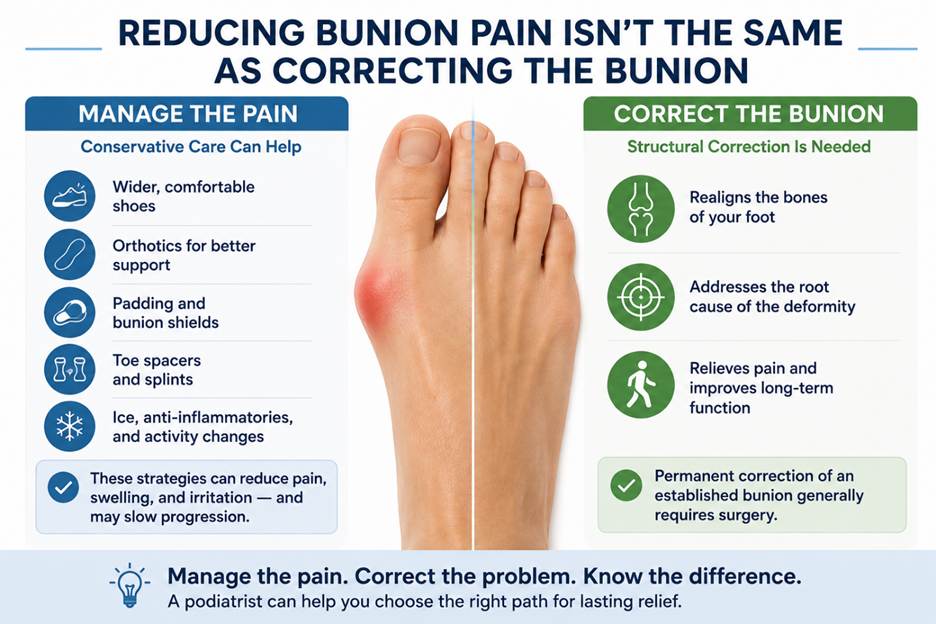
That doesn’t mean you’re out of options for treating bunions. It means the goal of non-surgical treatment isn’t to erase the bunion. It’s to manage symptoms and slow progression.
Can You Shrink or Reverse a Bunion Naturally?
Here’s where the pain-versus-correction distinction becomes essential.
You Cannot Shrink or Reverse a Bunion with Natural Remedies
No exercise, stretch, toe spacer, splint, or supplement realigns the bones of the foot. Claims that any of these “reverse” bunions don’t hold up to the evidence.
You Can Often Reduce Bunion Pain and Irritation Without Surgery
Sometimes dramatically. That’s a real and worthwhile goal. It’s just not the same as correcting the deformity.
Keeping those two goals separate saves a lot of frustration. If you go into conservative treatment expecting the bump to disappear, you’ll be disappointed. If you go in expecting relief and slower progression, conservative treatment often delivers.
What Do Podiatrists Recommend for Treating Bunions?
Conservative bunion treatment aims to reduce pressure on the joint, calm irritation, and prevent the bunion from worsening. A podiatrist will typically start here before surgery.
Common conservative approaches for how to treat bunions include:
- Better-fitting footwear. Wider shoes with a roomy toe box take direct pressure off the bunion. This approach is often the single most effective change a person can make, and it costs nothing beyond the shoes.
- Orthotics. Custom orthotics or over-the-counter inserts can improve how your foot distributes weight. That may reduce pain and, in some cases, help slow progression.
- Padding and bunion shields. Cushioning over the bump reduces friction against the shoe.
- Toe spacers and splints. These can improve comfort. They don’t permanently realign the toe.
- Anti-inflammatory measures. Ice, activity adjustments, and over-the-counter anti-inflammatories help manage flare-ups.
- Exercises. Foot and toe-strengthening exercises can support overall foot function and comfort. They won’t straighten the toe, but they’re a reasonable part of a comfort-focused plan.
Do Wider Shoes, Pads, Orthotics, or Exercises Actually Help?
Yes, for pain and pressure. The research on conservative treatment is consistent on this point. These measures can meaningfully improve comfort and function. The evidence is clear on what they don’t do: change the underlying bone position. Set expectations accordingly, and conservative care earns its place.
Is Walking Barefoot Good or Bad for Bunions?
There’s no strong evidence that going barefoot either causes or cures bunions. In fact, bunions are notably rarer in populations that habitually go unshod. That points back to tight footwear as an aggravating factor rather than barefoot walking as a treatment.
For most people, the practical takeaway is simpler. You want room for your toes. Whether that’s barefoot at home or in a wide-toe-box shoe matters less than avoiding narrow, cramped shoes that squeeze the joint.
What Happens If You Leave a Bunion Untreated?
A bunion isn’t a medical emergency, and plenty of people live with mild ones for years without much trouble. But “untreated” isn’t risk-free, because bunions tend to progress rather than stay the same.
Over time, an untreated bunion can lead to:
- Increasing pain, especially in shoes
- A larger, more prominent bump as the toe drifts further
- The big toe crowding or overlapping the second toe
- Related problems like calluses, corns, hammertoes, or pain spreading across the ball of the foot
- Difficulty finding shoes that fit comfortably
The practical point isn’t to alarm anyone. It’s that catching a bunion early gives you more good options for treatment. A mild bunion, managed well, may never need surgery. A severe one ignored for a decade leaves fewer non-surgical options.
“The best time to see someone about a bunion is when it first starts bothering you. Not years later, when it’s changed the whole front of your foot; early on, we can often manage it conservatively and keep it from progressing. People wait because it’s ‘just a bump.’ But earlier visits almost always mean simpler solutions for how to treat bunions.”
— Podiatrist Dr. Jason Sweeley, DPM, Silver Spring Foot & Ankle
When Does a Bunion Need Surgery?
Surgery isn’t automatic, and a bunion by itself, even a large one, isn’t necessarily a reason to operate. The decision usually depends on how much the bunion affects your life.
Surgery generally becomes a serious consideration when:
- Pain persists despite consistent conservative treatment
- The bunion limits your daily activities, work, or exercise
- The deformity is progressing or affecting other toes
- Everyday footwear has become genuinely difficult to wear comfortably
Notice what’s not on that list: cosmetic appearance alone. Correcting a bunion is a real surgical procedure with a real recovery. The goal is to restore function and relieve pain, not just to improve the foot’s appearance.
What Are the Surgical Options for How to Treat a Bunion?
Bunion surgery has advanced considerably, and there’s no single procedure that fits everyone. The right approach depends on the deformity’s severity, your foot’s specific mechanics, and your goals.
Broadly, surgical correction aims to realign the big toe joint bones and stabilize them in a corrected position. Older approaches focused mainly on shaving the bump and adjusting the toe. Modern techniques focus on correcting the underlying misalignment at the root of the problem. That makes recurrence less likely.
How Does Lapiplasty® Differ from Traditional Bunion Surgery?
Traditional bunion surgery often addresses the deformity in two dimensions. It aims to move the toe back toward alignment and remove the bump. The limitation is that many bunions are, in fact, three-dimensional problems. The bone is rotated, not just shifted sideways.
Failing to correct that frontal-plane rotation has been associated with a substantially higher risk of the bunion returning.
Lapiplasty® 3D Bunion Correction was designed to address that. It targets the deformity in all three dimensions, correcting the bone’s rotation and stabilizing the unstable joint at the bunion’s root.
The aim is a more complete correction and a lower likelihood of recurrence, and its fixation approach is intended to let many patients begin weight-bearing earlier in recovery than traditional methods typically allow.
“The way I frame it for patients is this. If your goal is pain relief, conservative treatment may be enough, and we’ll start there. If your goal is correcting the deformity itself so it doesn’t come back, that’s a different conversation. Lapiplasty lets us address the bunion in all three dimensions, which is a big part of why the correction tends to hold.”
— Podiatrist Dr. Jason Sweeley, DPM, Silver Spring Foot & Ankle
When to See a DPM About Bunion Treatment
You don’t need to wait until a bunion is severe to get it looked at. It’s worth booking an appointment if:
- Your bunion is painful, in shoes or out of them
- It’s getting visibly larger, or the toe is drifting
- It’s affecting how you walk, work, or stay active
- You’re having trouble finding shoes that fit
- You want to know your options before it progresses further
A local podiatrist can tell you where your bunion actually stands, what’s realistic with conservative care, and whether correction is worth considering.
Silver Spring Foot & Ankle treats patients in Harrisburg, Mechanicsburg, Carlisle, and communities throughout Cumberland, Dauphin, and Perry Counties. If a bunion is starting to get in your way, an evaluation by a DPM is the fastest route to a clear answer.
Frequently Asked Questions About How to Treat a Bunion
Can a bunion go away on its own?
No. A bunion is a change in the alignment of the bones in your foot, and it won’t reverse without treatment. Left alone, bunions tend to stay the same or slowly worsen over time. Conservative treatment can reduce pain and slow progression, but it can’t make an existing bunion disappear.
How do you shrink a bunion naturally?
You can’t shrink or reverse a bunion with natural remedies, exercises, or devices because none of them realign the bones. To reduce pain and irritation naturally, wear wider shoes, use padding, adjust your activity, and manage inflammation. Those measures target symptoms, not the deformity itself.
Can foot bunions be corrected?
Yes, but permanent structural correction of an established bunion generally requires surgery. Non-surgical treatment manages symptoms and can slow progression. Surgical procedures like Lapiplasty® realign and stabilize the joint to correct the underlying problem.
What triggers bunions?
Bunions usually develop from a combination of inherited foot structure and mechanics, age, and sometimes footwear or prior injury. Tight or high-heeled shoes can aggravate and accelerate a bunion but aren’t the sole cause.
Is walking barefoot better for bunions?
Going barefoot won’t cure a bunion, but it also won’t harm one. Bunions are notably rarer in populations that habitually go unshod. The useful takeaway is that toe room matters. Avoiding narrow, cramped shoes helps more than any barefoot “treatment.”
Is it okay to leave a bunion untreated?
A mild, pain-free bunion isn’t dangerous to leave alone. But because bunions tend to progress, untreated ones can grow, become painful, crowd other toes, and lead to related foot problems. Earlier evaluation generally means simpler, more effective options.
What do podiatrists recommend for bunions?
Podiatrists typically start with conservative care: better-fitting footwear, orthotics, padding, and measures to control pain and inflammation. If those don’t provide enough relief and the bunion is affecting your life, surgical correction may be discussed.
When does a bunion need surgery?
Surgery is generally considered when pain persists despite conservative treatment, the bunion limits daily activity, the deformity is progressing, or footwear has become difficult to manage. Appearance alone usually doesn’t warrant surgery.
