
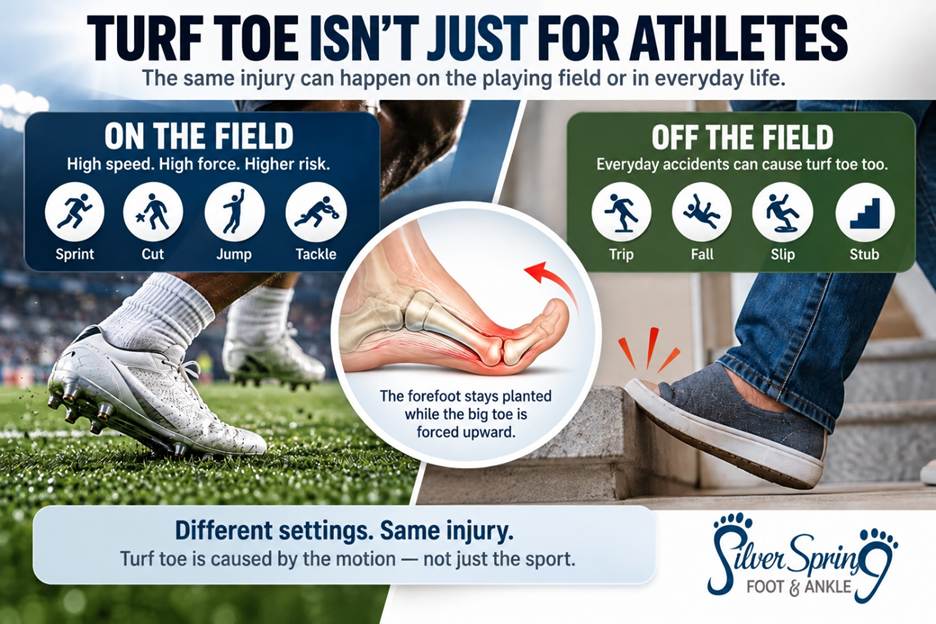
You don’t have to play football, run track, or even consider yourself an athlete to sprain your turf toe.
Turf toe is a sprain of the joint at the base of your big toe and the tissues that support it. It’s strongly linked to sports, but it can happen anytime the big toe is forced upward too far. A fall, a hard stubbed toe, or another everyday accident can cause the same injury.
Athletes do get it more often. Research has found turf toe in 10.9% of elite college football players. Earlier studies report that 30% to 45% of professional football players experience it at some point in their careers.
But if the base of your big toe is painful, swollen, or hard to move, don’t rule out turf toe just because you don’t play sports.
Key Takeaways
- Turf toe is a sprain of the big toe joint (the first MTP joint) and the soft tissue under it.
- It happens when the big toe bends upward too far, usually with the ball of the foot planted.
- Anyone can get it. Stubbing your toe, falling, or tripping can cause it.
- It’s graded 1 to 3. Mild cases heal in days to a couple of weeks. Severe cases can take months and sometimes need surgery.
- Trying to push through it is the most common mistake. Untreated turf toe can lead to lasting pain, stiffness, and joint problems.
- A podiatrist can confirm the diagnosis, rule out a fracture, and get you back on your feet safely.
What Is a Turf Toe Sprain?
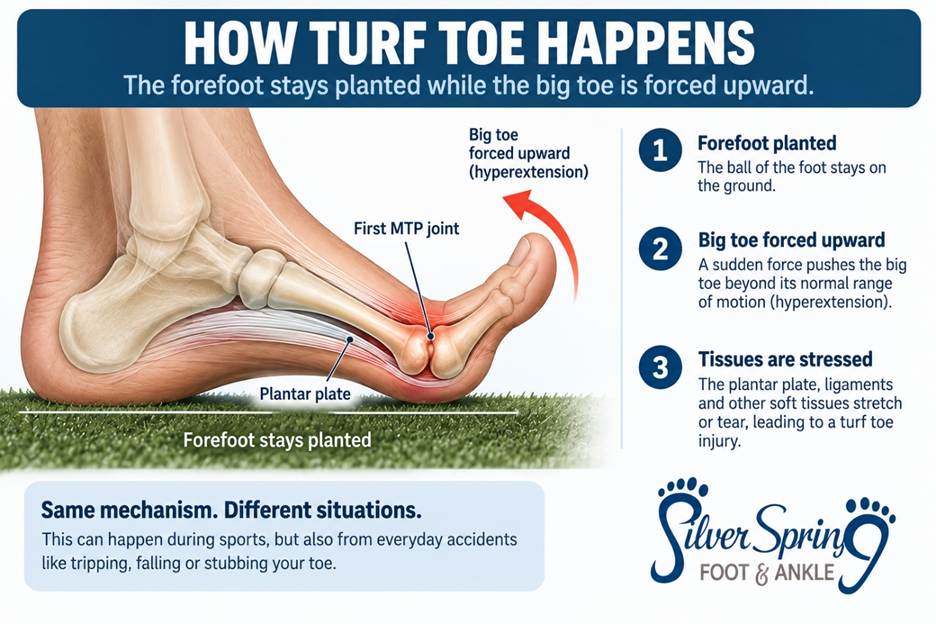
Turf toe is a sprain of the first metatarsophalangeal (MTP) joint. That’s the joint where your big toe meets your foot.
Ligaments, tendons, and a thick band of tissue called the plantar plate sit under that joint. Together, they keep the toe stable and let you push off when you walk, run, or jump. When the toe bends up too far and too fast, the tissues stretch or tear. That’s turf toe.
The name dates back to the 1970s, when artificial turf became common in football stadiums. The harder surface and more flexible cleats led to a rise in these injuries. But the injury itself isn’t tied to turf. It’s tied to the motion.
Can You Get Turf Toe If You’re Not an Athlete?
Yes. Turf toe is defined by how the toe is injured, not by who is injured.
The injury happens when you plant your foot, and something drives your big toe upward past its normal range. In football, that’s a player landing on the back of your heel. In daily life, it can be:
- Stubbing your toe hard against a step, curb, or furniture
- Tripping and catching your toe as you fall
- Slipping on ice or a wet floor and jamming your foot
- A car accident, where the foot is braced on the brake or floorboard at impact
- Wearing very flexible or unsupportive shoes, like flip-flops, that let the toe bend too far
It’s not unusual for a foot doctor in Mechanicsburg, Carlisle, or Harrisburg to see turf toe in someone who hasn’t played a sport in years. A slip on an icy porch step in January or a trip over a garden hose in July can do it. A week later, they’re still limping.
The common thread is sudden pain at the base of the big toe after bending the toe backward. If that sounds familiar, it’s worth having it checked.
“People hear the name and assume it can’t apply to them. It can. The toe doesn’t know whether you’re on a football field or a sidewalk.”
Podiatrist Dr. Jason Sweeley, Silver Spring Foot & Ankle
Why Is the Injury So Common in Athletes?
Athletes get turf toe more often because they repeatedly put the big toe joint in a risky position. Plus, they do it at high speed, with a lot of force.
Pushing off to sprint, cut, or jump loads the ball of the foot. If the toe gets caught, or another player lands on the heel, the joint gets forced past its limit.
The research on football players is striking:
- One study found turf toe in 10.9% of elite college football players.
- Earlier studies report that 30% to 45% of NFL players have had turf toe during their careers.
- NCAA injury surveillance found players were nearly 14 times more likely to suffer turf toe in a game than in practice.
- The same data showed a higher injury rate on newer artificial surfaces than on natural grass.
- Running backs and quarterbacks were the positions most often affected.
Football gets the headlines, but turf toe also shows up in soccer, basketball, wrestling, dance, gymnastics, and martial arts. Any activity with hard pushing off or a planted forefoot carries some risk.
Footwear matters too. Very flexible shoes let the toe bend further than stiff-soled shoes do. That’s true for athletes and for anyone else.
Turf Toe Symptoms
Turf toe symptoms show up at the base of the big toe, on the top or the underside of the joint. Common signs include:
- Pain at the base of the big toe, especially when you push off or bend the toe upward
- Swelling around the joint
- Bruising on the top or bottom of the foot near the toe
- Tenderness when you press on the joint
- Stiffness or limited motion in the big toe
- A feeling that the joint is loose or unstable (in more serious injuries)
Mild turf toe may feel like a sore, stiff toe that gets worse with activity. A severe injury can make it hard to put any weight on the ball of your foot.
Symptoms can also build over time. Some people don’t remember one big moment. They notice the toe hurts more each week. That’s more common in athletes with repeated stress on the joint.
Turf Toe Grades: Grade 1, Grade 2, and Grade 3
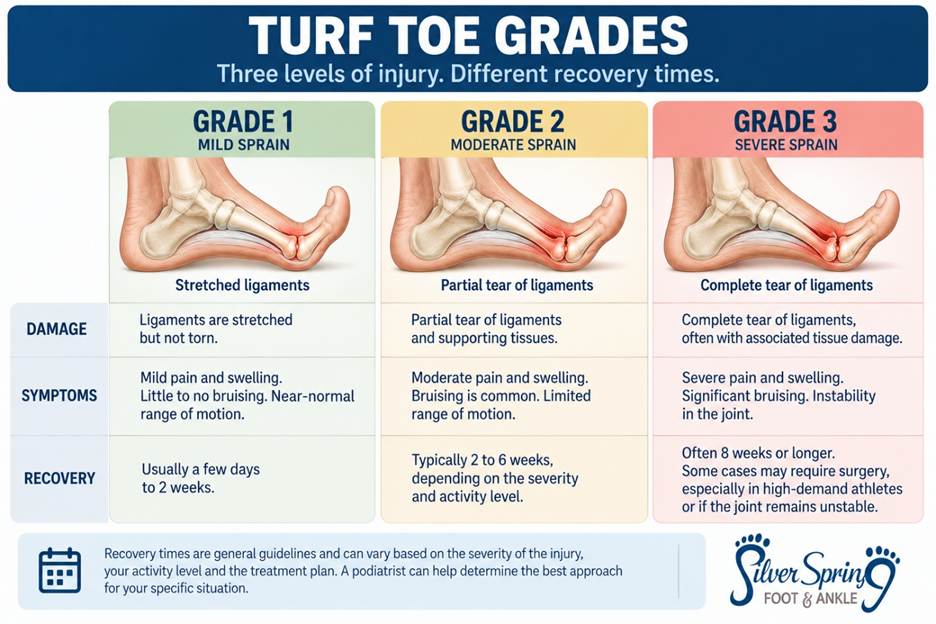
Doctors grade turf toe by how much damage the tissues under the joint sustain. The grade tells you a lot about treatment and how long recovery will take.
Grade 1
The ligaments and plantar plate are stretched but not torn. You’ll have some pain and mild swelling, but you can usually still walk and bear weight. Most people recover in a few days to two weeks with rest and protection.
Grade 2
There’s a partial tear of the soft tissue. Expect more pain, more swelling, bruising, and limited motion. Walking is painful. Recovery often takes two to six weeks, and you need to protect the joint while it heals.
Grade 3
The plantar plate or ligaments are completely torn. In some cases, the small bones under the joint (the sesamoids) are fractured or displaced. The pain and swelling are severe, and you may not be able to bear weight on the toe. Recovery can take eight weeks or more, and some grade 3 injuries need surgery.
These recovery ranges follow the grading system used by the American Academy of Orthopedic Surgeons and in published sports medicine reviews of turf toe. Grade alone doesn’t tell the full story, though. Your age, activity level, and how quickly you get treatment all affect how well you heal.
How Is a Turf Toe Injury Diagnosed?
A physical exam diagnoses turf toe. Imaging is added when the exam calls for it.
At your appointment, a podiatrist will ask how the injury happened and check the joint for swelling, bruising, and tenderness. They’ll test how far the toe can move and whether the joint feels stable when it’s pushed in different directions.
A podiatrist may order X-rays to rule out a fracture and check the position of the sesamoid bones. X-rays won’t show a soft tissue sprain on their own. If the exam suggests a more serious injury, an MRI can show how much of the plantar plate or ligaments have torn.
Getting the diagnosis right matters. Several other conditions can mimic turf toe, including a sesamoid fracture, sesamoiditis, a bunion flare-up, gout, or a toe fracture. Each of these is treated differently. Guessing wrong can cost you weeks.
“A sore big toe isn’t always turf toe, and turf toe isn’t always mild. The exam and the X-ray are how we tell the difference. That’s not something you want to work out on your own with a bag of frozen peas.”
Podiatrist Dr. Jason Sweeley, Silver Spring Foot & Ankle
How Do You Treat Turf Toe?
Treatment depends on the injury grade. Most turf toe sprains heal without surgery, but they need protection while they do.
Mild to Moderate (Grade 1 and 2)
- Rest. Stop the activity that caused it. Pushing through a turf toe injury is the fastest way to make it worse.
- Ice and elevation. Ice for 15 to 20 minutes at a time during the first few days to control swelling.
- Compression. A light wrap can reduce swelling.
- Taping. Taping the big toe to limit upward bending takes stress off the healing tissue. A podiatrist can show you how to do this correctly.
- Stiff-soled shoes. A rigid shoe or a carbon-fiber insert keeps the toe from bending. Keep flexible shoes in the closet until the joint heals.
- Walking boot. For grade 2 injuries, you may need a boot for a few weeks.
- Anti-inflammatory medication. Over-the-counter options can help with pain and swelling. Ask your doctor first if you have other health conditions.
Once the pain settles, gentle range-of-motion exercises and strengthening help the joint recover fully.
Severe (Grade 3)
Grade 3 injuries need longer immobilization, often in a boot or cast, followed by a structured rehab program. If the plantar plate is fully torn, the sesamoids are out of place, or the joint stays unstable, surgery may be needed to repair the tissue.
Surgery is uncommon. NCAA data show fewer than 2% of turf toe injuries required an operation. But when it’s needed, it’s needed. Skipping it can leave you with a joint that never works right.
How Long Does Turf Toe Take to Heal?
There’s no single answer. Recovery depends on the injury grade and how well you protect it while it heals.
A rough guide:
- Grade 1: A few days to two weeks
- Grade 2: Two to six weeks
- Grade 3: Eight weeks to several months, longer if surgery is needed
Professional football gives a real-world picture of how long this can take. In a study of NFL players injured between 2010 and 2015, those who returned within the same season averaged 37 days. Three of the 24 players needed season-ending surgery. College players in NCAA injury surveillance data, whose injuries were milder on average, lost about 10 days.
Those are elite athletes with full-time medical teams. For most people, the timeline depends on how quickly the swelling subsides, how well the toe moves, and whether you can push off without pain.
Rushing back is the biggest risk. A grade 1 that’s pushed too hard can become a lingering problem that takes much longer to fix.
Can You Play Sports With Turf Toe?
With a mild injury and the right protection, sometimes. With a moderate or severe injury, no.
Returning to sports too early is the most common mistake in turf toe injuries. The pain may fade before the tissue is actually healed. Pushing off on a partly torn plantar plate can finish the tear.
“One of the biggest mistakes athletes make with turf toe is trying to play through it. A more serious sprain can become a lingering problem if the joint doesn’t have time to heal. I’d rather see someone miss two weeks now than the rest of the season.”
Podiatrist Dr. Jason Sweeley, Silver Spring Foot & Ankle
Before returning to play, you should be able to bend the toe upward without pain, push off at full strength, and run or cut without limping. Taping or a stiff insole can help protect the joint during the first weeks back.
What Happens If a Turf Toe Sprain Goes Untreated?
An untreated turf toe sprain, or one pushed through before it heals, can cause long-term joint problems.
Complications documented in the sports medicine literature include:
- Persistent pain and stiffness in the big toe joint
- Loss of push-off strength, which changes how you walk and run
- Joint instability, where the toe feels loose or drifts out of position
- Hallux rigidus, a form of arthritis that stiffens the joint over time
- Progressive deformity, including a toe that cocks upward or a bunion that gets worse
- Sesamoid problems, since those small bones sit right in the injured area
These problems are much harder to fix than the original sprain. The big toe joint plays an important role in pushing your body forward with each step. A joint that doesn’t work properly can affect the way you walk.
If the base of your big toe has been hurting for more than a few days after a fall, a stubbed toe, or a hard push-off, get it checked out.
When to See a Podiatrist for Turf Toe
Make an appointment if you have:
- Pain at the base of the big toe that lasts more than a few days
- Swelling or bruising around the joint
- Trouble bending the toe or pushing off when you walk
- A toe that feels loose or unstable
- Pain that came on after a fall, a stubbed toe, or an awkward landing
You don’t need to be an athlete, and you don’t need to wait to see if it gets better on its own. A podiatrist can examine the joint, determine whether imaging is needed, and tell you what you’re dealing with and how to treat it.
If you’re searching for podiatrists near you in Mechanicsburg, Carlisle, or Harrisburg, Silver Spring Foot & Ankle can evaluate your big toe, rule out a fracture, and develop a treatment plan to get you back on your feet.
Turf Toe Sprain FAQs
Can you get a turf toe sprain if you’re not an athlete?
Yes. Turf toe is a sprain of the big toe joint caused by the toe bending too far upward. It can happen from a fall, stubbing your toe, slipping on ice, or a car accident. Athletes get it more often, but anyone can. If the base of your big toe is painful and swollen after an injury like that, see a podiatrist.
What causes turf toe?
Turf toe happens when the big toe is forced upward past its normal range while the ball of the foot is planted. Common causes include pushing off hard in sports, another player landing on the heel, stubbing or jamming the toe, falls, and wearing very flexible shoes that let the toe bend too far.
Should I go to the ER for turf toe?
Usually not. A turf toe injury isn’t an emergency. But if the toe looks deformed, you can’t put any weight on your foot, or you heard a pop at the time of the injury, get it checked right away. Urgent care or a podiatrist can rule out a fracture or a dislocation.
What can be mistaken for turf toe?
A sesamoid fracture, sesamoiditis, a broken toe, a bunion flare-up, and gout can all cause pain in the same spot. A podiatrist tells them apart with an exam and, when needed, imaging.
How painful is a turf toe sprain?
It ranges from a sore, stiff toe (grade 1) to pain that keeps you from bearing weight (grade 3). Pain is usually worst when you bend the toe upward or push off.
Can you walk with turf toe?
Often, yes, but it hurts. Walking on a mild turf toe is fine as long as you protect the toe. Walking on a severe one can worsen the injury. Stiff shoes or a boot make walking safer while it heals.
Does a turf toe injury require surgery?
Rarely. Most turf toe heals with rest and protection. Surgery is reserved for complete tears, unstable joints, or sesamoid injuries that don’t heal on their own.
What is stage 3 turf toe?
Stage 3, or grade 3, turf toe is a complete tear of the plantar plate or ligaments under the big toe joint. It may include a sesamoid fracture. It’s the most serious grade and the one most likely to need surgery.
How do you tape a turf toe sprain?
Taping anchors the big toe so it can’t bend upward past a safe point. A podiatrist can show you the technique. If done wrong, taping can cut off circulation or fail to protect the joint.
