
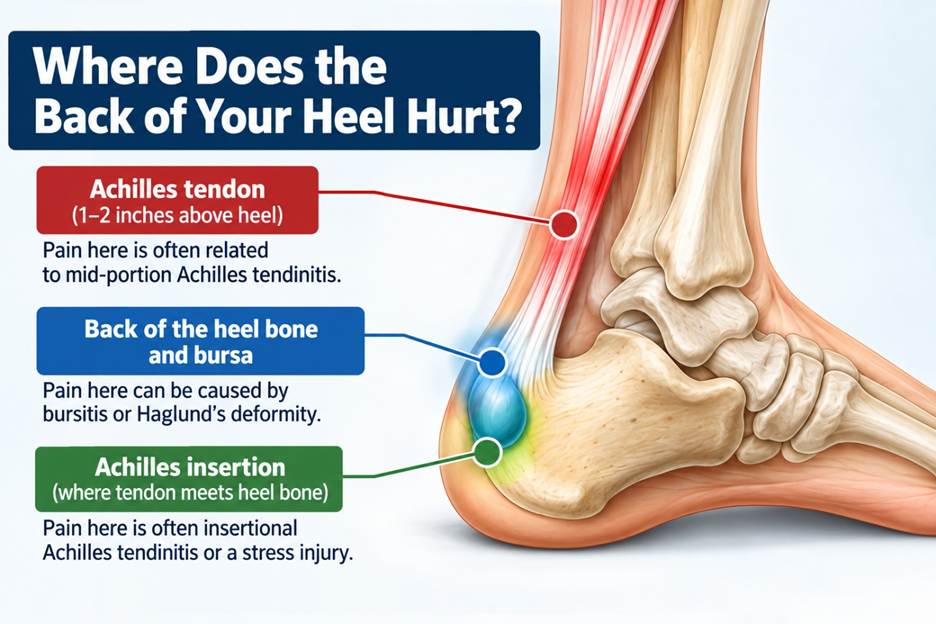
Pain in the back of your heel usually comes from the Achilles tendon or the tissue and bone around where it attaches. The most common causes are Achilles tendinitis, bursitis, and a bony bump called Haglund’s deformity. Less often, it’s a stress fracture or an irritated nerve.
These problems sit within an inch or two of each other, so they’re easy to confuse. Where exactly it hurts and when it hurts are the best clues to which one you have.
It’s common, especially as we get older. In a large study of adults aged 50 and older, about 1 in 8 reported pain in the back of the heel. More than half said it interfered with daily life.
Key Takeaways
- Most common causes: Achilles tendinitis, bursitis, and Haglund’s deformity cause most pain in the back of the heel.
- Location matters: Pain right on the heel bone and pain an inch or two above it are often different problems.
- Timing gives clues: Morning stiffness, pain when you run, and pain from shoes each point to something different.
- A pop is urgent: A sudden pop or snap followed by weakness could be a torn Achilles tendon. Get it checked right away.
- Most cases don’t need surgery: Activity and footwear changes, strengthening, and in-office care settle most cases.
- Two weeks is a fair test: If home care hasn’t clearly helped by then, it’s time for a diagnosis.
What Causes Pain in the Back of the Heel
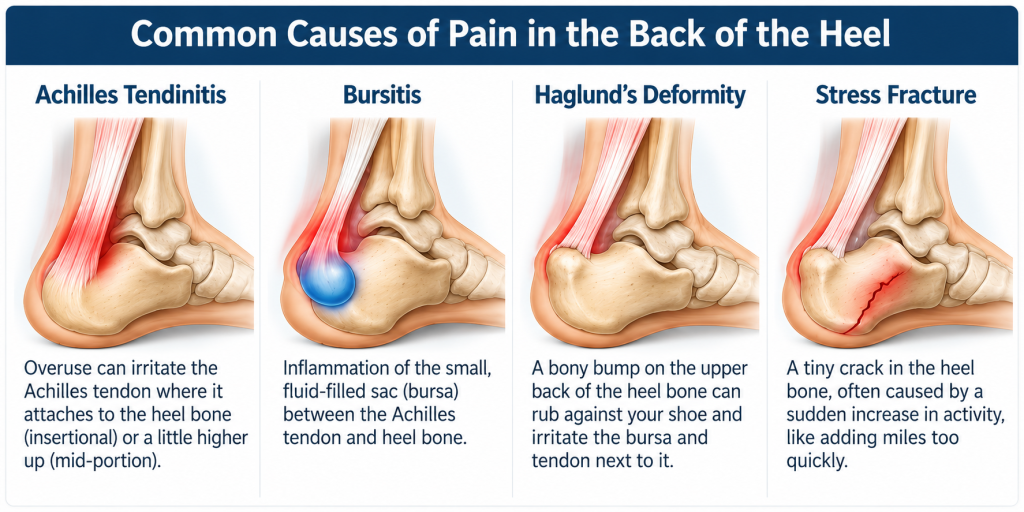
Most pain in the back of the heel starts in one of four places:
- The Achilles tendon
- The bursa beside it
- The heel bone under it
- A nearby nerve
Achilles Tendinitis
The Achilles tendon connects your calf muscles to your heel bone. Overuse can irritate it in two different spots:
- Where the tendon meets the heel bone, this is called insertional Achilles tendinitis. The pain sits low, right on the back of the heel.
- An inch or two above the heel. This is the middle part of the tendon. It may feel thick, tender, or sore when you pinch it.
The two respond to different stretches and exercises, so knowing which one you have matters.
Bursitis
A bursa is a small, fluid-filled sac that cushions the space between the Achilles tendon and the heel bone. When it’s irritated, the back of the heel can look puffy and feel warm or tender, especially in shoes with a stiff back.
Haglund’s Deformity
Haglund’s deformity is a bony bump on the upper back of the heel bone. The bump itself may not hurt. Pain occurs when it rubs against your shoe, irritating the bursa and adjacent tendon.
Stress Fracture
A stress fracture is a tiny crack in the heel bone. It usually follows a sudden spike in activity, such as adding miles too quickly. The pain feels deep, and squeezing the heel from both sides often hurts.
Less Common Causes
An irritated nerve can cause burning or tingling along the back or outer edge of the heel. Some forms of arthritis can inflame the spot where the Achilles attaches, often in both heels at once. In active kids, pain in the back of the heel usually comes from a growth plate issue called Sever’s disease.
What the Timing of Your Pain Can Tell You
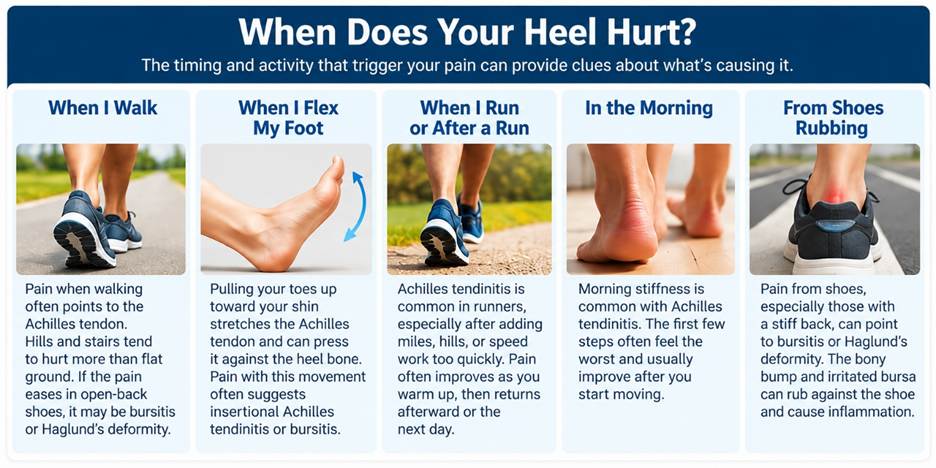
When your heel hurts is a clue, not a diagnosis. Several of these problems overlap, and you can have two at once. Still, the pattern helps narrow things down when treating heel pain.
Back of Heel Pain When Walking
Pain in the back of the heel when you walk most often points to the Achilles tendon. The tendon works hardest when you push off your toes, so hills and stairs tend to hurt more than flat ground.
Pay attention to your shoes, too. If the pain eases in sandals or open-back shoes, something is being rubbed. That points toward bursitis or Haglund’s deformity. Pain that builds with every step and doesn’t let up when you change shoes deserves a closer look for a stress fracture.
Back of Heel Pain When Flexing Your Foot
Pulling your toes up toward your shin stretches the Achilles tendon and presses it against the heel bone. If that movement is low on the heel, the usual suspects are insertional Achilles tendinitis and bursitis.
Pain when you point your toes or rise up on them is a little different. That’s the tendon working under load, and it suggests the tendon itself is irritated.
Back of Heel Pain When Running or After a Run
Achilles tendinitis is one of the most common running injuries. It often shows up after you add miles, hills, or speed work too quickly, which is easy to do when you’re training for a fall race like the Harrisburg Marathon.
An irritated tendon tends to follow a pattern. It hurts at the start of a run, loosens up as you warm up, then aches afterward or the next morning. Pain that worsens the longer you run and lingers after you stop is more worrying. That pattern can mean a stress fracture, and it’s a reason to stop running until you’ve been examined.
Back of Heel Pain in the Morning
Stiffness and soreness at the back of the heel when you first get up usually point to the Achilles tendon. The tendon tightens overnight, and the first few minutes of walking stretch it back out.
This is easy to mix up with plantar fasciitis, which also hurts first thing in the morning. The difference is location. Plantar fasciitis hurts on the bottom of the heel. Achilles problems hurt on the back.
Morning stiffness in both heels that lasts well into the day can signal an inflammatory condition, and it’s worth mentioning to your doctor.
A Painful Bump on the Back of the Heel Bone
A hard bump on the back of the heel is usually Haglund’s deformity or a bone spur where the Achilles attaches. Some people describe it as an extra bone on the heel. Shoes with rigid backs, like dress shoes, work boots, and skates, make it worse.
If the area around the bump is red, swollen, or squishy, the bursa is probably inflamed as well.
What Can Be Mistaken for Achilles Pain
Bursitis, Haglund’s deformity, and stress fractures are the problems most often mistaken for Achilles tendinitis. They all hurt in the same small area, but each has something that sets it apart.
| Condition | Where It Hurts | What Sets It Apart |
| Achilles tendinitis | On the tendon, at the heel bone or just above it | Stiff in the morning, sore when pushing off |
| Bursitis | Deep, between the tendon and the heel bone | Puffy and tender, worse in stiff-backed shoes |
| Haglund’s deformity | Upper back corner of the heel bone | A hard bump you can feel |
| Stress fracture | The heel bone itself | Hurts when you squeeze the heel from both sides |
| Nerve irritation | Back or outer edge of the heel | Burning, tingling, or numbness |
| Sever’s disease | Back of the heel in a growing child | Shows up during growth spurts and sports seasons |
This matters because the treatments differ. A stretch that helps one of these can aggravate another, and a stress fracture needs rest that tendinitis doesn’t.
If You Felt a Pop, Don’t Wait
A sudden pop or snap in the back of your heel or lower calf can mean a torn Achilles tendon. People often say it felt like being kicked or hit from behind.
Signs of a possible tear include:
- A pop or snap you felt or heard
- Sudden, sharp pain in the back of the heel or calf
- Trouble pushing off the foot or standing on your toes
- A gap or dent you can feel in the tendon
The pain can fade quickly, and some people can still walk. Don’t let that fool you. A torn Achilles is easier to treat when caught early, so see a podiatrist right away.
How to Treat Pain in the Back of the Heel
Most heel pain improves without surgery. The goal is to take stress off the irritated spot while it calms down, then rebuild the tendon’s strength.
What You Can Do at Home
For mild pain in the back of the heel, a few simple changes can reduce stress on the area and give it time to recover. The right approach depends on what’s causing the pain, but these steps can help in many cases:
- Ease off, but keep moving. Cut back on running, jumping, and hills. Walking on flat ground, swimming, and cycling are usually fine.
- Try a heel lift. A small lift inside both shoes shortens the distance the Achilles has to stretch. It’s a short-term fix, not a permanent one.
- Change what touches your heel. Shoes with a soft or padded heel, or an open heel, prevent the rubbing that contributes to bursitis and Haglund’s deformity.
- Skip flat shoes and bare feet. Both make the Achilles stretch farther with every step.
- Stretch gently. Easy calf stretches help most Achilles problems. If your pain is right on the heel bone, don’t drop your heel off the edge of a step. That deep stretch can make it worse.
- Use ice after activity for 15 to 20 minutes, with a cloth between the ice and your skin.
How a Foot Doctor Can Help
An exam pins down which structure is causing the pain. X-rays can show a bony bump, a spur, or a fracture, and other imaging can show the tendon itself. From there, treatment may include:
- A strengthening plan. Slow, controlled heel-lowering exercises are a mainstay for Achilles problems. The right version depends on where the tendon hurts.
- Custom orthotics or heel lifts. These change how force moves through the heel.
- A walking boot. A boot rests a stress fracture or a badly irritated tendon.
- Shockwave therapy. Sound waves stimulate healing in tendon pain that hasn’t responded to other care. Look for podiatrists near you who offer shockwave therapy.
- Surgery. It’s a last resort, usually considered only after months of other treatment.
One treatment to be careful with is a steroid injection. Doctors generally avoid injections in the Achilles tendon itself. For a full list of options, see our guide to heel pain treatment.
Will Heel Pain Go Away on Its Own?
Sometimes. Mild soreness from one hard workout or a new pair of shoes often settles within a week or two once you back off.
Tendon problems are slower. Tendons don’t get much blood flow, so they heal more slowly than muscle. Pain that’s been building for months usually takes months to resolve, even with good care.
What rarely works is ignoring it. Pushing through Achilles pain tends to turn a short-term problem into a stubborn one. If two weeks of home care hasn’t clearly helped, or the pain keeps coming back, get a diagnosis.
“With pain in the back of the heel, I start by pressing on three spots: the tendon, the place where it meets the bone, and the sides of the heel. Which one is tender tells me more than almost anything else. An inch in either direction can change the diagnosis.”
Podiatrist Dr. Jason Sweeley, DPM, Silver Spring Foot & Ankle
Back of Heel Pain FAQs
What Are Two Signs of Achilles Tendinitis?
The two most common signs are stiffness at the back of the heel first thing in the morning and soreness along the tendon during or after activity. The tendon may also look thicker or feel tender when you pinch it.
What’s the Quickest Way to Get Rid of Achilles Tendinitis?
There’s no shortcut, but starting early is the fastest route. Cut back on the activity that triggered it, use a heel lift, and begin a strengthening plan. Pushing through the pain slows recovery.
How Long Does an Achilles Strain Take to Heal?
It depends on how long it’s been going on. A mild, recent strain can settle in a few weeks. A tendon that’s been sore for months often needs steady work for a few months.
Is Walking Good for Pain in the Back of the Heel?
Easy walking on flat ground in supportive shoes is usually fine and better than complete rest. Avoid hills and stairs when you can. Stop if the pain increases as you go.
What Shoes Help With Pain in the Back of the Heel?
Look for good cushioning, a heel that sits slightly higher than the toe, and a soft or padded back. Avoid rigid heel counters, flat shoes, and worn-out pairs. [Link: footwear pillar post]
Heel Pain Treatment in Mechanicsburg, Carlisle, and Harrisburg
Pain in the back of your heel can have multiple causes, and the right treatment depends on the cause. If you’re looking for podiatrists in Mechanicsburg, Carlisle, or Harrisburg, Silver Spring Foot & Ankle can find the source and build a plan to fix it. Schedule an appointment or call 717.237.9000.
