
Foot blisters are a small injury with an outsized ability to ruin your day. The good news is that most blisters heal on their own in about a week if you protect them and stop whatever caused them. The bad news is that most of what people believe about blisters, including why they form and how to prevent them, is outdated.
Foot blisters are especially common among runners and hikers. Research has found them in 16% to 76% of runners and 29% to 95% of hikers, depending on the activity, conditions, and population studied. On long-distance hikes, blisters showed up four times more often than tendinitis and six times more often than ankle sprains.
If you’ve hiked the Appalachian Trail through Boiling Springs or trained for the Harrisburg Marathon, you probably don’t need the statistics. You’ve had one.
Here’s what to do about the blister you have now, and how to keep the next one from forming.
What Causes Foot Blisters?
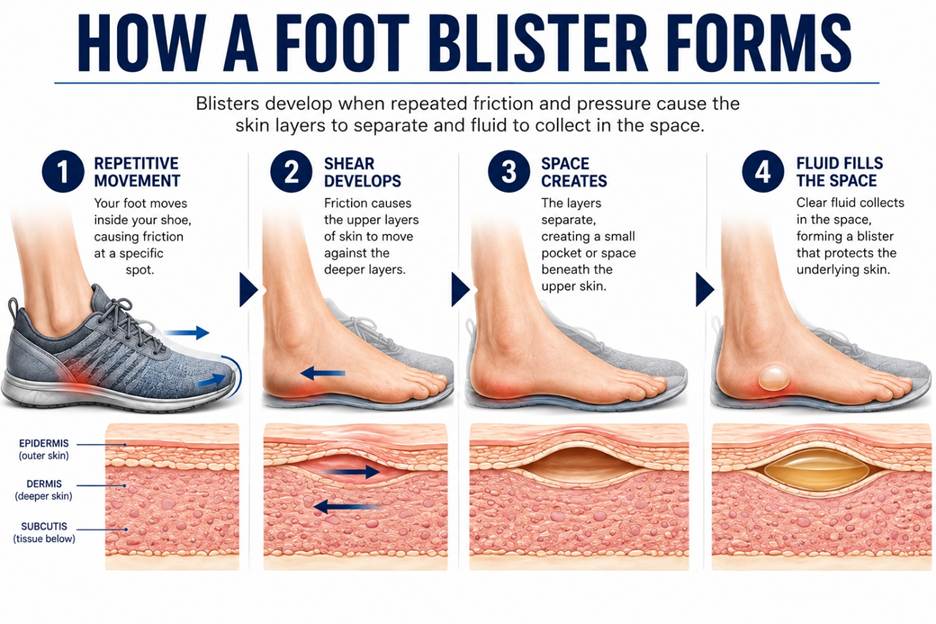
A foot blister is a tear inside the layers of your skin, caused when the skin and the bone underneath move out of sync with each step.
That’s not the explanation most people have heard. The common story is that a shoe or sock rubs against the skin until it wears a raw spot that fills with fluid. Research now shows that surface rubbing isn’t the mechanism. Foot blisters form when three things come together:
- Bone movement: With every step, the bones in your foot shift as your muscles and tendons pull on them.
- High friction: Your skin is held in place against your sock and shoe. Sweat and heat increase this grip.
- Repetition: The same stretch happens thousands of times over a run, a hike, or a long shift.
When the bone moves and the skin doesn’t, the soft tissue in between stretches. Do that enough times and a layer inside the skin tears. Over the next couple of hours, the tear fills with clear fluid, and you develop a blister.
It explains why blisters appear where they do, typically on the ball of the foot, the back of the heel, or the sides of the toes. It’s also why some prevention tricks don’t work as well as people think. Reducing any of these three factors makes blisters less likely.
“The biggest mistake people make with a blister is continuing whatever caused it in the first place. You can protect the blister. But if the same shoe keeps loading the same spot the same way, you’re not giving it a chance to heal.”
— Podiatrist Dr. Jason Sweeley, Silver Spring Foot & Ankle
How Do You Treat Foot Blisters?
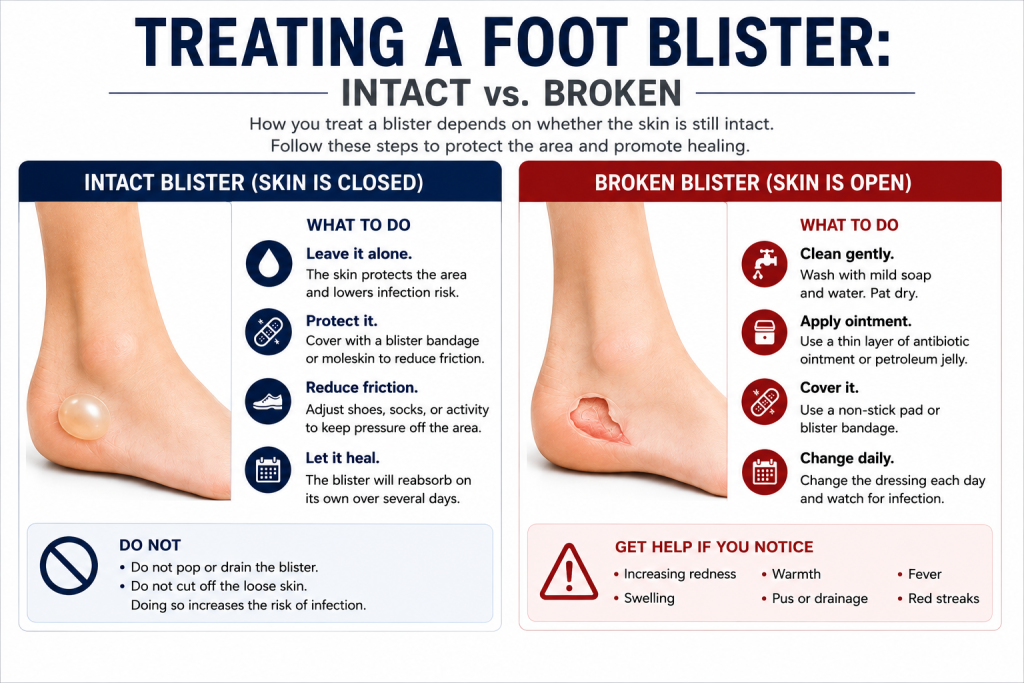
The right treatment depends on whether the blister is still intact, has broken open, or has lost its top layer of skin entirely.
If the Foot Blister Is Intact
Leave it alone. The fluid-filled roof is the best dressing you’ll get. It keeps the wound sterile and protects the new skin forming underneath.
- Wash the area gently with soap and water and pat it dry.
- Cover it with a soft bandage, blister pad, or a piece of moleskin cut with a hole so the pad surrounds the blister without pressing on it.
- Take pressure off the spot. Change shoes, loosen laces, or skip the activity that caused it for a day or two.
If the Foot Blister Has Broken Open
Don’t peel the loose skin off. Even a torn roof still protects the raw skin underneath.
- Wash the area and pat it dry.
- Smooth the flap of skin back over the wound.
- Apply a thin layer of petroleum jelly and cover it with a bandage.
- Change the bandage daily or whenever it gets wet or dirty.
If the Roof Is Gone
A deroofed foot blister is now an open wound and needs extra care.
- Clean it gently. Avoid scrubbing.
- Keep it moist with petroleum jelly and cover it with a non-stick dressing.
- Watch it closely for signs of infection, especially if you keep using the foot.
How Long Do Foot Blisters Take to Heal?
A small intact blister usually heals in three to seven days. A broken or deroofed blister can take one to two weeks to heal, longer if it keeps getting irritated. The fluid is reabsorbed, the skin underneath firms up, and then the old roof dries and peels away on its own.
Do Blisters Heal Faster Dry or Moist?
Moist and covered. A dry, exposed wound forms a scab that slows new skin growth. A covered wound with a thin layer of petroleum jelly heals faster and hurts less. “Letting it breathe” is one of the most persistent bits of bad advice about blisters.
Should You Pop a Foot Blister?
Usually no. An intact blister already does the job a bandage would. Opening it invites infection.
There’s one exception: a large, tense, painful blister in a spot you can’t avoid loading, like the ball of the foot. It may be more comfortable and less likely to tear on its own if you drain it carefully.
If you drain one:
- Wash your hands and the blister.
- Sterilize a needle with rubbing alcohol.
- Puncture the edge of the blister in one or two spots and press gently to let the fluid out.
- Leave the roof in place. Don’t cut or peel it.
- Apply petroleum jelly and cover it.
If you have diabetes and foot neuropathy, poor circulation, or numbness in your feet, don’t drain a blister yourself. See a podiatrist instead. More on that below.
Should You Cover a Foot Blister or Let It Breathe?
Cover it. A covered blister heals faster, hurts less, and is far less likely to tear or get infected.
The idea that a wound needs air is a myth that refuses to die. Skin heals best in a clean, slightly moist environment. The only time you’d leave a blister uncovered is at night, if the bandage bothers you and there’s no risk of it rubbing on anything.
Can You Walk or Run With Foot Blisters?
You can, if it’s covered and you can do it without pain. But remember what causes a blister: repetition of the same stretch in the same spot. Every mile on a fresh blister is more of what created it.
If you have to keep going, whether it’s a race, a hike, or a work shift:
- Pad around the blister so the shoe doesn’t press directly on it.
- Change socks if they’re damp.
- Loosen or re-lace the shoe to reduce movement over the spot.
- Cut the distance or take a rest day if you can.
A blister that won’t stop hurting when you walk is telling you the load is too high. Listen to it.
How Can You Tell if a Foot Blister Is Infected?
Watch for:
- Redness spreading beyond the edge of the blister
- Warmth or swelling around it
- Pain that’s getting worse instead of better
- Cloudy, yellow, or foul-smelling fluid or pus
- Red streaks running up the foot or leg
- Fever or chills
If you have any of these, it’s time to see a podiatrist. Evaluate signs of infection promptly. Left untreated, an infection can spread into deeper tissue.
Why Do I Keep Getting Blisters on My Feet?
Recurrent blisters in the same spot mean one of the three causes keeps recurring. Most often it’s one of these:
Shoe Fit
A shoe that’s too loose lets your foot slide. A shoe that’s too tight pins the skin in place while the bones move. Both raise the stretch inside the skin. If you’re getting blisters in the same place in the same shoes, start with the shoes.
Socks
Cotton holds moisture and increases friction. Synthetic or wool blends that wick sweat make a measurable difference for runners.
Sudden Increases in Activity
A big jump in mileage, a new job on your feet, or the first long hike of the season means more repetitions than your skin has adapted to.
Foot Structure and Gait
Some feet move more inside the shoe. A podiatrist can spot this and recommend inserts or shoe changes that provide better stability.
How Can You Prevent Foot Blisters?
Prevention means reducing bone movement, friction, or repetition. Here are some foot care options that actually help:
- Get the fit right: Snug through the heel and midfoot, roomy in the toes. Lace to hold the foot steady without pinching.
- Wear the right socks: Moisture-wicking synthetic or wool blends, fitted so they don’t bunch. Two thin layers can reduce shear for some people.
- Manage moisture: Change socks on long efforts. Antiperspirant on the feet has some evidence for hikers.
- Build up gradually: Let your skin adapt to new distances and new shoes over weeks, not days.
- Protect known hot spots: If you always blister in the same place, pad it before you start. Cushioned pads that absorb movement work better than thin tape, and the evidence for taping alone is weaker than its popularity suggests.
- Stop at the hot spot: A warm, stinging, red patch is a blister in progress. Fixing it then takes a minute. Fixing it later takes a week.
Are Foot Blisters More Serious if You Have Diabetes?
Yes. For most people, a blister is a nuisance. For someone with diabetes, it can be the start of a wound that doesn’t heal.
Diabetes can reduce sensation in the feet, so you may not feel a blister forming or notice it breaking. It can also slow circulation and healing, which gives infection more time to take hold. A blister that goes unnoticed for a few days can become an ulcer.
If you have diabetes:
- Check your feet every day, including between the toes and under the heel.
- Don’t pop or drain a blister yourself.
- Cover any blister and call your podiatrist rather than waiting to see what happens.
- Treat redness, warmth, or drainage as urgent.
Our guide to diabetic foot care covers daily checks and what else to watch for.
“A blister that’s a nuisance for most people can be a much bigger concern for someone with diabetes and reduced sensation. If you can’t reliably feel what’s happening to your foot, don’t wait for pain to tell you there’s a problem.”
— Podiatrist Dr. Jason Sweeley, Silver Spring Foot & Ankle
When Should You See a Podiatrist for a Foot Blister?
Most blisters don’t need a foot doctor. Make an appointment if:
- You have diabetes, poor circulation, or numbness in your feet and develop any blister
- The blister shows signs of infection
- It’s very large, very painful, or filled with blood
- It hasn’t started healing after a week
- You get blisters repeatedly in the same spot despite changing shoes and socks
- The blister is keeping you from walking normally
Repeat blisters are also worth a visit even when each one heals fine. They’re a sign that something about your shoes, socks, or foot mechanics is loading one spot too hard, and we can usually fix it.
In Marine recruits, for example, developing a foot blister was associated with a 50% higher risk of another training injury. Even a seemingly minor blister can affect how you walk and train, which is why recurring blisters shouldn’t be ignored.
If you’re looking for podiatrists near you in Mechanicsburg, Carlisle, or Harrisburg, Silver Spring Foot & Ankle sees patients from across Central PA. If a blister isn’t healing, keeps coming back, or you’re not sure how to handle it, [schedule an appointment].
Frequently Asked Questions About Foot Blisters
What ointment is best for foot blisters?
Plain petroleum jelly is enough for most blisters. It keeps the wound moist and the dressing from sticking. If a blister has opened and there’s concern about infection, your podiatrist may recommend an antibiotic ointment.
Does Neosporin help blisters heal faster?
Not much faster than petroleum jelly on a clean blister. Antibiotic ointment is generally reserved for situations where infection is a concern. Some people develop skin irritation from it. If the area gets itchy or red after using one, stop and call your podiatrist.
Why put Vaseline on a blister?
It keeps the healing skin moist, reduces friction between the wound and the dressing, and helps the bandage come off without pulling the roof.
What should you never do with a foot blister?
Don’t peel the roof off or drain it with a dirty needle. Don’t keep wearing the shoe that caused it without protecting the spot. And if you have diabetes, don’t treat it at home without telling your podiatrist.
Can you get a blister from walking too much?
Yes. Repetition is one of the three things that cause a blister. A long walk in shoes you don’t normally wear, or a sudden jump in daily steps, is one of the most common ways people get them.
