
Your foot hurts every time you run. But you can’t remember doing anything that could have injured it.
There was no fall. No collision. No single moment when something went wrong. Just a gradual ache that started a few weeks ago and has been getting worse. It eases up when you rest. It comes right back when you lace up your shoes.
That pattern is the hallmark of a stress fracture in your feet. Not a dramatic break, but a tiny crack in the bone that develops over time from repetitive impact. And if you keep running on it, that tiny crack becomes a bigger problem.
Podiatrist Dr. Jason Sweeley, DPM, a foot and ankle specialist, diagnoses and treats stress fractures at Silver Spring Foot & Ankle in Mechanicsburg. The sooner a foot doctor near you identifies the stress fracture, the simpler the treatment and the faster the return to activity.
Get Relief Fast
If your foot has been hurting during runs for more than a week or two and isn’t improving, don’t wait it out. You can treat a stress fracture that’s caught early with rest and reduced weight-bearing. One that you ignore can become a complete fracture requiring surgery.
At Silver Spring Foot & Ankle, we see most new patients within a few days. Often the next day you call.
Want to schedule an appointment? Call (717) 237-9000 or schedule online.
Quick Answers About Stress Fractures in Feet
Stop worrying and get some quick insights into stress fractures in feet and their impact.
| Question | Answer |
|---|---|
| What is a stress fracture in the foot? | A stress fracture is a tiny crack in a bone caused by repetitive impact rather than a single traumatic event. It develops when the bone is loaded faster than it can repair itself. |
| Can you walk on a stress fracture? | Many patients can bear weight with mild pain, which is why stress fractures are often mistaken for soft tissue injuries. Continuing to walk or run on an undiagnosed stress fracture risks turning a partial crack into a complete fracture. |
| How do you tell if it’s a stress fracture? | Classic signs include pinpoint tenderness over a specific bone, pain that worsens with activity and improves with rest, and a gradual onset without a clear injury event. Imaging confirms the diagnosis. |
| What happens if a foot stress fracture goes untreated? | A partial stress fracture can progress to a complete fracture. Certain locations, like the navicular or fifth metatarsal, carry a higher risk of complete fracture and require more aggressive treatment. |
| How long does a foot stress fracture take to heal? | Most stress fractures heal in six to eight weeks with proper treatment. High-risk locations or fractures that were active for a long time before diagnosis may take longer to heal. |
| Do stress fractures show up on X-ray? | Not always, especially early on. MRI is more sensitive for detecting stress fractures before they show up on X-ray. A podiatrist determines the appropriate imaging based on the clinical picture. |
| Can I cross-train with a stress fracture? | It depends on the location and severity. Many patients can stay fit with low-impact activities like swimming or cycling while their fractures heal. Avoid high-impact activity and running until the bone recovers. |
What Is a Stress Fracture?
A stress fracture is a small crack in a bone caused by repetitive loading rather than a single traumatic event. Bone is living tissue that constantly remodels itself in response to stress. When impact loads accumulate faster than the bone can repair the micro-damage, a crack develops.
Stress fractures can affect any part of the foot, but they most commonly occur in the metatarsals, particularly the second and third. They’re the long bones connecting the toes to the midfoot.
The navicular bone on top of the midfoot and the heel bone are also common sites. The fifth metatarsal and navicular are high-risk locations because they have a more limited blood supply. Fractures there are more likely to lead to complications.
Why Stress Fractures in Your Feet Are Easy to Miss
Stress fractures often aren’t visible on standard X-rays, especially early on. The crack is too small to show up clearly. MRI is much more sensitive and can detect a stress fracture before it shows up on X-ray.
That matters because patients with a normal X-ray often assume nothing is wrong and keep running. And that’s exactly when the injury progresses.
A clinical evaluation with the right imaging can mean the difference between catching a stress fracture early and missing it entirely.
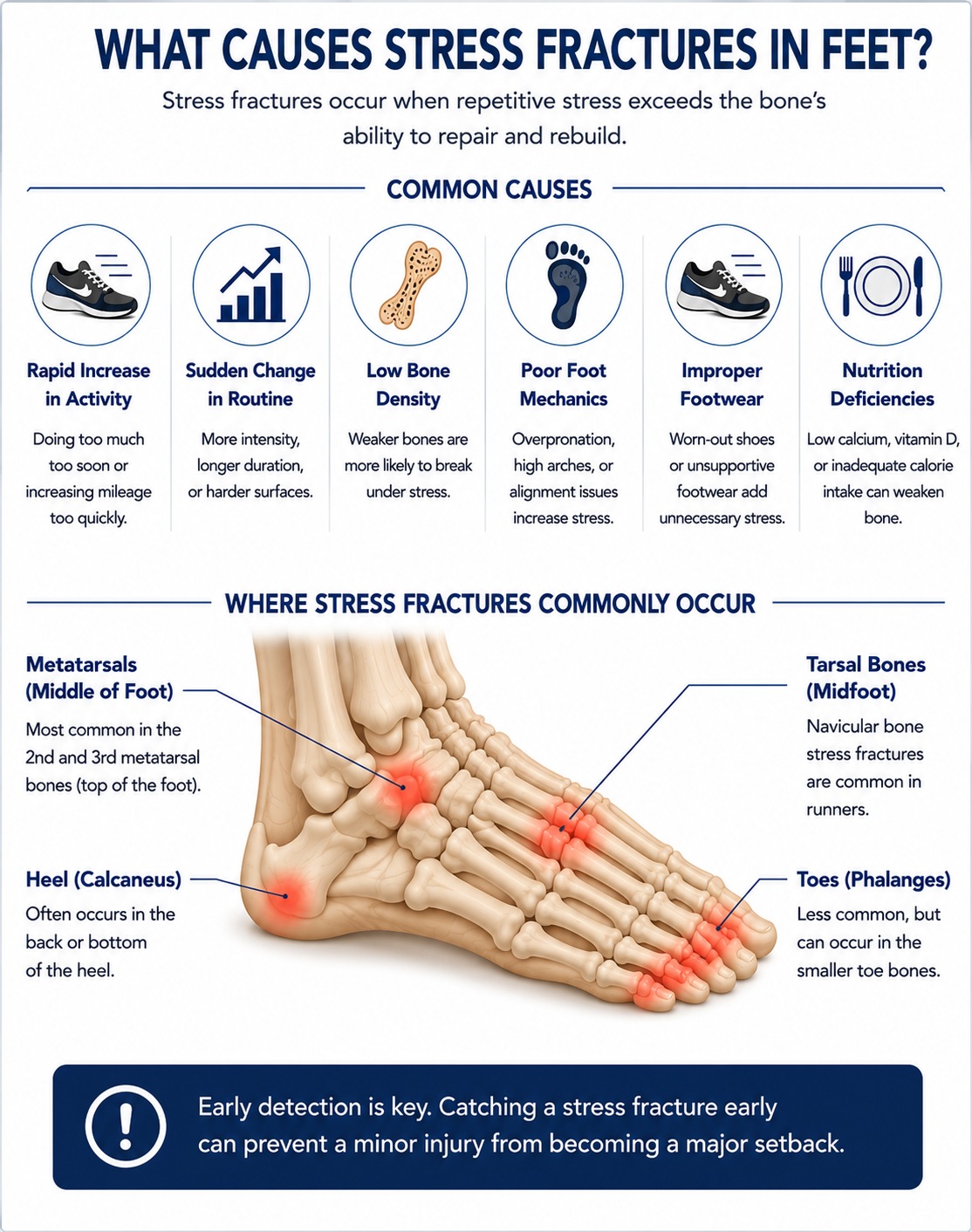
What Causes Stress Fractures in Feet?
Stress fractures develop when you repeatedly load bone beyond its capacity to recover. Several situations make that more likely.
- Rapid training increases. Adding mileage too quickly is the most common cause in runners. The standard guideline is no more than a 10 percent weekly increase. Many stress fractures happen when patients return to training after a break and try to pick up where they left off.
- High-impact activity without adequate recovery. Running, jumping, and marching place significant repetitive stress on the foot bones. Inadequate rest between sessions doesn’t allow the bone to repair micro-damage before you load it again.
- Improper or worn-out footwear. Shoes that don’t provide adequate cushioning and support increase the impact forces transmitted to the bones with every stride.
- Hard training surfaces. Concrete and asphalt provide less shock absorption than softer surfaces. Runners who transition from trails to roads without adjusting volume are at higher risk.
- Bone density issues. Conditions that reduce bone density, including osteoporosis, low vitamin D, and the relative energy deficiency common in endurance athletes, increase susceptibility.
- Foot structure. High arches, flat feet, and leg-length discrepancies alter how forces distribute across the foot bones.
We regularly see stress fractures in runners training on local trails and roads throughout Carlisle, Mechanicsburg, and Harrisburg, as well as in athletes preparing for events like the Harrisburg Marathon.
What a Stress Fracture Feels Like
The symptoms of a foot stress fracture are distinctive once you know what to look for. Most patients describe a pattern that fits closely.
- Pain that builds gradually over weeks rather than starting after a specific incident.
- Pinpoint tenderness directly over the affected bone.
- Pain that increases during activity and subsides with rest.
- Swelling on the top of the foot, often mild early on.
- Pain that worsens with each run if you keep training.
- In some cases, pain that becomes constant even at rest as the fracture progresses.
Important: If you can press directly on a bone in the foot and reproduce your exact pain, that’s a significant warning sign. Don’t push through it. Ignoring stress fractures can cause complete fractures, particularly in high-risk locations like the navicular and fifth metatarsal.
When Should You See a Foot and Ankle Specialist About Foot Pain?
Most runners who develop stress fractures initially assume the pain is a soft tissue issue: a muscle strain, a tendon problem, or general overuse soreness. They try rest for a few days, feel better, go back out, and the pain returns. That cycle can repeat for weeks before a foot doctor properly evaluates the condition.
See a podiatrist if any of these apply.
- Foot pain that follows the activity-rest-activity pattern described above.
- Localized foot pain rather than diffuse pain.
- Swelling on the top of the foot without a clear injury.
- Pain that is progressively worse over multiple training sessions.
- Foot pain in a runner who has recently increased mileage or returned from a break.

How a Foot and Ankle Doctor Treats Stress Fractures in Feet
Treatment depends on the fracture’s location, how far it has progressed, and how long it has been present. Our foot and ankle specialists evaluate all of that before recommending a plan.
Activity Modification and Protected Weight-Bearing
The foundation of stress fracture treatment is offloading the bone so it can heal. Depending on the location and severity, this may mean a walking boot, crutches, or simply stopping the activity that caused the fracture while the bone recovers. The goal is to eliminate the repetitive load that prevented the bone from repairing itself.
Immobilization
Some locations require more aggressive immobilization. Navicular and fifth metatarsal stress fractures, in particular, may require a non-weight-bearing cast or boot because those areas have limited blood supply and a higher risk of complications if they don’t heal properly.
Return to Activity
Returning to running or impact activity is gradual and progressive. Returning too soon before the bone has fully healed is the most common cause of reinjury. Dr. Sweeley guides patients through the return-to-activity process to reduce that risk.
Addressing Contributing Factors
A stress fracture signals that something in your training load, footwear, nutrition, or foot mechanics needs to change. Custom orthotics, footwear recommendations, and training modifications are part of the treatment plan to reduce the risk of future fractures.
Ready to schedule an appointment? Call (717) 237-9000 or schedule online.
Can You Prevent Foot Stress Fractures?
Many stress fractures are preventable with smarter training habits and the right equipment.
- Increase mileage gradually—no more than 10 percent per week. Give the bone time to adapt to new loads.
- Replace running shoes regularly. Most shoes lose meaningful cushioning after 300 to 500 miles.
- Vary your surfaces. Mixing trail and road running reduces repetitive stress on the same bone locations.
- Build in rest days. Bone remodeling happens during recovery, not during training. Rest is part of the training plan.
- Address nutrition. Adequate calcium, vitamin D, and overall caloric intake support bone health and recovery.
- Consider custom orthotics. If you have flat feet, high arches, or a history of stress fractures, orthotics can redistribute load more evenly across the foot.
“Runners are remarkably good at pushing through pain. It’s one of the things that makes them good runners. But a stress fracture is one of those situations where pushing through makes the problem significantly worse. Patients who come in early are back to running within six to eight weeks. The ones who wait until it’s a complete fracture are looking at a much longer road back.”
Dr. Jason Sweeley, DPM, Podiatrist, Silver Spring Foot & Ankle
Ready to Find Out What’s Going On With Your Foot?
If foot pain follows you on every run and rest isn’t fixing it, the right move is to see a podiatrist. Our foot and ankle specialists can tell you if you have a stress fracture. He can create a treatment plan to help you get back to running.
Patients come to Silver Spring Foot & Ankle from across the West Shore and greater Harrisburg area—Mechanicsburg, Camp Hill, Lemoyne, Carlisle, Harrisburg, and the surrounding communities.
The sooner a foot doctor diagnoses it, the simpler the treatment. Call (717) 237-9000 or request an appointment online. Same-day and next-day appointments are often available.