
You’re halfway through a walk on the Cumberland Valley Rail Trail when the outer edge of your foot starts to ache. Or maybe you rolled your ankle months ago, the swelling went down, and the side of your foot still hurts every time you step off a curb.
Foot pain usually comes from one of a handful of sources:
- An irritated tendon
- A problem involving a bone or joint
- A bump near the little toe
- A sprain that never fully healed
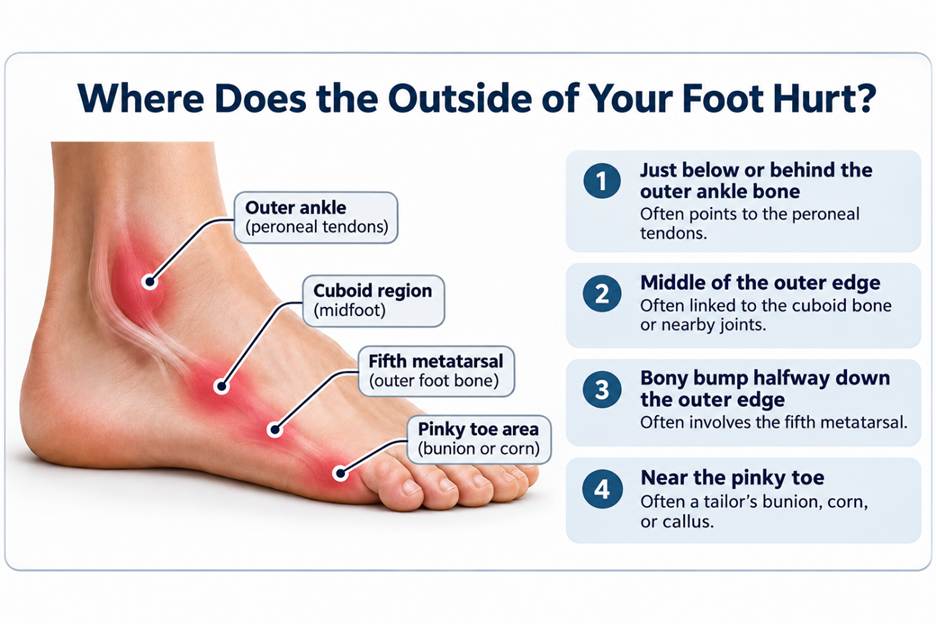
The exact spot that hurts is your best clue. Pain just below the ankle bone points one way, and pain in the middle of the outer edge points another. Pain near the pinky toe points somewhere else entirely.
Most of these problems get better with the right care. The catch is that several feel alike but need very different treatment, so guessing can cost you weeks.
Key Takeaways
- Where it hurts tells you the most. Pain below the ankle bone often points to the peroneal tendons. Pain in the middle of the outer edge points to the cuboid bone or the base of the fifth metatarsal. A bump near the pinky toe is often a tailor’s bunion or a corn.
- A sprain that “healed” can still hurt. Lingering side-of-the-foot pain after a rolled ankle is common. It can come from a small fracture or a cuboid problem that gets missed.
- A normal X-ray doesn’t always mean nothing’s wrong. Cuboid syndrome and early stress fractures often don’t show up on first X-rays.
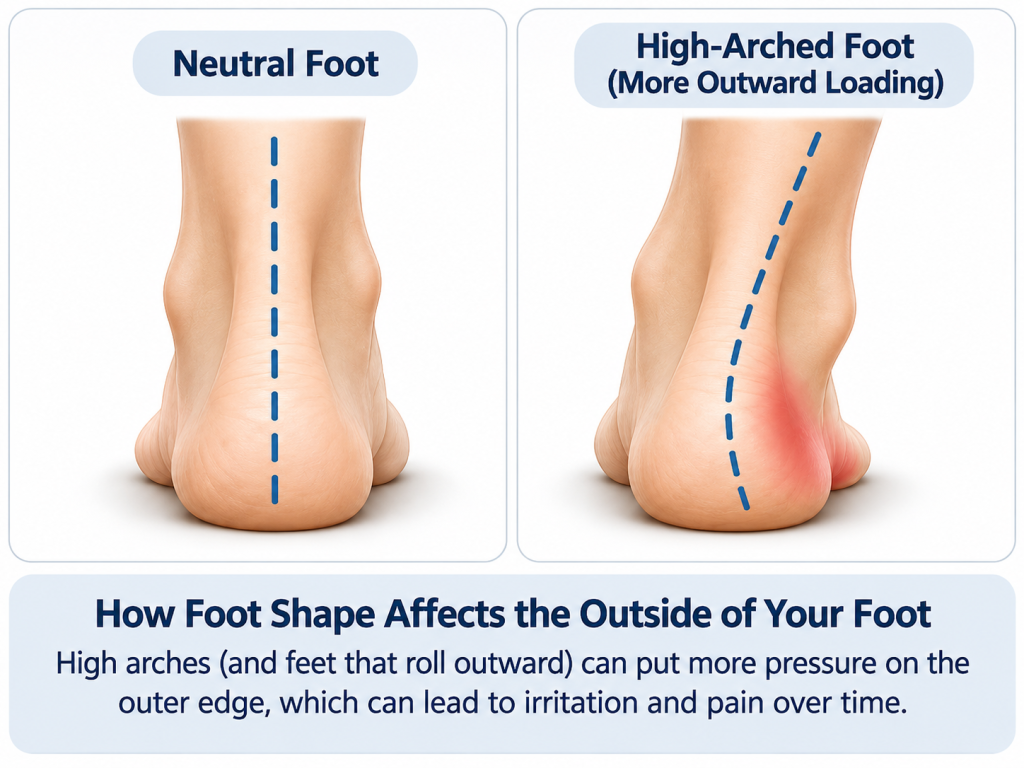
- High arches load the outside edge. If your feet roll outward, the outer edge takes more of your weight with every step.
- Pinpoint bone pain needs an exam soon. Pain you can cover with one fingertip, especially after a twist or a jump, can be a fracture that needs proper treatment.
Pain on the Side of Your Foot: Outside or Inside?
When people say “the side of my foot hurts,” they can mean either edge. It matters, because the two sides have different causes.
The outside edge runs from your outer ankle bone to your pinky toe. Doctors call it the lateral side. That’s what this article covers.
The inside edge runs along your arch toward your big toe. Pain there is more often tied to a bunion, a strained tendon that supports the arch, or a pinched nerve near the inner ankle. If that sounds more like you, our Parts of the Foot guide can help you narrow it down.
Foot shape plays a role too. People with flat feet tend to have more trouble on the inside. People with high arches tend to have more trouble on the outside.
What Causes Pain on the Outside of Your Foot
Start by pressing gently along the outer edge of your foot and noting where it’s most tender. Use this table to match the spot to the most likely causes, then read the section that fits.
How it started matters too. Sudden pain from a twist or fall points toward a fracture or sprain. Pain that crept up over weeks points toward overuse, like tendinitis or a stress fracture.
| Where It Hurts | How It Often Feels | Likely Causes |
| Just below or behind the outer ankle bone | Aching, swelling, sometimes a popping feeling | Peroneal tendinitis, an old ankle sprain |
| Middle of the outer edge | Sharp with weight, like a sprain that won’t quit | Cuboid syndrome, a fifth metatarsal fracture |
| The bony bump halfway down the outer edge | Pinpoint pain after a twist or rolled ankle | Fifth metatarsal fracture, peroneal tendon strain, bursitis |
| Near the pinky toe | Rubbing, a bump, or a hard spot in your shoe | Tailor’s bunion, corns or calluses, a stress fracture |
| Anywhere along the edge, with burning or tingling | Numbness, pins and needles | An irritated nerve, neuropathy |
| Deep and stiff, worse in the morning | Achy, stiff joints | Arthritis |
Peroneal Tendinitis
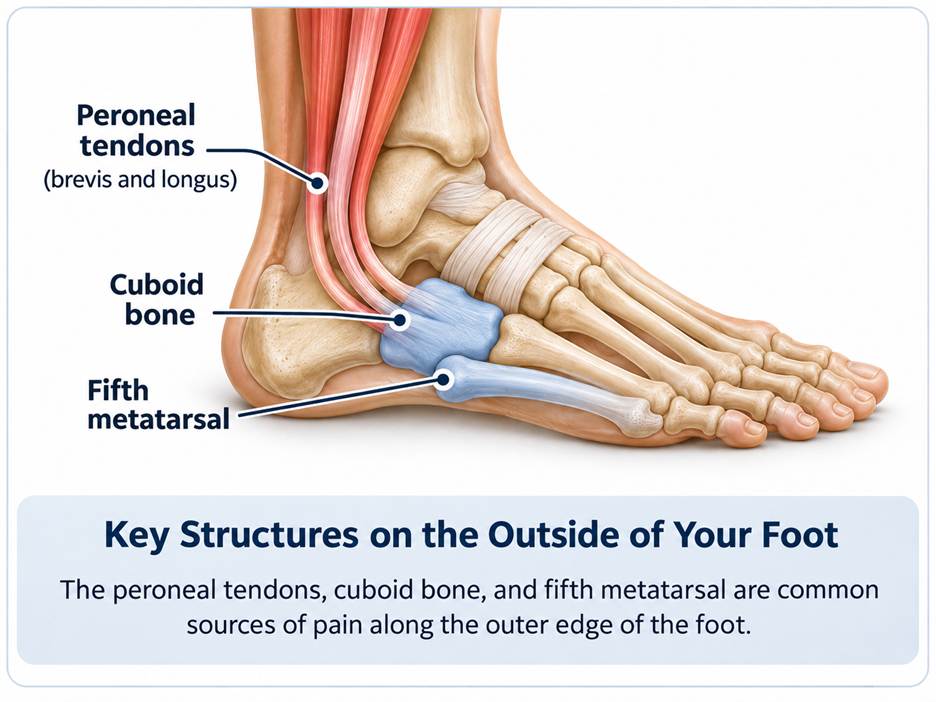
Two tendons, the peroneal tendons, run behind your outer ankle bone and down the side of your foot. They keep your ankle steady and help stop it from rolling. When they’re overworked, they get irritated and sore.
It’s common in runners and in sports with lots of cutting and quick changes of direction, like soccer and basketball. Ramping up mileage too fast, running in worn-out shoes, or having high arches can all add strain. You’ll usually feel pain and swelling just behind or below the ankle bone, and it gets worse with activity.
Most cases improve with rest, better shoes, bracing, and physical therapy. If the pain keeps coming back, it’s worth seeing a podiatrist near you. They can determine whether the tendon is irritated, partially torn, or more severely damaged. Many tears heal with a boot and therapy, and surgery is usually saved for those that don’t.
Cuboid Syndrome
The cuboid is a small, cube-shaped bone in the middle of the outer edge of your foot. In cuboid syndrome, the small joints around the cuboid stop moving and working normally. Experts think the bone shifts very slightly out of alignment, though the exact cause isn’t fully understood. Either way, the surrounding joints and ligaments become irritated and sore.
It often follows a rolled ankle, but it also shows up with overuse. One review found it in about 4% of athletes with foot injuries and 17% of professional ballet dancers with foot or ankle injuries.
Cuboid syndrome is easy to miss. It can feel like a sprain, and X-rays usually look normal. The good news is that once it’s found, a hands-on technique to restore normal joint motion often brings quick relief.
Get more details about cuboid syndrome and treatment.
Fifth Metatarsal Fracture
The fifth metatarsal is the long bone that runs along the outer edge of your foot to your pinky toe. You can feel its base as a bony bump about halfway down the side of your foot. It’s one of the most commonly broken bones in the foot.
There are two main types, and the difference matters:
- Avulsion fracture: A tendon pulls a small chip of bone off the base, usually when you roll your ankle. Cleveland Clinic says these make up 93% of fifth metatarsal fractures. People often overlook them because they assume they just sprained their ankle.
- Jones fracture: A break a little farther along the bone, in an area with poor blood flow. It’s often caused by a twist, landing from a jump, or repeated stress. It heals more slowly and is more likely to need surgery.
Both hurt right on the bone and make walking difficult. You may see swelling or bruising along the outer edge.
Tailor’s Bunion
A tailor’s bunion, also called a bunionette, is a bony bump at the base of the pinky toe. It’s the same idea as a regular bunion, just on the other side of the foot. Tight, narrow shoes can press on it, making it red, swollen, and sore. Wider shoes and padding can help, and a podiatrist can discuss other options if it keeps getting worse.
Corns and Calluses
The outside of the pinky toe is one of the most common spots for a corn, because it rubs against the side of your shoe all day. A hard, painful spot that feels worse in certain shoes is a strong hint. Our corn treatment page explains how we treat them and how to keep them from coming back.
Stress Fracture
A stress fracture is a tiny crack that develops from repeated impact rather than a single injury. On the outside of the foot, it usually affects the fifth metatarsal. The pain starts as a dull ache with activity and gradually sharpens. Early stress fractures often don’t show on X-rays, so they can take time to diagnose.
Nerve Irritation
The sural nerve runs down the outside of your leg and along the outer edge of your foot. If something presses on it—like a tight boot, scar tissue from an old injury, or swelling—you may feel burning, tingling, or numbness rather than an ache. Numbness in both feet is a different story and can point to neuropathy, which is especially important to check if you have diabetes. See our diabetic foot care page for more.
Arthritis
The joints in the middle and outer part of the foot can wear down over time, especially after an old injury. Arthritis pain is usually deep and achy, with stiffness that’s worst first thing in the morning or after sitting for a while.
Bursitis
A bursa is a small, fluid-filled sac that cushions tissue where it rubs over bone. On the outside of the foot, a bursa can develop over the bony bump at the base of the fifth metatarsal or near the base of the pinky toe. Constant pressure from shoes can inflame it. The area may look puffy or red and feel tender to the touch. High arches, which put more weight on the outer edge of the foot, can increase the risk.
Why the Side of Your Foot Still Hurts After a Sprain
A rolled ankle is the most common story behind outside-of-foot pain. Most sprains heal in a few weeks. But one review notes that up to 40% of people have lingering symptoms after an ankle sprain.
When the ankle feels better but the outer edge of your foot doesn’t, the sprain may not be the whole injury. The same twist that sprains your ankle can also:
- Pull a chip of bone off the base of the fifth metatarsal
- Disrupt how the joints around the cuboid bone move
- Strain or tear one of the peroneal tendons
Each of these can hide behind the ankle sprain. Ice and rest calm the swelling, so it seems like you’re healing, but the real problem remains.
If you’re more than a few weeks out from a sprain and the pain has moved from the ankle to the side of your foot, or it’s getting worse instead of better, it’s time to have it looked at.
How Your Arches and Shoes Load the Outside Edge
Some feet put more weight on the outer edge than others. If you have high arches, your foot tends to roll outward as you walk. That puts extra stress on the peroneal tendons, the fifth metatarsal, and the joints along the outside of your foot. It also makes rolled ankles more likely.
Your old shoes can tell you a lot. Flip over a pair you’ve worn for a while and look at the soles. Heavy wear along the outer edge, or uppers that lean outward when the shoes sit on a table, suggests your feet roll that way.
Shoes can cause outer edge pain on their own, too. A few common problems:
- Narrow toe boxes can squeeze the pinky toe, leading to bunions and corns.
- Worn-out running shoes lose the support that keeps your foot from rolling.
- Stiff boots or high-top shoes can press on the nerve along the outer edge.
Our guide to how shoes can cause foot pain walks through fit, support, and when to replace them.
What You Can Do at Home
Hurt it in a twist, fall, or jump? Skip home care and get it checked first.
After an injury, foot doctors may use the Ottawa foot rules to help determine whether an X-ray is needed. Warning signs include tenderness at the base of the fifth metatarsal or being unable to take four steps immediately after the injury and during an examination. If either sounds like you, don’t wait a week to see if it improves.
For mild pain that built up gradually, with no injury, a few simple steps often help while you figure out what’s going on:
- Back off what hurts. Cut back on running, jumping, or long days on your feet. Switch to biking or swimming if they don’t cause pain.
- Ice the sore spot for 15 to 20 minutes at a time, with a cloth between the ice and your skin.
- Check your shoes. Pick a pair with a roomy toe box and good support, and retire any that are worn down on the outer edge.
- Pad pressure spots. A simple pad can take pressure off a corn or tailor’s bunion.
If home care isn’t working after a week or two, don’t keep pushing through it. Several of these problems, like fractures and tendon tears, get harder to treat the longer they go.
When to See a Podiatrist About Pain on the Outside of Your Foot
Some signs mean you shouldn’t wait. Make an appointment if you have:
- Pain right on the bone that you can point to with one finger
- Trouble putting weight on your foot, or a limp
- A pop or snap when the pain started, or swelling or bruising after a twist, fall, or jump
- Side of foot pain that started with a sprain and hasn’t gone away
- Numbness, tingling, or burning along the edge of your foot
- Diabetes and any new foot pain or skin change
- Ankle sprains that keep happening on the same side
Our post on 10 signs it’s time to see a podiatrist covers more reasons to get checked.
How a Foot Doctor Finds the Cause
Because so many outside-of-foot problems feel alike, a careful exam matters more than any single test. A foot and ankle specialist starts by asking how the pain began and pressing along the outer edge of your foot to pinpoint the source. They also watch how you stand and walk, and look at your arches and your shoes.
X-rays help confirm or rule out a fracture. When a tendon problem or hidden injury is likely, ultrasound or an MRI may be the next step. For conditions like cuboid syndrome, the hands-on exam is often what makes the diagnosis, since imaging can look normal.
How Outside of Foot Pain Is Treated
Treatment depends on the cause. Most people get better without surgery. Depending on what we find, your plan may include:
- Rest, ice, and changes to your activity
- A walking boot or brace to protect a fracture or tendon while it heals
- Hands-on treatment to restore normal motion around the cuboid
- Custom orthotics to support high arches and take load off the outer edge
- Padding and footwear changes for tailor’s bunions and corns
- Physical therapy to strengthen the ankle and help prevent repeat sprains
- Shockwave therapy for some long-lasting tendon pain
- Surgery for some Jones fractures, torn tendons, or bunions that don’t respond to other care
“When someone tells me their ankle healed, but the side of their foot never did, I take that seriously. A rolled ankle can hurt more than the ligament, and the other injuries tend to hide until the swelling’s gone. The fix is usually simple once we know what we’re dealing with. The hard part is getting people in before they’ve spent months working around it.”
Dr. Jason Sweeley, DPM, Silver Spring Foot & Ankle
Where It Hurts Is a Clue, Not a Diagnosis
Knowing where your foot hurts narrows the list. It doesn’t tell you which problem you have. A tendon, a bone, and a joint can all hurt in the same spot, and each requires a different treatment. That’s why a hands-on exam is the fastest way to stop guessing.
Looking for a podiatrist in Mechanicsburg, Carlisle, or Harrisburg? Our foot doctors at Silver Spring Foot & Ankle can pinpoint what’s behind the pain on the outside of your foot and build a plan to get you back on your feet. Schedule an appointment today.
Frequently Asked Questions About Pain on the Outside of Your Foot
How Do You Fix Pain on the Outside of Your Foot?
The fix depends on the cause, so getting the right diagnosis comes first. Tendon irritation usually improves with rest, supportive shoes, and bracing. Cuboid syndrome often needs a hands-on adjustment. A fracture needs a boot or cast, and sometimes surgery. Treating the wrong problem can drag recovery out for months.
What Can Be Mistaken for Peroneal Tendonitis?
Cuboid syndrome, a fifth metatarsal fracture, and a lingering ankle sprain can all feel like peroneal tendonitis. They cause pain in nearly the same area and often start with similar injuries. A hands-on exam, and sometimes imaging, is the best way to tell them apart.
Why Does the Outside of My Foot Hurt When I Walk?
Walking loads the outer edge with every step, so anything irritated there—like a peroneal tendon, the cuboid bone, or a stressed fifth metatarsal—will hurt more as you move. If the pain started after a twist or keeps getting worse, have it checked.
Is Pain on the Side of My Foot Serious?
Often it isn’t, and it gets better with rest and better shoes. But a fracture or torn tendon can look like a minor problem at first. Pinpoint bone pain, swelling after an injury, or trouble walking are reasons to see a doctor soon.
Can I Walk on a Fifth Metatarsal Fracture?
Many people can, which is why these fractures get missed. Walking on one can slow healing or keep it from healing right, especially with a Jones fracture. If you think you might have one, keep weight off it until it’s checked.
How Long Does Outside of Foot Pain Take to Heal?
It depends on the cause. Mild tendon irritation may settle in a few weeks. Cleveland Clinic says a fifth metatarsal fracture treated in a boot or cast usually heals in six to eight weeks. Cuboid syndrome often improves quickly with hands-on treatment.
Can My Shoes Cause Pain on the Outside of My Foot?
Yes. Narrow toe boxes squeeze the pinky toe, worn-out soles let your foot roll outward, and stiff boots can press on the nerve along the outer edge.
